Material Data Sheets
Specifications, emission properties, and performance data for each scintillator crystal offered in the ScintIQ™ line.
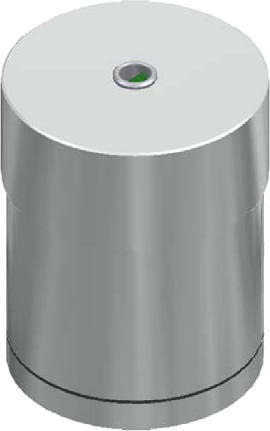
NaI(Tl) — Sodium Iodide
High light yield workhorse crystal; the standard for general gamma spectroscopy and isotope identification.
CsI(Tl) — Cesium Iodide
Rugged, slightly hygroscopic crystal with high light yield and excellent linearity; well-suited to portable systems.
LaBr3(Ce) — Lanthanum Bromide
Outstanding energy resolution (2.6% at 662 keV) with fast decay; favored for high-resolution field spectroscopy.
CeBr3 — Cerium Bromide
Ultra-fast decay, low intrinsic background, and sub-3% resolution; a strong alternative to LaBr3 where background counts matter.
LBC — Lanthanum Bromo-Chloride
Elpasolite-family crystal offering high resolution with reduced intrinsic activity compared to pure LaBr3.
BaF2 — Barium Fluoride
Fastest known scintillator (sub-1 ns component); used in coincidence timing and time-of-flight measurements.
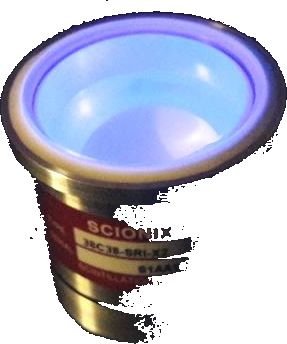
SrI2(Eu) — Strontium Iodide
Exceptional energy resolution near 2.4% at 662 keV with very high light yield; emerging standard for premium field systems.
CLLBC — Dual-Mode Elpasolite
Simultaneous gamma and neutron detection in one crystal via pulse-shape discrimination; no separate He-3 tube required.
CLYC:Ce — Dual-Mode Elpasolite
Strong neutron-gamma discrimination with good gamma resolution; widely used in dual-particle field instruments.
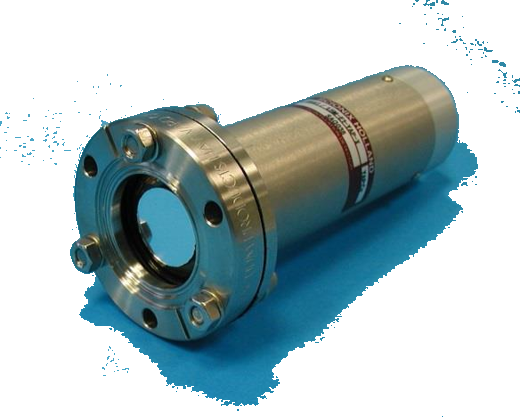
YAP:Ce — Yttrium Aluminum Perovskite
Rugged, non-hygroscopic oxide crystal with fast decay; suited to X-ray detection and high-temperature environments.
YAG:Ce — Yttrium Aluminum Garnet
Dense oxide scintillator with excellent mechanical strength; non-hygroscopic and stable in demanding conditions.
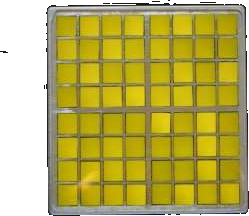
GAGG:Ce — Gadolinium Aluminum Gallium Garnet
High density, high light yield, non-hygroscopic; one of the brightest oxide crystals, favored for SiPM-coupled assemblies.
LYSO — Lutetium Yttrium Oxyorthosilicate
High density and very fast decay make LYSO the choice for PET imaging and time-of-flight coincidence systems.
BGO — Bismuth Germanate
Highest effective-Z of the standard crystals; no intrinsic radioactivity, non-hygroscopic, proven in PET and calorimetry.
PbWO4 — Lead Tungstate
Very fast, radiation-hard, high-density crystal with low light yield; the calorimeter material for high-energy physics.
6Li Glass — Lithium-6 Loaded Glass
Cerium-activated lithium-6 glass for direct thermal-neutron detection; non-hygroscopic and rugged for field probes.
Readout & Electronics Data Sheets
SiPM readout assemblies, multi-channel analyzers, digitizers, and complete detector systems from Berkeley Nucleonics.
ScintIQ SiPM Readout Module
Universal SiPM front-end and bias supply for coupling any ScintIQ crystal to a digital MCA or digitizer.
NaI(Tl) 2×2 SiPM Detector Assembly
Turnkey 2-inch x 2-inch NaI(Tl) detector with integrated SiPM array and signal conditioning; drop-in field unit.
SiPM Alpha/Beta Detector
Thin-crystal SiPM assembly optimized for low-energy alpha and beta counting with pulse-shape separation.
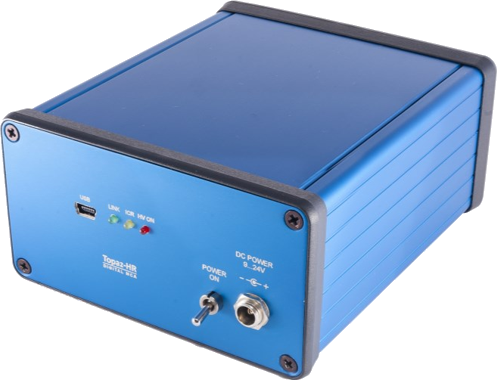
TOPAZ-HR High-Resolution MCA
16k-channel multi-channel analyzer with shaping amplifier, stabilization, and USB/Ethernet readout for lab spectroscopy.
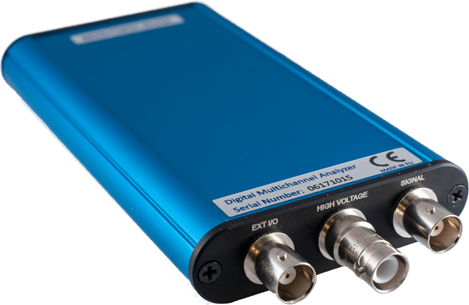
TOPAZ-Pico Compact MCA
Palm-sized multi-channel analyzer for field deployments; battery-powered with Bluetooth streaming to mobile apps.
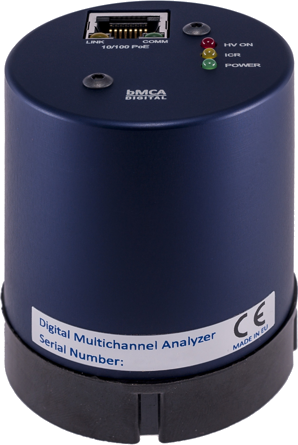
bMCA Ethernet Multi-Channel Analyzer
Network-connected MCA for remote and distributed monitoring; 4096 channels, PoE-capable, SNMP-ready.
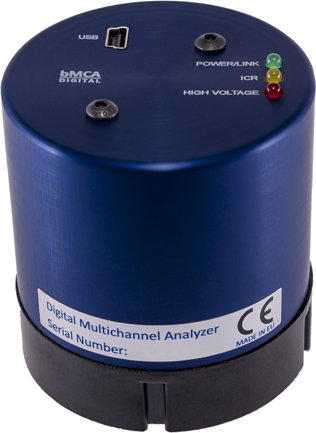
bMCA USB Multi-Channel Analyzer
Compact USB MCA with on-board HV supply; plug-and-play with any PMT or SiPM detector.
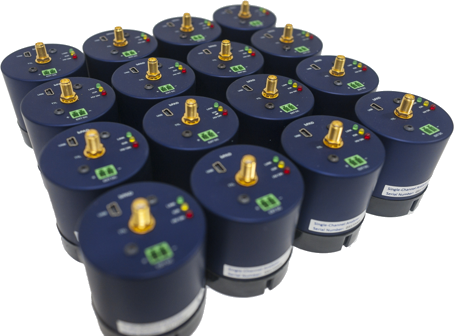
bPAD Pulse-Analysis Digitizer
High-speed waveform digitizer for pulse-shape discrimination; supports dual-mode crystals such as CLLBC and CLYC.
bGamma Gamma Spectrometry Software
Acquisition and analysis software for ScintIQ MCAs: live spectra, energy calibration, ROI tools, and isotope library matching.
V102AR406/3.5M-X6 Detector Assembly
Integrated PMT-coupled crystal detector assembly with voltage divider, ready to pair with a ScintIQ MCA or HV supply.
Configurators & Selection Tools
Interactive tools to compare materials, narrow down detector options, and generate a configuration for a quote.
ScintIQ Material Comparison
Side-by-side comparison of key properties (light yield, decay time, resolution, hygroscopicity) across all 14 materials.
ScintIQ Material Selector
Guided selection tool: answer questions about your application and the tool narrows the recommended crystal list.
ScintIQ Detector Configurator
Build a complete detector assembly by choosing crystal, size, housing, window, and readout, then request a quote.
Application Briefs
Short application notes covering how ScintIQ detectors are deployed across key markets and use cases.
Homeland Security & Interdiction
Handheld and vehicle-mounted ScintIQ assemblies for border screening, RIID, and radiological threat response.
Medical Imaging & Nuclear Medicine
LYSO and BGO assemblies for PET detector rings; NaI(Tl) and CeBr3 for gamma camera heads and SPECT.
Environmental Monitoring
Fixed and deployable ScintIQ systems for dose-rate monitoring, contamination surveys, and effluent screening.
High-Energy Physics & Research
Calorimeter crystals (BGO, LYSO, BaF2) and fast-timing assemblies for particle physics detectors and accelerator diagnostics.
Neutron Detection & PSD
Dual-mode CLLBC and CLYC assemblies for simultaneous neutron-gamma detection without He-3 tubes.
Well Logging & Industrial Measurement
High-temperature-rated NaI(Tl), YAP:Ce, and BGO assemblies for downhole gamma logging and industrial gauging.
Technical Notes & Reference
Background reading on scintillation physics, detector selection, and measurement technique.
Choosing a Scintillator: Key Properties Explained
A plain-language guide to light yield, decay time, energy resolution, hygroscopicity, and effective-Z, with guidance on matching these to application requirements.
Neutron-Gamma Discrimination with Dual-Mode Crystals
How pulse-shape discrimination separates neutron and gamma events in elpasolite crystals such as CLLBC and CLYC.
SiPM vs. PMT Readout: A Practical Comparison
Trade-offs in gain, bias voltage, magnetic-field sensitivity, form factor, and cost when choosing between SiPM and PMT coupling.
Energy Resolution in Scintillation Detectors
Sources of peak broadening (intrinsic, statistical, non-proportionality, electronic noise) and how to interpret FWHM specifications.
Nuts & Bolts of Scintillation Detectors
Berkeley Nucleonics web-based reference covering scintillation physics, crystal properties, readout electronics, and system design from first principles.