1Overview
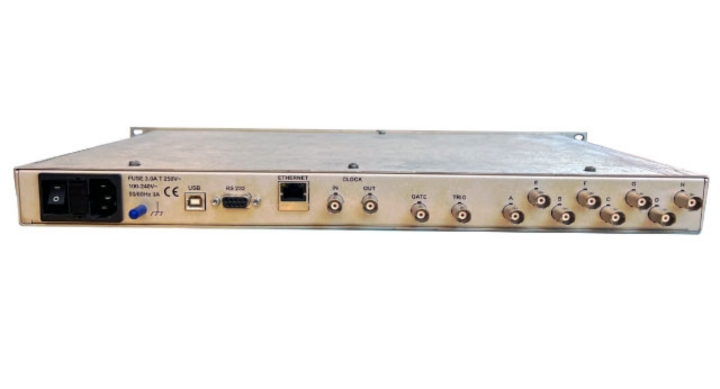
The Model 588 delivers high-quality timing and synchronization in a compact, low-profile 1U rackmount design. It is built for remote applications, large-system gating, and system integrators who want a clean alternative to the tangle of multiple boxes and cables that distributed timing often requires.
Up to eight independent precision channels fit in a single rack unit. The 588 accepts a low-amplitude clock input, as small as 20 mV up to 100 MHz, and phase-locks to a laser photodiode or an external reference for jitter below 50 ps. TCP/IP communication with SCPI command support and complimentary NI-certified LabVIEW drivers make it straightforward to fold into an automated test rack.
Availability and successor. Berkeley Nucleonics lists the Model 588 as available until 2026 and points to the Model 588B as its successor. For new designs, review the
Model 588B datasheet or contact Berkeley Nucleonics to confirm the right choice for your timeline.
2Key Features
- 8 independent precision timing channels
- Accepts a low-amplitude clock input from 20 mV up to 100 MHz
- Ultra-low jitter below 50 ps when phase-locked to a laser photodiode or external reference
- Direct synchronization with laser systems
- TCP/IP communication with SCPI command support
- Complimentary NI-certified LabVIEW drivers
- Low-profile 1U packaging optimized for rack integration and remote use
3Channels & Timing Architecture
The 588 organizes timing around an internal rate generator and a programmable timing generator with independent channels. Each channel sets its own delay, width, and mode, and any channel can be multiplexed onto any other. The architecture is the same whether the unit is ordered as 4 or 8 channels.
Internal rate generator
| Parameter | Value |
|---|
| Rate | 0.0002 Hz to 10.000 MHz |
| Resolution | 10 ns |
| Accuracy | 1 ns + 0.0001 × period |
| Jitter | < 50 ps RMS |
| Settling | 1 period |
| Burst mode | 1 to 1,000,000 pulses |
| Timebase | 100 MHz, low-jitter PLL |
| Oscillator | 50 MHz, 25 ppm |
| System output modes | Single shot, burst, duty cycle, continuous |
| Pulse control | Internal rate generator, external trigger, external gate |
Programmable timing generator, channel features
| Parameter | Value |
|---|
| Channel output modes | Single shot, burst, continuous, duty cycle |
| Control modes | Internally triggered, externally triggered, external gate, each channel independently configurable |
| Output multiplexer | Any/all channels may be multiplexed to any/all |
| Delayed output | Output to 9,999,999 pulses |
| Timebase | Same as internal rate generator |
| Pulse polarity | Normal, complemented, inverted |
4Specifications
Quick specs
| Parameter | Value |
|---|
| Channels | 4 or 8 independent channels |
| Delay resolution | 250 ps |
| Accuracy | 1 ns + 0.0001 × delay |
| Jitter | < 50 ps RMS |
| Voltage | TTL / 20 V adjustable |
| Memory | 24 storage slots |
Programmable timing generator, delay
| Parameter | Value |
|---|
| Range | 0 to 1000 s |
| Accuracy | 1 ns + 0.0001 × setpoint |
| Resolution | 250 ps |
| Pulse inhibit delay | < 120 ns typical |
| Output inhibit delay | < 50 ns typical |
Programmable timing generator, width
| Parameter | Value |
|---|
| Range | 10 ns to 1000 s |
| Accuracy | 1 ns + 0.0001 × setpoint |
| Resolution | 10 ns |
Output module AT20, TTL/CMOS mode
| Parameter | Value |
|---|
| Output impedance | High |
| Output level | 4.0 V typical into 1 kΩ |
| Rise time (10% to 90%) | 3 ns typical |
| Jitter | 50 ps RMS channel to channel |
Output module AT20, adjustable mode
| Parameter | Value |
|---|
| Output level | 2.0 V to 20.0 VDC into 1 kΩ, or 1.0 V to 10.0 VDC into 50 Ω |
| Amplitude resolution | 10 mV |
| Current | 200 mA typical, 400 mA short pulses |
| Rise time (10% to 90%) | 15 ns typ @ 20 V into Hi-Z (25 ns typ @ 10 V into 50 Ω) |
| Slew rate | 0.1 V/ns |
| Overshoot | < 100 mV + 10% of pulse amplitude |
Features
| Feature | Specification |
|---|
| User setting storage | 24 memory locations |
| Communications | USB, RS-232, and Ethernet |
| External clock in | 10 MHz to 100 MHz in 1 MHz increments |
| External clock out | T0, Rate, Channel, 2x ExtPLL, 1x ExtPLL, ½ ExtPLL, ¼ Ext, 40 MHz, 20 MHz, 10 MHz, 5 MHz, or disabled |
Physical and environmental
| Parameter | Value |
|---|
| Dimensions | 19″ × 10″ × 1.75″ [843 × 254 × 45 mm] |
| Weight | 8 lbs (verify; unit conversion in source appears inconsistent) |
| Power | 100 to 240 VAC, 50/60 Hz, < 3 A |
| Fuse | 3.15 A, 250 V time-lag (Qty 2) |
| Operating temperature | 32 to 104°F [0 to 40°C] |
| Storage temperature | −40 to 158°F [−40 to 70°C] |
| Shipping dimensions | 24″ × 19″ × 7″ |
| Shipping weight | 10 lbs |
5Triggering & I/O
The 588 uses the IA15 input module for external trigger and gate functions. The trigger generates individual pulses, starts a burst, or starts a continuous stream. The gate inhibits pulses or outputs, globally or per channel.
Input module IA15, trigger input
| Parameter | Value |
|---|
| Function | Generate individual pulses, start a burst or continuous stream |
| Rate | DC to 1/(200 ns + longest active pulse), maximum 10 MHz |
| Slope | Rising or falling |
| Threshold | 200 mV to 15 VDC |
| Maximum input | 60 V peak |
| Resolution | 10 mV |
| Trigger accuracy | ±3% of threshold voltage |
| Impedance | 1.5 kΩ + 40 pF |
| Trigger jitter | < 800 ps RMS |
| Insertion delay | < 180 ns |
| Minimum pulse width | 2 ns |
Input module IA15, gate input
| Parameter | Value |
|---|
| Mode | Pulse or output inhibit |
| Polarity | Active high or active low |
| Channel behavior | Global and individual channel |
| Pulse inhibit delay | 120 ns |
| Output inhibit delay | 50 ns |
6Options & Configurations
The 588 ships as a 4 or 8-channel unit. Options adjust output impedance, add automated incrementing, extend trigger logic, and adapt the power cord.
| Option | Description |
|---|
| TZ50 | Replaces the standard AT20 TTL Hi-Z output with a 50 Ω output impedance; the adjustable output module is unchanged |
| I (Incrementing) | Automatic high-speed incrementing or decrementing of delay and/or pulse width per channel |
| DT15 | Dual trigger logic. Adds an additional trigger via the gate input |
| EU | Replaces the US standard plug with a European standard plug |
| Model | Outputs |
|---|
| 588-4C | 4 channels |
| 588-8C | 8 channels |
7Applications
- Timing and synchronizing across distributed systems
- Pulse picking
- Laser timing, firing flashlamps or diodes before a Q-switch or shutter through delayed channel enables
- Single-shot or burst-mode laser pulse bursts
- Complex pulse trains assembled through the output multiplexer
The 1U form factor makes the 588 a strong fit for remote installations and large test racks where bench instruments and loose cabling would be impractical.
8Ordering
Choose the 4 or 8-channel model, then add the output, logic, and cord options the application requires.
| Step | Selection |
|---|
| 1. Base model | 588-4C or 588-8C |
| 2. Output | Standard AT20 Hi-Z, or TZ50 for 50 Ω |
| 3. Logic and control | I (incrementing), DT15 (dual trigger) |
| 4. Cord | EU for European plug |
For configuration help, current availability, and 588B migration guidance, contact Berkeley Nucleonics Corporation at info@berkeleynucleonics.com or 800-234-7858.
Verification notes. The Model 588 is listed as available until 2026, with the
Model 588B named as its successor; confirm current availability before ordering. The published unit weight (8 lbs) carries a bracketed metric figure that appears inconsistent in the source
(verify). Confirm all values against the latest Model 588 datasheet.