1Overview
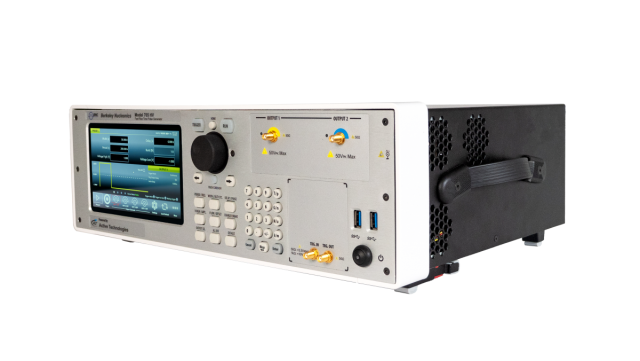
The Model 765-HV is the high-voltage member of the 765 family. It delivers pulse amplitudes up to plus or minus 50 Vpp into 50 Ω while holding rise time below 400 ps (20% to 80%) at full output. Repetition rates reach 400 MHz, and pulse widths go as narrow as 1 ns.
Each of its one or two channels is fully programmable for amplitude, offset, delay, and width at 10 ps resolution, with period jitter below 15 ps. A redesigned analog front end keeps edge transitions precise with low overshoot and ringing, even at maximum amplitude. The instrument is driven by a 7-inch capacitive touchscreen with a rotary encoder, and it is SCPI programmable over USB, LAN, or a remote interface.
2Key Features
- Pulse amplitude up to plus or minus 50 Vpp into 50 Ω
- Rise and fall time below 400 ps (20% to 80%) at full output
- Up to 400 MHz repetition rate per channel
- One or two independent channels
- Plus or minus 25 V adjustable DC offset
- Pulse width from 1 ns to 8 s
- 10 ps resolution on width, delay, and timing control
- Low overshoot below 5% and jitter below 15 ps RMS
- 7-inch touchscreen GUI with rotary encoder
- SCPI programmable over USB, LAN, or remote interface
3Channels & Timing Architecture
The Model 765-HV is configured with one or two independent channels. Amplitude, DC offset, delay, and width are programmed separately on each channel, with channel-to-channel jitter below 15 ps RMS. The DC offset is selectable across software baselines of minus 25 V, minus 12.5 V, 0 V, plus 12.5 V, and plus 25 V, with 12.5 mV resolution.
Timing is referenced to a plus or minus 2 ppm internal clock, with a 10 MHz to 100 MHz external reference clock input for system locking. Pulse delay covers 0 ps to the full period, and the period itself spans 5 ns to 8 s, both at 10 ps resolution. Multiple-pulse modes (single, double, triple, quadruple, and external width) let each channel emit grouped pulses, with the higher 400 MHz rates available in the multi-pulse modes.
4Specifications
Channels and Period
| Parameter | Model 765-HV |
|---|---|
| Channels | 1 or 2 independent |
| Pulse period range | 5 ns to 8 s |
| Pulse period resolution | 10 ps |
| Pulse period jitter | < 15 ps RMS |
| Pulse period accuracy | ±2 ppm max |
| Pulse frequency | Up to 200 MHz (single mode); up to 400 MHz (double, triple, quad mode) |
Width and Delay
| Parameter | Model 765-HV |
|---|---|
| Pulse width range | 1 ns to (period − 1 ns) |
| Pulse width resolution | 10 ps |
| Pulse width accuracy | ±(1% + 100 ps) |
| Pulse width jitter | < 10 ps RMS |
| Pulse delay range | 0 ps to period |
| Pulse delay resolution | 10 ps |
| Pulse delay accuracy | ±(0.1% + 100 ps) |
| Channel-to-channel jitter | < 15 ps RMS |
High-Voltage Output and Edges
| Parameter | Model 765-HV |
|---|---|
| Pulse amplitude (p-p) | 100 mVpp to ±50 Vpp |
| Amplitude resolution | 10 mV |
| Amplitude accuracy | ±(2% of amplitude + 2% of |DC offset| + 200 mV) |
| DC offset / baseline range | 0 V or ±25 V adjustable |
| Selectable baselines | −25 V, −12.5 V, 0 V, +12.5 V, +25 V |
| DC offset resolution | 12.5 mV |
| Rise time (20% to 80%) | < 400 ps (up to ±50 Vpp) |
| Fall time (20% to 80%) | < 530 ps (up to ±50 Vpp) |
| Rise time (10% to 90%) | < 630 ps (up to ±50 Vpp) |
| Fall time (10% to 90%) | < 840 ps (up to ±50 Vpp) |
| Overshoot | < 8% (≤ 25 Vpp), < 5% (25 to ±50 Vpp) |
| Output impedance | 50 Ω nominal |
Power, Physical, and Compliance
| Parameter | Model 765-HV |
|---|---|
| Power requirements | 100 to 240 VAC ±10%, 47 to 63 Hz |
| Max power consumption | 300 W |
| Operating temperature | +5 °C to +40 °C |
| Display | 7-inch capacitive touch LCD (1024 x 600) |
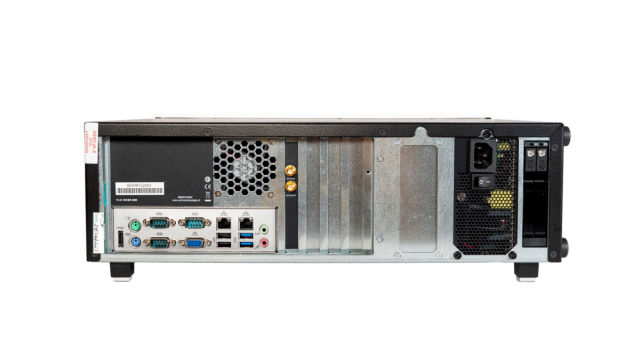
| Interfaces | HDMI, VGA, LAN, USB 2.0/3.0, PS/2, audio I/O |
| Dimensions (W x H x D) | 445 x 135 x 320 mm, 3U 19-inch rackmount |
| Weight | 9.7 kg (21.4 lbs) |
| Compliance and safety | EN61010-1 (safety); EN 61326-1:2013 (EMC / immunity) |
5Triggering & I/O
Trigger modes cover single, continuous, burst, and gated operation, with multiple-pulse output in single, double, triple, quadruple, and external-width modes. The trigger input impedance is programmable between 50 Ω and 1 kΩ, and the trigger output is adjustable from 1.8 V to 3.3 V into 50 Ω.
| Parameter | Model 765-HV |
|---|---|
| Trigger input impedance | 50 Ω or 1 kΩ (programmable) |
| Trigger input range | ±3.5 V (50 Ω), ±10 V (1 kΩ) |
| Min detectable trigger amplitude | < 50 mVpp |
| Trigger threshold range | ±8 V (10 mV res., ±100 mV acc.) |
| Max trigger input frequency | 40 MHz |
| Min trigger pulse width | 1 ns |
| Trigger output | 1.8 V to 3.3 V adjustable, 50 Ω |
| Trigger delay (in to out) | < 100 ns |
| Trigger jitter | < 30 ps (≤ 15 MHz input) |
| Reference clock input | 10 to 100 MHz, 50 Ω AC-coupled, −5 dBm to +4 dBm |
| Reference clock output | 10 MHz or external clock frequency |
| Reference clock accuracy | ±2 ppm |
6Options & Configurations
- One-channel or two-channel configuration
- Software-selectable DC offset baselines: minus 25 V, minus 12.5 V, 0 V, plus 12.5 V, plus 25 V
For applications below 5 Vpp that need the fastest possible edge, the standard Model 765 reaches sub-70 ps rise times at 800 MHz across the same family architecture.
7Applications
- Radar and sonar systems
- Semiconductor and laser testing
- Big physics, including colliders, photomultipliers, and particle experiments
- High-power microwave and electromagnetic systems
- X-ray and flash radiography sources
- Pulsed electron beam and lightning-pulse simulation
- High-speed digital pattern and timing generation
8Ordering / In the Box
Specify channel count (one or two) and any required DC offset baselines when ordering. The instrument ships as a 3U 19-inch rackmount unit with power cord and a calibration certificate.
| Item | Detail |
|---|---|
| Model 765-HV, 1-channel | 400 MHz, up to ±50 Vpp, < 400 ps rise time, one independent channel |
| Model 765-HV, 2-channel | 400 MHz, up to ±50 Vpp, < 400 ps rise time, two independent channels |
To configure or quote, contact Berkeley Nucleonics at info@berkeleynucleonics.com or 800-234-7858.