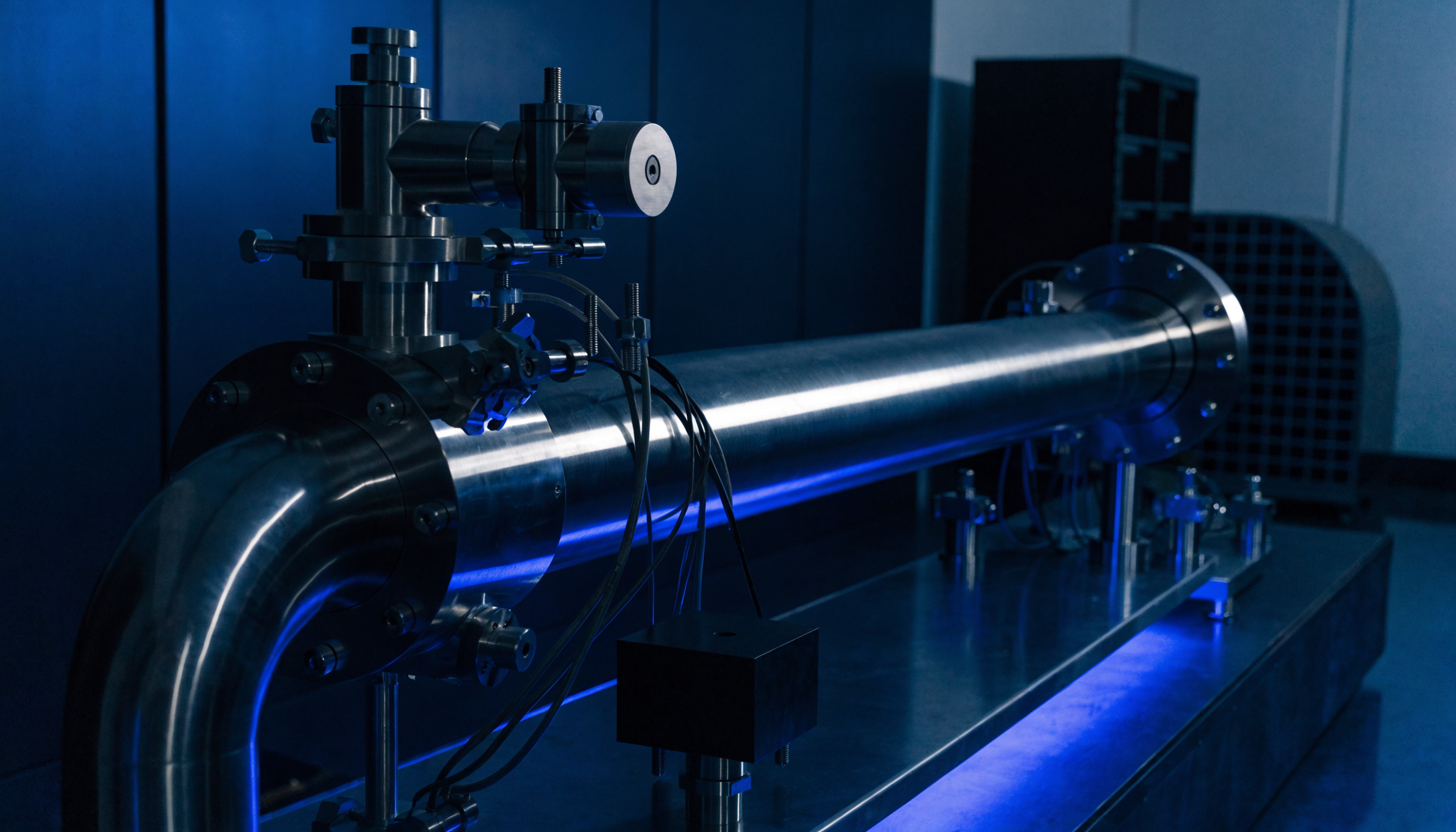
Time-of-Flight Mass Spectrometry
Time-of-flight mass spectrometry resolves species by the time it takes an ion to travel a known flight path. The lighter the ion, the faster it arrives, so the entire measurement rests on a single moment: the instant the extraction grid pulses and launches a packet of ions down the drift tube. Everything downstream, the mass resolution, the peak shape, the ability to separate two species that differ by a fraction of a dalton, traces back to how cleanly that launch happens.
The same logic governs the deflection plates that steer and gate the beam, the Bradbury-Nielsen and beam-blanking gates that select which ions pass, and the pulsed optics in injectors and accelerator front ends. In each case a high-voltage transition has to start at a precise, repeatable moment, rise quickly to a flat level, and hold that level without disturbance until the packet has cleared the region. The pulse generator is not a peripheral here. It sets the timing reference the rest of the instrument is measured against.
The Challenge
Driving an extraction grid or a deflection plate is not like driving a 50 ohm cable. These electrodes look almost purely capacitive to the source, often tens to hundreds of picofarads of plate plus wiring, and a capacitive load fights every attempt to move it quickly. Current has to flow to change the voltage, governed by I = C times dV/dt, so a fast edge into a real plate demands a large, brief current surge from the output stage. Get that wrong and the edge slumps, slews unevenly, or rings.
Ringing and overshoot are the specific enemies of TOF performance. A flat top that wobbles after the transition imprints that wobble onto the launched ion energy, which smears arrival times and widens peaks. Jitter does the same damage in the time domain: if the launch moment shifts shot to shot, every accumulated spectrum is the sum of slightly misaligned events, and resolution degrades exactly where it matters most. The bench therefore needs an HV pulse that is fast, flat, clean, and repeatable into a load that resists all four at once. Many general-purpose HV sources cannot hold those properties together.
There is also the matter of bipolar geometry. Real ion optics frequently need to sit at one potential and then swing to another, sometimes crossing zero, so the useful instrument is one that defines an upper and a lower voltage and snaps cleanly between them on command.
The BNC Approach
The DEI Pulsers line is built around capacitive-load pulsing rather than adapted to it. The output stage is a half-bridge totem-pole design that actively drives the load in both directions, pushing current to charge the plate on the rising edge and pulling it back on the falling edge. That two-sided drive is what keeps edges fast and flat-tops settled when the load is a grid or a pair of plates rather than a matched cable.
Operation is defined by two programmable levels, a VHigh and a VLow, so the output rests at one potential and transitions to the other on each trigger. That bipolar-offset behavior maps directly onto how extraction and deflection optics are biased, letting a single instrument hold a standing potential and pulse a packet without external level-shifting. Built-in voltage and current monitors bring the output waveform out to an oscilloscope so the engineer can see the real edge into the real load, confirm the flat top, and watch for the onset of ringing as the load or rate changes.
The line spans single-shot operation, for a triggered launch synchronized to the rest of the instrument, through repetition rates into the tens of kilohertz for high-throughput acquisition. Across that range the design targets fast rise times and low timing jitter, which together preserve the launch precision that mass resolution depends on. Treat the figures below as capability targets and confirm the exact numbers for your configuration against the current published datasheet.
Recommended Instruments
For most TOF-MS extraction and deflection work, the flagship choice is the PVX-4141. It delivers a 3,500 V output with a fast edge in the neighborhood of 25 ns and very low timing jitter, on the order of a few hundred picoseconds, while running from single-shot up to roughly 30 kHz. That combination of clean edge, low jitter, and useful repetition rate makes it the default for gating and launching ion packets into a capacitive grid.
When the application needs more voltage headroom, for larger extraction stacks, longer flight regions, or accelerator-front-end optics, the PVX-4110 extends the same bipolar, capacitive-load-optimized approach to plus or minus 10,000 V. Where the requirement is moderate voltage at the broadest possible rate and edge flexibility, the PVX-4000 series (including the 2 kV and 2 kV-EX variants) covers lower-voltage extraction and deflection tasks with high repetition capability. All three share the VHigh/VLow operating model and the built-in monitors, so the choice comes down to the voltage and rate your ion optics actually demand.
Getting Started
Start by characterizing the load: the electrode capacitance, the voltage swing your ion optics require, the polarity arrangement, and the repetition rate of your acquisition. Decide whether you need a standing bias with a pulsed transition (the common case, which the VHigh/VLow model serves directly) or a simple gate to and from ground. From there the recommended model follows from the voltage and rate, and the built-in monitors let you verify the real edge into your real grid on day one rather than inferring it from a datasheet curve.
Talk to a BNC applications engineer at info@berkeleynucleonics.com or 800-234-7858. Bring your electrode capacitance, required voltage swing, and acquisition rate, and we will match a DEI pulse generator to the launch precision your spectrometer needs.