EW & SIGINT
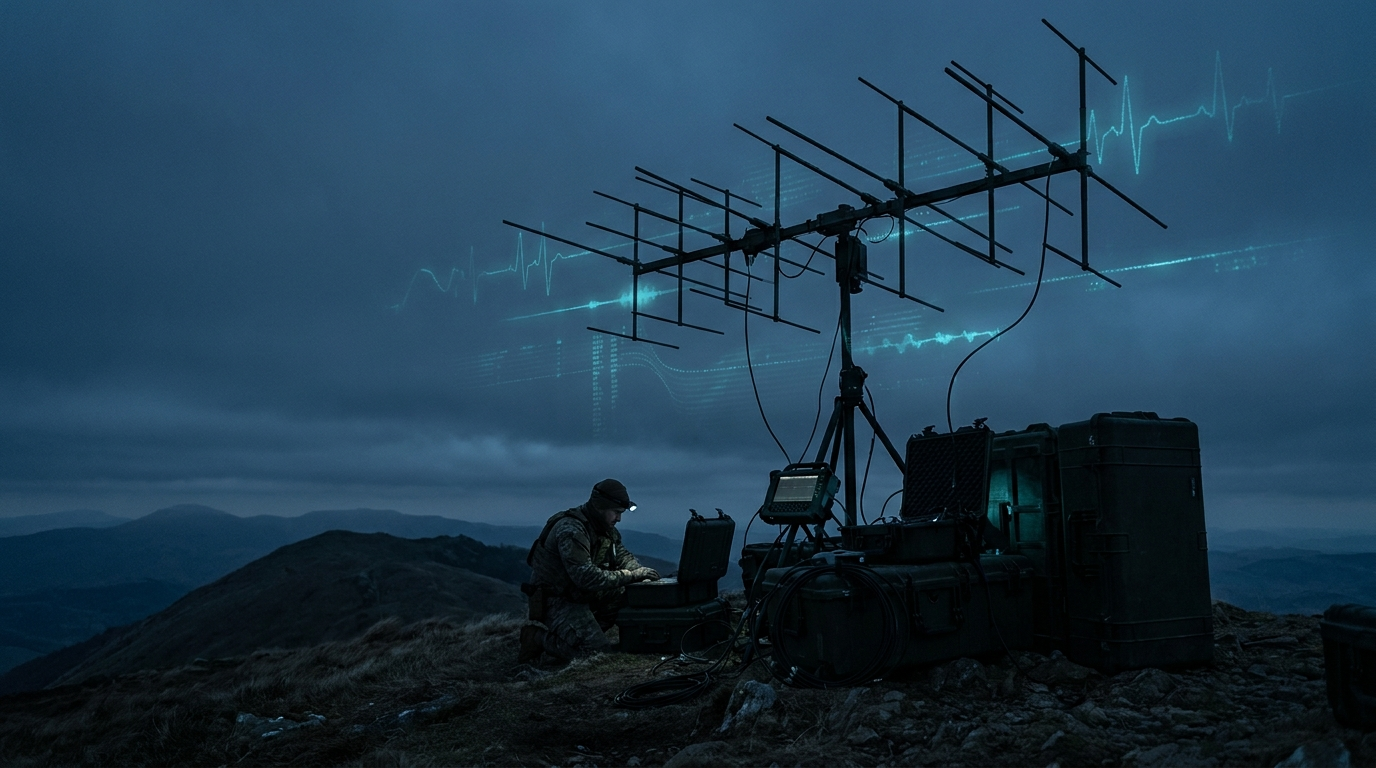
Electronic warfare and signal intelligence work lives at the edge of the spectrum. The emitters that matter are often short, agile, and deliberately hard to find. A frequency-hopping radio dwells on a channel for milliseconds. A radar pulse may last a fraction of a microsecond and then go quiet. A drone control link can appear, move, and disappear before a slow analyzer finishes a single sweep. The operator does not get a second look.
That puts three demands on the instrument at once. It has to see a wide slice of spectrum without scanning, so nothing slips through between sweeps. It has to capture and characterize a signal fast enough to read its structure: center frequency, modulation, and the pulse parameters that fingerprint a radar. And it has to do all of this on a battery, in the weather, far from a lab bench. Most rack equipment can deliver one or two of those. Field teams need all three in something they can carry.
The harder problem is interpretation. Detecting energy is easy. Knowing what the energy is, fast enough to act, is the real job. Pulse descriptor words, modulation recognition, and a clean record of the raw signal are what turn a blip into intelligence.
How the ICX-FieldHawk line solves it
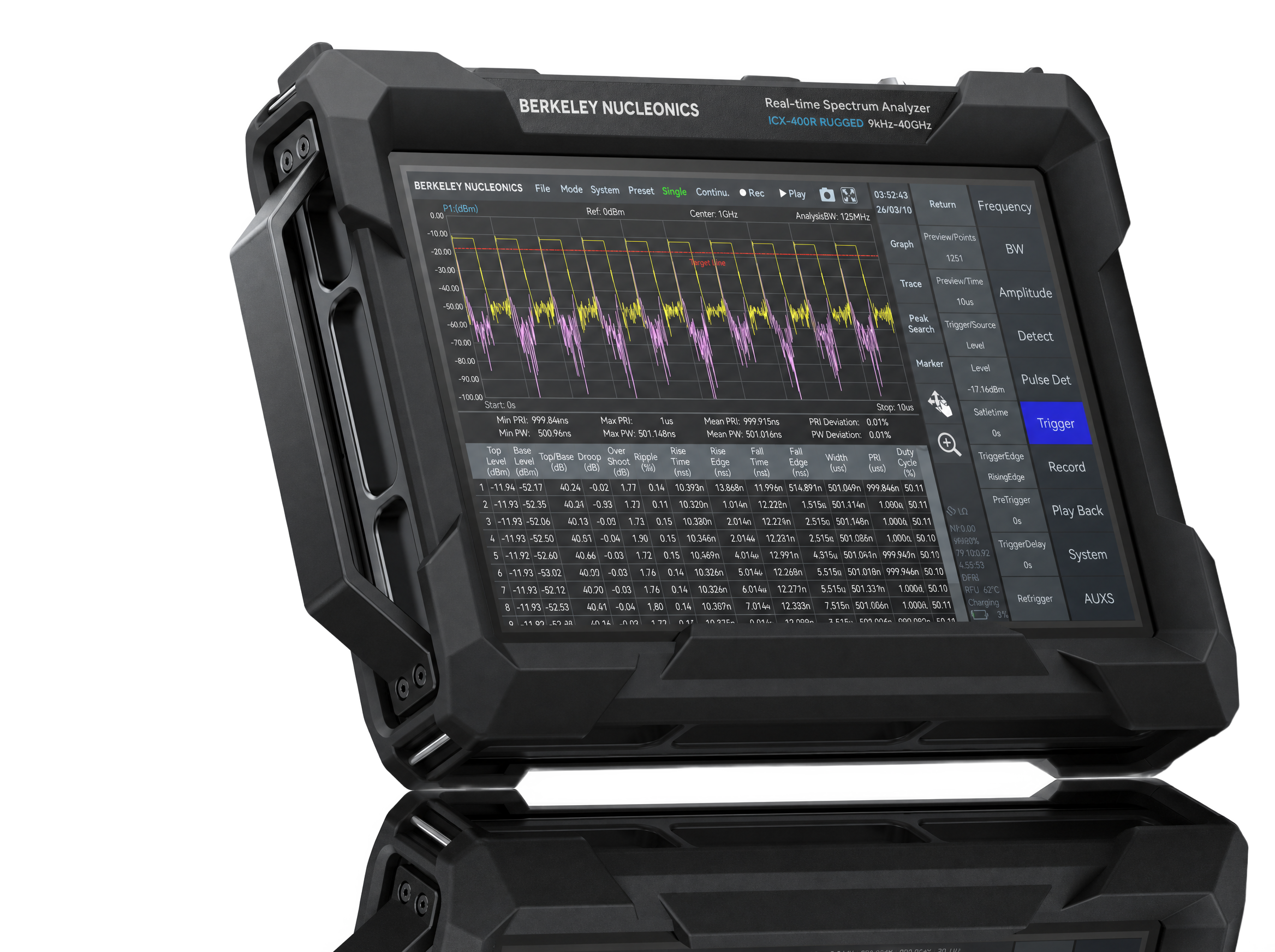
The ICX-FieldHawk receivers are built around wide real-time bandwidth, so the instrument watches a large span continuously rather than stepping through it. A persistent display reveals the faint, the brief, and the intermittent: signals that a swept analyzer would miss between passes. When something appears, it shows up the moment it transmits.
On top of that live view, the SpecICX-gen3 firmware adds pulse analysis. It measures pulse repetition interval, pulse width, and duty cycle directly, then tracks how those values change over time. For pulsed emitters and radar work, that is the difference between seeing a flash and reading a signature. The same firmware handles signal capture and characterization across modulation types, so an operator can move from detection to identification without leaving the screen.
Then there is the record. The ICX-FieldHawk line supports IQ record and playback, capturing the raw complex samples of an event for later analysis. A signal that lasted a few milliseconds in the field can be replayed, demodulated, and dissected at length back at the bench. This matters for counter-UAS development, where the control and video links are short, hopping, and worth studying frame by frame. Capture once, analyze as long as you need.
Which models and accessories fit
For most EW and SIGINT field work, the recommended platform is the ICX-FieldHawk-R. It carries an IP68 environmental rating, so it survives dust, rain, and immersion that would stop a benchtop unit. Onboard AI assists with signal classification at the edge, flagging emitters of interest without a constant operator watch. For a team moving through unfriendly terrain, ruggedness is not a luxury. It is the difference between an instrument that works and one that stays in the case.
Where the receiver needs to disappear into a larger system, the ICX-FieldHawk-U USB core module is the right tool. It integrates into SDR platforms, vehicle racks, and custom processing chains, exposing the same real-time engine through a programmable interface. C-UAS prototypes, distributed sensor nodes, and embedded direction-finding builds all start here. One sensing core, many host configurations.
For directional work, pair either receiver with the ANT-100G directional antenna. Its gain and front-to-back ratio help an operator bear in on an emitter, separate it from background traffic, and support angle-of-arrival estimates. Detection tells you a signal exists. The ANT-100G helps you point at it.
| Need | Recommended model | Why |
|---|---|---|
| Dismounted field operations | ICX-FieldHawk-R | IP68 rugged build, onboard AI classification, battery operation |
| SDR / embedded integration | ICX-FieldHawk-U | USB core module for vehicle, rack, and C-UAS prototype builds |
| Direction finding | ANT-100G | Directional gain for bearing and angle-of-arrival work |
Recommended configuration
A capable two-piece kit starts with the ICX-FieldHawk-R for dismounted operations and an ICX-FieldHawk-U reserved for vehicle and bench integration, both running SpecICX-gen3 with pulse analysis and IQ record enabled. Add an ANT-100G for directional sweeps and bearing. This pairing covers live wideband awareness, pulse fingerprinting, raw capture for after-action analysis, and a clear path into C-UAS and SDR development.
For a quick question, chat with an engineer at berkeleynucleonics.com.