Optics & Photonics
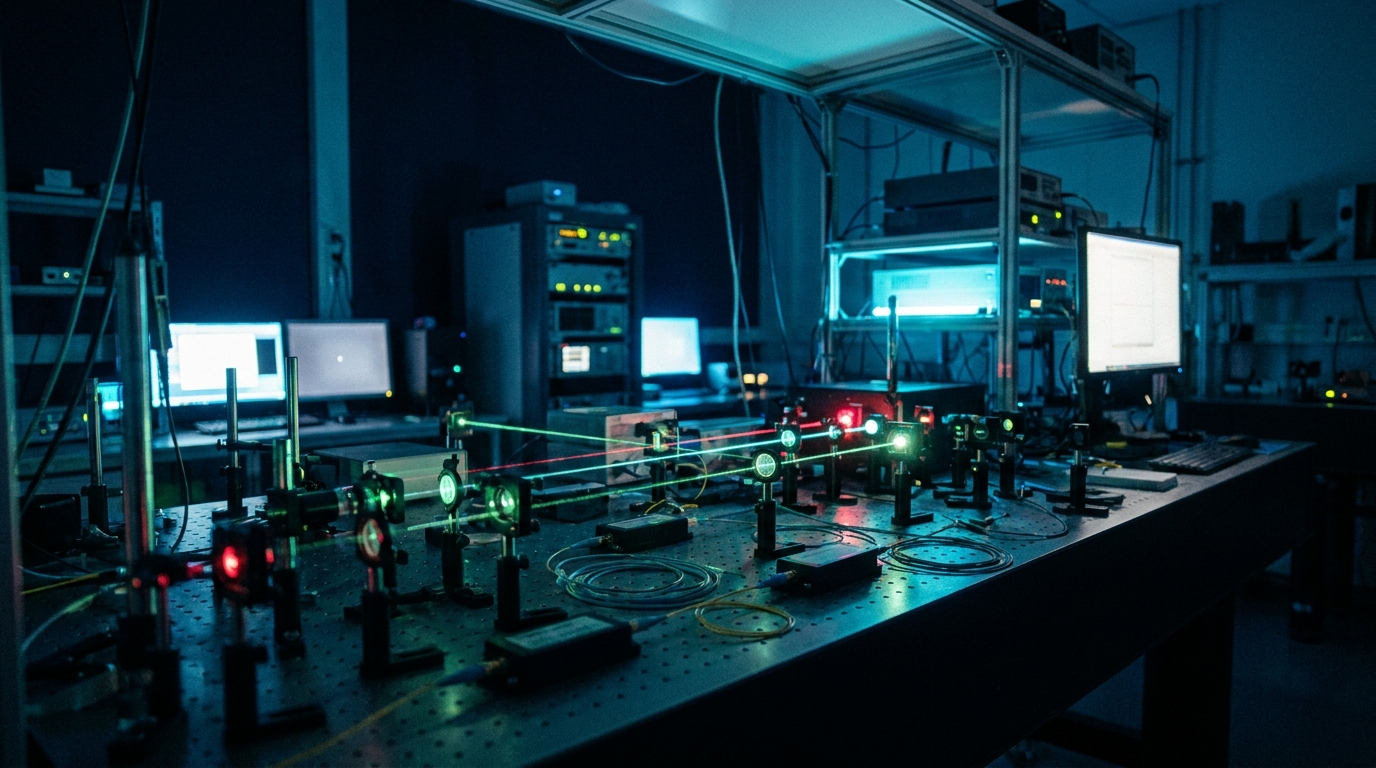
Optics and photonics research lives at the boundary between an electrical drive signal and a light field. The instruments that convert one into the other, electro-optic and acousto-optic modulators, Pockels cells, and directly modulated laser sources, respond to whatever voltage waveform you put in front of them. That makes the arbitrary waveform generator a central tool on the bench. The shape of the optical pulse, the steepness of its edges, and the timing relationship between channels are all set by the electrical drive, so the quality of the experiment follows directly from the quality of the generator.
The work spans several recurring tasks. Pulse carving slices a continuous-wave beam into a defined train, which demands sharp, well-controlled edges. Intensity shaping writes an arbitrary envelope onto the light for spectroscopy, ranging, or quantum-state preparation, which demands fine amplitude resolution. Pre-distortion, sometimes called pre-compensation, deliberately bends the drive waveform so that the modulator's own nonlinear transfer curve flattens out at the optical output. Multi-channel experiments add the requirement that several drives, pump and probe, gate and signal, modulator and trigger, stay locked together to a known phase.
The challenge
These tasks place a specific and demanding set of requirements on the generator. Sharp optical pulses need fast rise and fall times and the analog bandwidth to support them, because a slow electrical edge becomes a slow optical edge no matter how good the modulator is. Intensity shaping needs fine vertical resolution, since the small voltage steps that define a smooth envelope are lost on a coarse converter. Long experiments, a full ranging sequence or an extended quantum protocol, need deep waveform memory so the pattern does not have to loop before the science is done. Underlying all of it, the drive has to be quiet: low timing jitter so the optical pulse lands where it should, and the ability to deliver real amplitude directly into a 50 ohm modulator input without an external amplifier in the path adding noise and delay.
Meeting every one of these at once is the hard part. A generator built only for speed often gives up vertical resolution. A generator built for resolution often gives up bandwidth and memory. Photonics work needs both halves of that trade at the same time, and it needs them to coexist on the same channel so the carved edge and the shaped envelope come from one clean source.
Direct drive matters here as much as the numbers on the front panel. An external amplifier between the generator and a 50 ohm modulator adds its own bandwidth ceiling, noise floor, and propagation delay. A generator that swings the modulator directly removes that stage and the uncertainty that comes with it.
How the Model 686 solves it
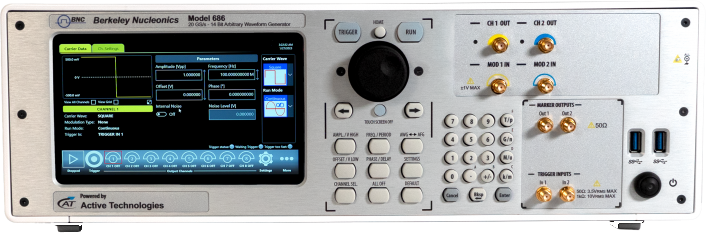
The Model 686 is built for exactly this combination. It samples at 20 GS/s with 10 GHz of analog bandwidth and a rise and fall time of 50 ps, which gives the sharp electrical edges that pulse carving and fast optical gating depend on. It drives 5 Vpp into 50 ohm, enough to swing many electro-optic and acousto-optic modulators directly, so the modulator sees a clean source rather than the accumulated noise of an external amplifier chain.
For shaping work the Model 686 carries 14-bit vertical resolution, fine enough to write smooth intensity envelopes, and it pairs that resolution with in-firmware pre-compensation that counteracts modulator nonlinearity directly in the instrument. You define the target optical shape, and the correction is applied to the drive waveform without a separate processing stage. Memory runs up to 9 Gpts, deep enough to hold long, non-repeating sequences for extended protocols and ranging patterns. Tight multi-channel synchronization keeps pump and probe, or modulator and trigger, locked to a known phase across the experiment.
Low jitter ties the picture together. Sharp electrical edges only translate into sharp optical pulses if those edges arrive on time, and the Model 686 holds its timing tightly enough that the carved pulse lands where the experiment expects it, pulse after pulse, across a long run.
Where amplitude resolution is the first priority rather than edge speed, the Model 685 offers 16-bit vertical resolution. For high-dynamic-range intensity shaping and the most demanding linearization work, those extra bits resolve detail that a faster, lower-resolution drive would flatten. The two extra bits over the Model 686 give finer control of the small steps that define a smooth envelope, which is exactly what high-contrast intensity profiles and precise modulator linearization ask for.
Recommended configuration
For a general optics and photonics bench that carves pulses, gates beams, and drives modulators with fast edges, start with the Model 686 at 20 GS/s. Its 10 GHz bandwidth and 50 ps edges cover the fast work, the 5 Vpp output drives most modulators directly, and the in-firmware pre-compensation linearizes the modulator response without an added stage. Use the multi-channel synchronization to lock the drives in a pump-probe or gate-and-signal arrangement, and size the memory toward the 9 Gpts ceiling when the sequences run long.
Where the experiment leans on high-resolution intensity shaping or precise linearization more than on raw edge speed, choose the Model 685 for its 16-bit resolution. Many labs keep both roles in mind: the Model 686 for speed-driven carving and gating, the Model 685 where the amplitude detail matters most.
Talk to an application engineer
Berkeley Nucleonics can help you match a Model 686 or Model 685 configuration to your optics and photonics bench. Call 800-234-7858 or email info@berkeleynucleonics.com.
For a quick question, chat with an engineer at berkeleynucleonics.com.