1The Governing Equation
Almost every difficulty in driving a Pockels cell, a deflection plate, an extraction grid, or any other capacitive load traces back to one relation. A capacitor does not respond to voltage. It responds to the rate of change of voltage. The current that flows into a capacitor is set by how fast you move its voltage, written plainly as I = C times dV/dt: current equals capacitance times the rate of change of voltage.
Each term earns its place. I is the instantaneous current the source must deliver, in amperes. C is the load capacitance, in farads, fixed by the device and its wiring. dV/dt is the slew rate, the rate at which the output voltage changes, in volts per second. When the voltage is flat, dV/dt is zero and no current flows into an ideal capacitor. When the voltage is moving, the source has to supply current in proportion to both the capacitance and the speed of the change. This is the lens for everything below.
2Why a Fast Edge Demands Big Current
The consequence of I = C times dV/dt is direct: a faster edge into the same capacitor demands proportionally more current. Halve the rise time and you double the slew rate, so you double the peak charging current the driver must source. The capacitance has not changed. Only the speed has, and current tracks speed.
This is why capacitive-load pulsing is harder than driving a resistor. A resistive load draws a current set by Ohm's law and the voltage level. A capacitive load draws a current set by the steepness of the edge, and a square pulse with sharp transitions is the steepest edge you can ask for. The current does not flow during the flat top. It flows in a sharp burst concentrated on each transition, where the voltage is changing fastest.
3Slew-Rate Limits
Every driver can only source and sink so much peak current. That ceiling is a hard physical limit set by the output devices, and it caps how fast the output can slew into a given capacitance. Rearrange the governing equation and the limit becomes plain: dV/dt = I_peak / C. The maximum slew rate equals the maximum peak current the driver can deliver, divided by the load capacitance.
This sets the achievable rise time on any given load. For a voltage swing of deltaV, the time to cross it is roughly t_rise ~ C times deltaV / I_peak. A bigger swing or a bigger capacitance takes longer at a fixed current, and the only way to recover the speed is to deliver more current. A generator rated for a fast edge into a small capacitance will not hold that edge into a much larger one, because the current ceiling has not moved. When you specify a pulser, the question is never rise time alone. It is rise time into your capacitance, at your voltage.
4RC and Cabling Effects
The driver is not the only thing between the source and the load. The output resistance of the generator, plus the series resistance of the cable and any source-termination resistor, forms an RC time constant with the load capacitance. That time constant, tau = R times C, rounds the corners of the edge no matter how hard the driver pushes. An ideal step filtered through an RC network arrives as an exponential, with a ten-to-ninety-percent rise time on the order of 2.2 times R times C.
Cabling makes this worse in two ways. Every length of coax adds its own capacitance in parallel with the load, on the order of tens of picofarads per foot, so a long run can rival the device you are trying to drive. That added capacitance then combines with the series resistance to lengthen tau. The guidance is direct: keep the load close, keep the leads short, and treat the cable capacitance as part of the load you must charge. A clean fast edge at the generator output can still arrive soft at the device if the path between them is long.
5The Average-Power Budget
Peak current sets whether you can make the edge. Average power sets whether you can sustain it. Each time you charge the load capacitance from zero to V, you store an energy of E ~ (1/2) C V^2 in the capacitor. When the edge falls and the cell discharges, that stored energy is dissipated rather than recovered, so a full charge-and-discharge cycle moves energy proportional to C times V squared every period.
Run that cycle at a repetition rate f and the average power follows as a scaling relation: P ~ C times V^2 times f. This is an order-of-magnitude relation, and the exact numerical factor depends on the waveform and on how much of the energy is dissipated in the driver versus the load. The structure is what matters. Average power scales with capacitance, with the square of voltage, and linearly with repetition rate. Double the voltage and the power budget roughly quadruples. Double the rep rate and it doubles. This is why a pulser comfortable at a low rep rate can run into a thermal wall when you push the duty up, even though nothing about the single-pulse shape has changed.
6Overshoot, Ringing, and Damping
Real wiring has inductance. The load capacitance combines with the inductance of the leads and the internal current path to form an LC resonant circuit, and an underdamped LC circuit overshoots and rings when you hit it with a fast edge. The faster the edge, the more energy you dump into that resonance, so the speed you want for performance is the speed that excites the ringing.
The control is damping. A small series resistance, sized against the LC, brings the response toward critical damping and trades a little edge speed for a clean settle with controlled overshoot. Too little resistance leaves the output ringing past the device's safe limits. Too much softens the edge through the RC effect of the previous section. The right value lets the edge settle cleanly without ringing into the device, and it is found by considering the lead inductance and the load capacitance together, not either alone.
7The Half-Bridge Totem-Pole Advantage
A capacitor has to be charged on the rising edge and actively discharged on the falling edge. A simple driver that switches the load high and then relies on a passive pull-down resistor to bring it low will charge fast but fall slowly, because the resistor can only sink the current the RC time constant allows. The falling edge ends up far softer than the rising edge, and the asymmetry shows up directly in the optical or beam response.
A half-bridge totem-pole arrangement solves this with two switches, an upper device and a lower device. The upper switch actively sources current to charge the load on the rising edge. The lower switch actively sinks current to discharge it on the falling edge. Both edges are driven hard into the capacitance instead of one being driven and the other left to coast. The result is symmetric rise and fall times, a sharper square pulse, and a fast falling edge that a pull-resistor design cannot match. For Pockels-cell switching and similar capacitive loads, this active sink on the falling edge is often the difference that matters most.
8A Worked Numeric Example
The numbers below are an illustrative example, chosen to show the arithmetic. They are not a product specification. Suppose you drive a 100 pF load, a Pockels cell plus its cable, from 0 to 2000 V, and you want the edge to complete in 50 ns.
Slew rate. The voltage changes by 2000 V in 50 ns. So dV/dt = 2000 V / 50 ns = 4 times 10^10 V/s, which is 40 V/ns. That is the rate the output has to move during the edge.
Peak current. Apply the governing equation. I = C times dV/dt = 100e-12 F times 4e10 V/s = 4 A. To make a 50 ns edge into 100 pF at 2000 V, the driver has to source 4 amperes at the peak of the edge. If you wanted the edge twice as fast, at 25 ns, you would need 8 amperes, because the current scales directly with the slew rate.
Energy per edge. Each full charge stores E ~ (1/2) C V^2 = 0.5 times 100e-12 times 2000^2. Working it through: 2000 squared is 4e6, times 100e-12 is 4e-4, times one half is 2e-4 joules, which is 0.2 mJ per charge.
Average power. Run that at a 10 kHz repetition rate. The charge energy alone gives 0.2 mJ times 10,000 = 2 W. Both the charge and the discharge dissipate energy, so budget for the discharge as well rather than counting the charge only. The takeaway is the scaling, not the exact watt: hold the rep rate and double the voltage to 4000 V, and this term quadruples toward roughly 8 W before the discharge is even added.
I = C times dV/dt and the power scaling. Actual peak current, rise time, and thermal limits depend on the specific generator and load, and must be verified against the published BNC datasheet.9Relationship Summary
The table collects the first-order relations in one place. Read them as scaling laws that tell you which way a number moves when you change the load, the voltage, the speed, or the rep rate. They set the shape of the design problem before any specific model enters the picture.
| Quantity | Relation | Note |
|---|---|---|
| Peak current | I = C dV/dt | Scales with capacitance and slew rate; sets the driver demand. |
| Slew rate | dV/dt = I_peak / C | Capped by the driver's peak current into the load capacitance. |
| Rise time | t_rise ~ C deltaV / I_peak | Longer for bigger swing or bigger C at fixed current. |
| Energy per edge | E ~ (1/2) C V^2 | Stored on charge, dissipated on discharge. |
| Average power | P ~ C V^2 f | Scales with C, the square of V, and linearly with rep rate. |
10Talk to an Engineer
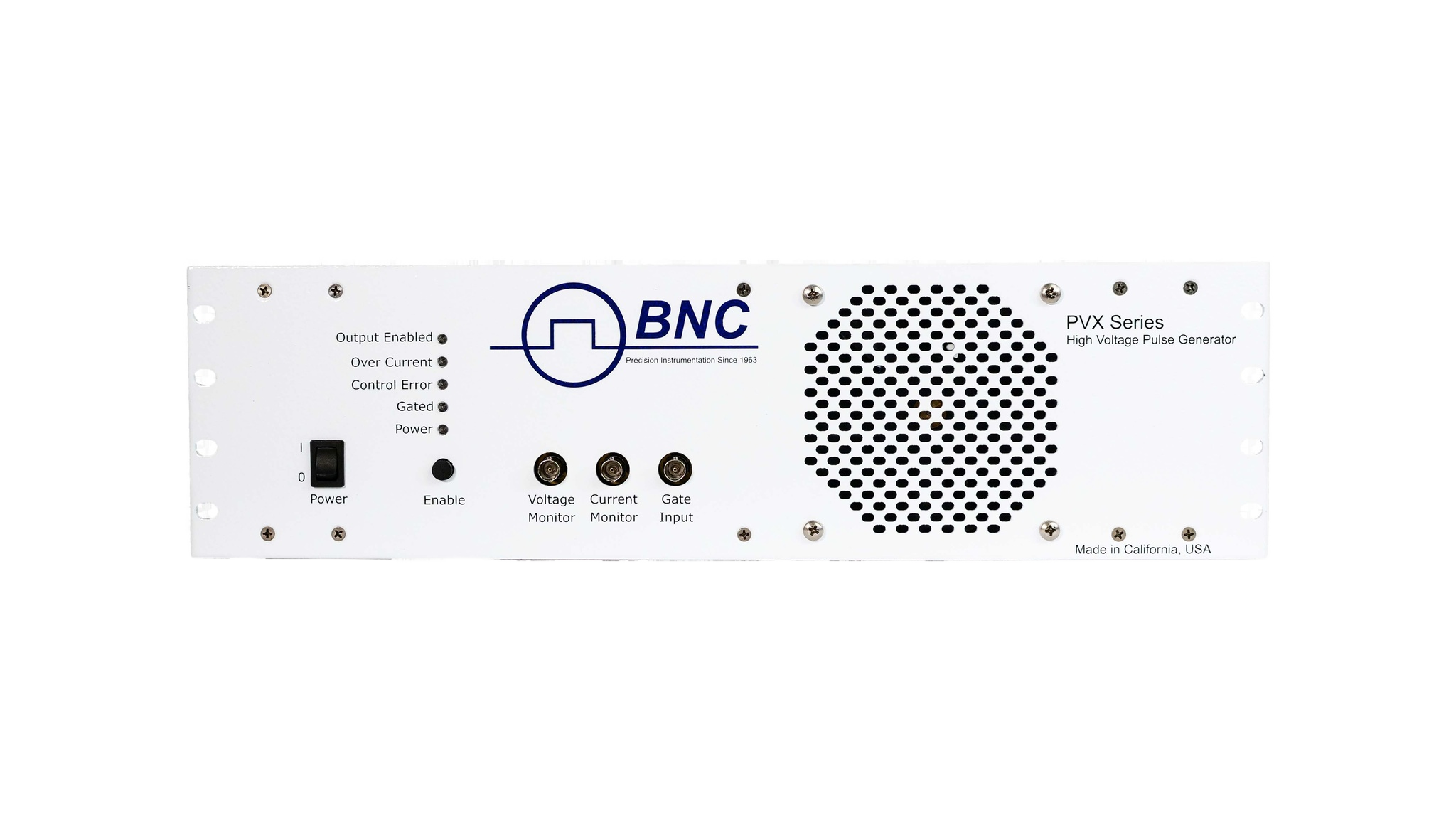
The physics on this page narrows the field, but the last step is matching it to your real capacitance, voltage, edge, and duty cycle. That is where a worked error budget against a real datasheet replaces the scaling laws. The DEI Pulsers line, including the PVX-4000, the PVX-2506, and the PVM-1001, spans a range of these tradeoffs, and the right choice depends on which term in I = C times dV/dt and P ~ C V^2 f is the one that binds.
For help choosing, contact a BNC applications engineer at info@berkeleynucleonics.com or 800-234-7858.