1Overview
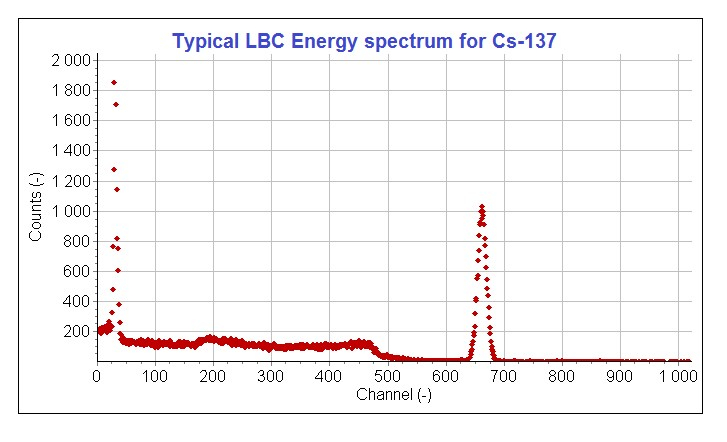
LBC (Lanthanum BromoChloride, LaBr2.85Cl0.15:Ce) is a high-resolution scintillation material closely related to LaBr3:Ce. Its key distinctions are straightforward: energy resolution around 3 % FWHM at 662 keV is standard, and the crystal is mechanically somewhat stronger than pure lanthanum bromide. The addition of chloride modifies the lattice slightly, improving ruggedness without a significant penalty to scintillation performance.
Like LaBr3:Ce, LBC contains lanthanum-138 and therefore exhibits a low-level intrinsic background. This differs from CeBr3, which is essentially background-free. For applications where that background is not a concern, LBC offers a competitive combination of light yield, resolution, and durability. It is hygroscopic and requires hermetic encapsulation.
When to choose LBC
- High-resolution gamma spectroscopy is the primary need and CeBr3's lower background is not required.
- A mechanically more robust crystal than LaBr3:Ce is preferred for field or semi-portable instruments.
- Resolution superior to NaI(Tl) is needed across a wide energy range, from low-energy X-rays through multi-MeV gammas.
- High photon count rate environments where good light yield (140× vs. NaI) helps maintain throughput.
2Specifications
| Parameter | Value | Notes |
|---|---|---|
| Chemical formula | LaBr2.85Cl0.15:Ce | Ce-doped lanthanum bromo-chloride |
| Density | 4.90 g/cm³ | |
| Maximum emission | 380 nm | Near-UV; compatible with standard bialkali PMT |
| Decay time (primary component) | 35 ns | Typical; single dominant decay component |
| Refractive index | 1.90 | At emission wavelength |
| Light yield (vs. NaI(Tl) = 100) | 140 | Photoelectron yield, bialkali PMT |
| Hygroscopic | Yes | Hermetic housing required |
| Energy resolution @ 662 keV | 3 % FWHM | Typical; measured with 137Cs |
| Intrinsic background | Yes (La-138) | Low-level; same as LaBr3:Ce |
| Maximum dimensions | verify | Contact BNC for largest available boules |
3Energy Resolution & Performance
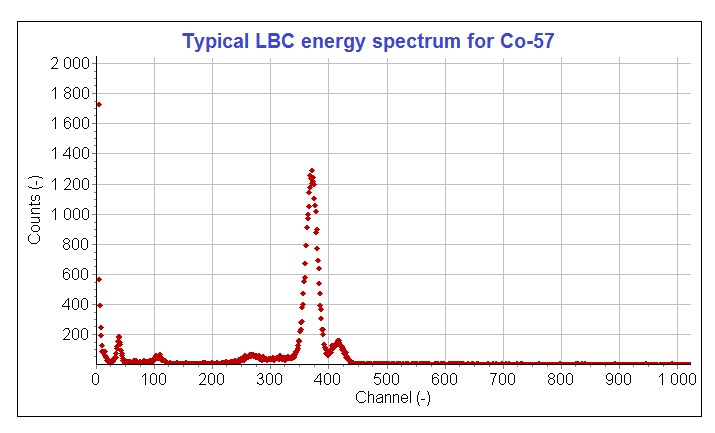
The table below compares typical energy resolution (% FWHM) for LBC against CeBr3 and NaI(Tl) at six representative gamma energies. LBC leads at every measured point. The advantage is most pronounced at lower energies, where LBC's high light yield provides the greatest statistical benefit.
| Energy (keV) / Source | LBC | CeBr3 | NaI(Tl) |
|---|---|---|---|
| 30 keV (129I) | 15 % | 22 % | 16 % |
| 59.5 keV (241Am) | 10 % | 15 % | 12 % |
| 122 keV (57Co) | 6.4 % | 10 % | 9 % |
| 356 keV (133Ba) | 4 % | 5 % | 8 % |
| 662 keV (137Cs) | 3 % | 4 % | 7 % |
| 1332 keV (60Co) | 2.5 % | 3 % | 5.5 % |
Values are typical; individual detector performance varies with crystal size, surface finish, coupling, and readout. All values are % FWHM. LBC figures are highlighted where LBC leads the comparison.
4Typical Applications
- High-resolution gamma spectroscopy: isotope identification, nuclear measurements requiring better resolution than NaI(Tl).
- Radiation isotope identification devices (RIIDs): portable and handheld instruments where sub-3 % resolution aids nuclide separation.
- Homeland security and border monitoring: rapid identification of special nuclear materials and industrial isotopes.
- Nuclear medicine and physics research: detector arrays for coincidence measurements, Compton cameras.
- Environmental and safeguards monitoring: field measurements requiring resolution well beyond NaI(Tl) without cryogenic cooling.
- Industrial and geophysical logging: where high count rates and broad energy range are needed in a moderate-footprint detector.
- Defense and treaty verification: in-field assay of fissile materials and activation products.
5Available Configurations
Berkeley Nucleonics supplies LBC scintillators as bare crystals, coupled assemblies, or complete detector modules. Because LBC is hygroscopic, every configuration includes a hermetically sealed housing. Standard and custom geometries are available; contact BNC for maximum boule dimensions and lead times.
Readout options
| Readout | Notes |
|---|---|
| PMT (photomultiplier tube) | Standard bialkali PMT; well-matched to 380-nm emission; requires HV supply |
| SiPM (silicon photomultiplier) | Compact, low-voltage operation; growing choice for portable instruments (verify availability) |
Housing and window options
Hermetic aluminum or stainless steel housing. Window material (quartz or borosilicate glass) selected for transmission at 380 nm. Custom reflector liners available. Integrated voltage-divider assemblies and preamplifier options: verify with BNC applications engineering.
Crystal geometries
Cylinders and rectangular parallelepipeds are standard forms. Phoswich configurations (LBC + another scintillator layer) are available for combined particle discrimination. Maximum dimensions: verify with BNC for current boule availability.
6Request a Quote
Talk to a BNC applications engineer
LBC detector configurations are built to order. Specify crystal size, readout type, housing, and quantity to receive a formal quote. Our team can advise on coupling, HV selection, and electronics to complete your system.
Email: info@berkeleynucleonics.com
Phone: 800-234-7858