
1Overview
NaI(Tl) is the benchmark scintillator against which all other inorganic materials are measured. Its photoelectron yield is defined as 100 (relative to a bialkali PMT), and no commercially mature material at comparable cost comes close to that figure for general gamma-ray detection. The emission peak at 415 nm falls squarely within the sensitivity window of both bialkali photomultiplier tubes and silicon photomultipliers, which makes NaI(Tl) compatible with either readout technology without spectral-matching compromises.
The principal limitation is hygroscopicity: NaI(Tl) absorbs moisture and degrades if exposed to air. Berkeley Nucleonics addresses this by supplying all NaI(Tl) crystals in hermetically sealed, machined aluminum housings with optical-quality entrance windows. This approach is standard practice, and the resulting assemblies are stable for extended field or laboratory use.
Choose NaI(Tl) when light yield and cost efficiency are the primary constraints and when energy resolution in the 6-8% range at 662 keV is sufficient. For applications that require better than 5% resolution, consider CeBr3, LaBr3(Ce), or SrI2(Eu). For gamma-neutron discrimination, CLYC or CLLBC assemblies are more appropriate.
2Specifications
Crystal properties are taken from the Scionix Physical Properties reference (revision 3, 21-01-2025). Assembly specifications for the 51B51/SIP-E3-X SiPM detector module are drawn from the BNC-published datasheet (rev. 0, 29-10-2018).
Crystal Physical Properties
| Parameter | Value | Notes |
|---|---|---|
| Material | NaI(Tl) (thallium-doped sodium iodide) | |
| Density | 3.67 g/cm³ | |
| Emission maximum | 415 nm | Near-UV / visible; matches bialkali PMT and SiPM |
| Decay constant | 0.23 μs (230 ns) | Effective average for gamma-rays |
| Refractive index | 1.85 | At emission maximum |
| Relative photoelectron yield | 100 | Reference baseline; bialkali PMT, room temperature, gamma-rays |
| Hygroscopic | Yes | Must be sealed; all BNC assemblies are hermetically enclosed |
| Energy resolution at 662 keV | <7.5% FWHM | From assembled SiPM detector; crystal-only value verify |
| Typical resolution range | 6.5-7% FWHM @ 662 keV | PMT-coupled, standard 2″×2″ assembly |
Important Properties
| Property | Detail |
|---|---|
| Key strength | Very high light output; the workhorse for general scintillation counting |
| Temperature behavior | Light yield and resolution are temperature dependent; usable across typical ambient range; verify for extreme temperature applications |
| Crystal growth | Established Bridgman-Stockbarger process; large volumes available commercially |
| Optical coupling | Silicone grease or optical epoxy to PMT or SiPM window; refractive index 1.85 requires careful coupling design |
| Maximum crystal dimensions | verify (large-volume crystals available; contact BNC for size requirements) |
3Energy Resolution and Performance
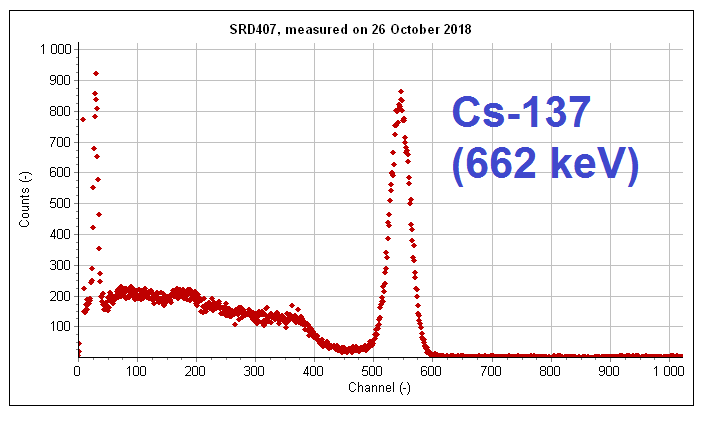
NaI(Tl) has served as the universal comparison standard for energy resolution since the 1950s. The 6.5-7% FWHM figure at 662 keV (Cs-137) is well-established and reproducible across manufacturers and assembly formats. Resolution degrades at lower energies and improves modestly at higher energies, following the expected statistical (Poisson) scaling with light yield.
Resolution in Context
| Material | Approx. Resolution @ 662 keV | Relative Light Yield |
|---|---|---|
| NaI(Tl) | 6.5-7% FWHM | 100 (reference) |
| CsI(Tl) | ~8-9% FWHM (verify) | 45 |
| CeBr3 | ~4% FWHM | 130 |
| LaBr3(Ce) | ~2.7% FWHM | 150 |
| SrI2(Eu) | ~2.7% FWHM (verify) | 120-140 |
Resolution figures for comparison materials are drawn from the ScintIQ material master table. Verify against individual datasheets before specifying.
Assembled SiPM Detector Performance (51B51/SIP-E3-X)
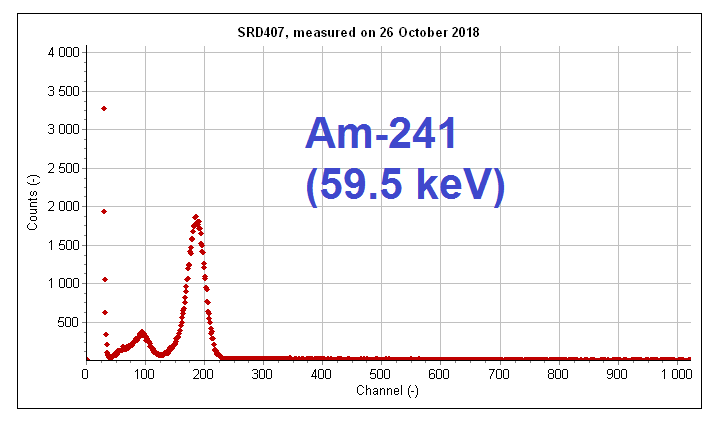
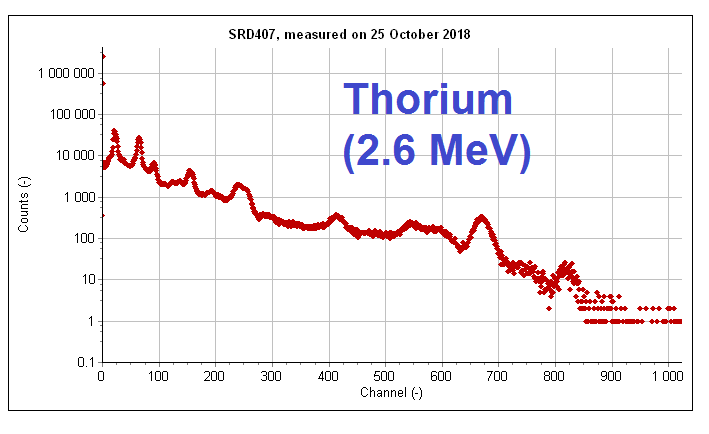
The following parameters apply to the assembled 2″×2″ NaI(Tl) SiPM detector module (model 51B51/SIP-E3-X). This unit pairs a 51 mm diameter by 51 mm tall NaI(Tl) crystal with an SiPM array (J-60035-4P), a temperature-compensated bias generator, and an integrated preamplifier in a compact aluminum housing.
| Parameter | Value |
|---|---|
| Pulse rise time (0-100%) | 560 ns |
| Pulse fall time (1/e) | 1.4 μs |
| Gain | Approx. 450 mV/MeV |
| Energy resolution | <7.5% FWHM @ 662 keV |
| Noise level | <15 keV |
| Warm-up time | 30 seconds |
4Typical Applications
NaI(Tl) covers the broadest application range of any single scintillation material. Its combination of high light yield and mature supply chain makes it suitable wherever moderate energy resolution and large active volume are valued over compactness or spectral selectivity.
- General scintillation counting: survey instruments, portable radiation monitors, contamination surveys
- Health physics and radiation protection: dose-rate meters, personnel monitoring, area surveys
- Environmental monitoring: in situ gamma spectroscopy, soil contamination mapping, airborne activity measurement
- Nuclear security and border monitoring: portal monitors, baggage and cargo screening, NORM/TENORM surveys
- Medical physics: gamma camera heads, thyroid uptake probes, well counters
- Geophysical and borehole logging: gamma-ray logging tools, formation evaluation (verify high-temperature ratings for borehole use)
- Industrial gauging: level measurement, density gauging, process monitoring
- Laboratory spectroscopy: activation analysis, isotope identification in research settings where LaBr3/CeBr3 cost is not justified
5Available Configurations
Berkeley Nucleonics supplies NaI(Tl) in crystal-only and fully assembled detector formats. Standard assembly sizes follow common detector conventions; custom dimensions are available. All crystals are grown to order and sealed in aluminum housings with specified optical windows before shipment.
Crystal Sizes
| Format | Typical Dimensions | Notes |
|---|---|---|
| Cylindrical (standard) | 25 mm dia. × 25 mm (1″×1″), 51 mm × 51 mm (2″×2″), and others | verify exact size list; contact BNC for custom |
| Rectangular / well-type | verify | Available for well counters and coincidence geometries |
| Large-volume arrays | verify | Multi-crystal array assemblies for high-efficiency applications |
Readout Options
| Readout Type | Characteristics |
|---|---|
| Photomultiplier tube (PMT) | Traditional, high-gain, broad voltage range; suitable for standard laboratory and field instruments |
| Silicon photomultiplier (SiPM) | Low-voltage operation (5-16 V supply), compact, magnetic-field tolerant; temperature-compensated bias integrated in BNC modules |
| Photodiode | verify availability for NaI(Tl); typically used with CsI(Tl) due to emission wavelength match |
Housing and Connector Options
| Parameter | Standard / Typical |
|---|---|
| Housing material | Aluminum (standard); stainless steel verify |
| Entrance window | Aluminum or beryllium window (verify per assembly) |
| Connector (SiPM module) | LEMO ERA0S302 (Pin 1 = +5-16 V supply; Pin 2 = signal) |
| Cable (SiPM module) | 3 m LIYCY with flying leads (Brown = power) |
| Power supply (SiPM module) | +5 to +16 V DC, 3 mA |
62″×2″ SiPM Detector Module
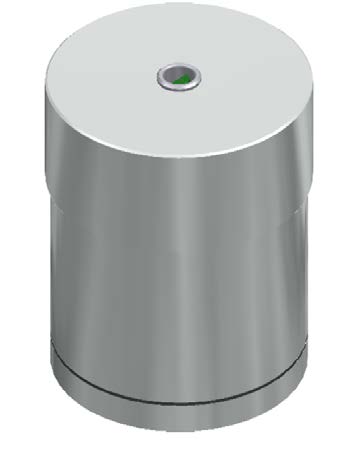
The 51B51/SIP-E3-X is Berkeley Nucleonics' compact NaI(Tl) detector assembly designed for low-voltage SiPM readout. It integrates a 51 mm diameter by 51 mm tall NaI(Tl) crystal, an SiPM array (J-60035-4P), a temperature-compensated bias generator, and a preamplifier into a single aluminum housing. The resulting package draws only 3 mA from a 5-16 V supply and requires no external high voltage.
| Parameter | Value |
|---|---|
| Scintillation material | NaI(Tl), Ø51 × 51 mm |
| Crystal readout | SiPM, Array J-60035-4P |
| Drawing number | V-1593 |
| Housing material | Aluminum |
| Outer diameter | 59.2 mm |
| Height | 75.3 mm |
| Power supply | +5 to +16 V DC (3 mA) |
| Warm-up time | 30 seconds |
| Connector | LEMO ERA0S302 (Pin 1 = +5-16 V; Pin 2 = signal) |
| Cable | 3 m LIYCY with flying leads (Brown = power supply +5-16 V) |
| Pulse rise time (0-100%) | 560 ns |
| Pulse fall time (1/e) | 1.4 μs |
| Gain | Approx. 450 mV/MeV |
| Energy resolution | <7.5% FWHM @ 662 keV |
| Noise level | <15 keV |
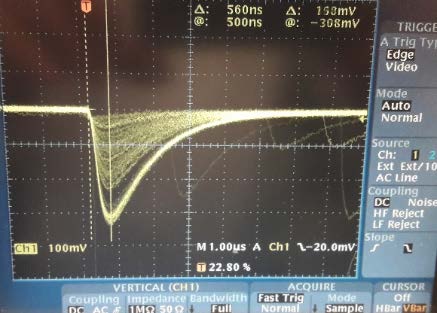
The SiPM readout eliminates the high-voltage power supply requirement typical of PMT-based assemblies. This simplifies system integration and makes the module well-suited for battery-powered portable instruments and compact multi-detector arrays. The temperature-compensated bias circuit maintains stable gain over typical ambient temperature ranges without external correction.
For a dedicated datasheet covering the full 51B51/SIP-E3-X detector module including ordering options and interface guidance, see the NaI(Tl) 2″×2″ SiPM Detector Module data sheet.
7Request a Quote
NaI(Tl) assemblies are available in standard and custom configurations. Standard 2″×2″ SiPM modules ship from qualified inventory. Custom crystal dimensions, housing designs, and readout integrations are quoted individually. Contact the ScintIQ applications team to discuss your geometry, activity, energy range, and readout requirements.
Talk to a ScintIQ Engineer
Whether you need a standard 2″×2″ assembly or a multi-crystal array in a custom housing, the BNC applications team can specify the right configuration for your measurement environment.
Compare Materials
NaI(Tl) is one of more than 20 scintillation materials available through the ScintIQ line. Use the interactive material comparison tool to filter by resolution, speed, density, and hygroscopicity requirements.