1Overview
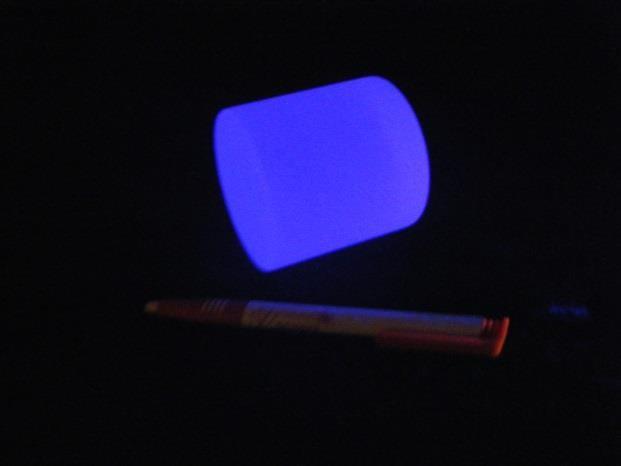
CeBr3 (cerium bromide) scintillation crystals are a compelling upgrade path from NaI(Tl) for applications that demand tight energy resolution and a clean spectral background. The material is self-activated by the Ce³⁺ ion, eliminating the need for a dopant and producing a fast 18–25 ns decay with emission centered at 370 nm, well within the peak quantum-efficiency band of most bialkali photomultiplier tubes and silicon photomultipliers.
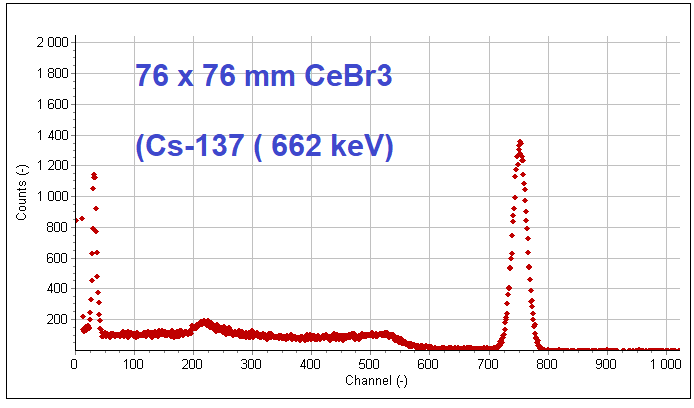
The key performance advantage is resolution. Above 200 keV, CeBr3 consistently outperforms NaI(Tl): 4% FWHM at the 662 keV Cs-137 line versus roughly 7% for NaI(Tl), and 3% FWHM at the 1332 keV Co-60 line versus 5.5% for NaI(Tl). The improvement is meaningful in practice: closely spaced photopeaks that are unresolvable in NaI(Tl) become distinct in CeBr3.
A second, equally important advantage is background purity. Lanthanum halide scintillators (LaBr3, LBC) contain naturally occurring La-138, which generates a continuous intrinsic gamma background in the 1.4–2.2 MeV range. CeBr3 contains no lanthanum and therefore carries no La-138 signature. Measurements below the 2.6 MeV Tl-208 line proceed without a competing internal source. For environmental monitoring, treaty verification, and low-activity source characterization, this distinction is significant.
2Specifications
| Parameter | Value |
|---|---|
| Material | CeBr3 (Cerium Bromide) |
| Density | 5.23 g/cm³ |
| Maximum emission wavelength | 370 nm |
| Refractive index | 2.09 (at 380 nm) |
| Photon yield | Approx. 60,000 photons/MeV |
| Relative light yield (vs. NaI(Tl) = 100) | ~130 |
| Decay time (typical) | 18–25 ns (size dependent) |
| Hygroscopic | Yes (requires hermetic housing) |
| Typical energy resolution @ 662 keV | 4% FWHM |
| Intrinsic background (Ac-227 complex) | 0.002 c/s/cm³ (typical, inside 100 mm Pb shield) |
| Maximum crystal dimensions | 127 mm diameter, 152 mm high |
| Lanthanum content (La-138 background) | None |
3Energy Resolution Performance
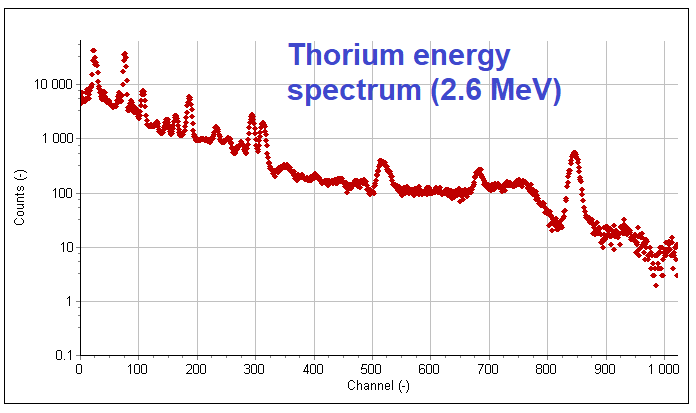
The table below compares CeBr3 and NaI(Tl) energy resolution across the range from low-energy X-rays through the 2.6 MeV Th-228 line. CeBr3 shows comparable or slightly inferior resolution at very low energies (30–60 keV), where NaI(Tl)'s high light yield provides an advantage, but surpasses NaI(Tl) from 122 keV upward. The improvement widens at higher energies.
| Energy (keV) / Isotope | CeBr3 Resolution (% FWHM) | NaI(Tl) Resolution (% FWHM) |
|---|---|---|
| 30 (I-129) | 20% | 18% |
| 59.5 (Am-241) | 13% | 11% |
| 122 (Co-57) | 8% | 8.5% |
| 662 (Cs-137) | 4% | 7% |
| 1332 (Co-60) | 3% | 5.5% |
| 2600 (Th-228) | 2.5% | 4.0% |
4Intrinsic Background
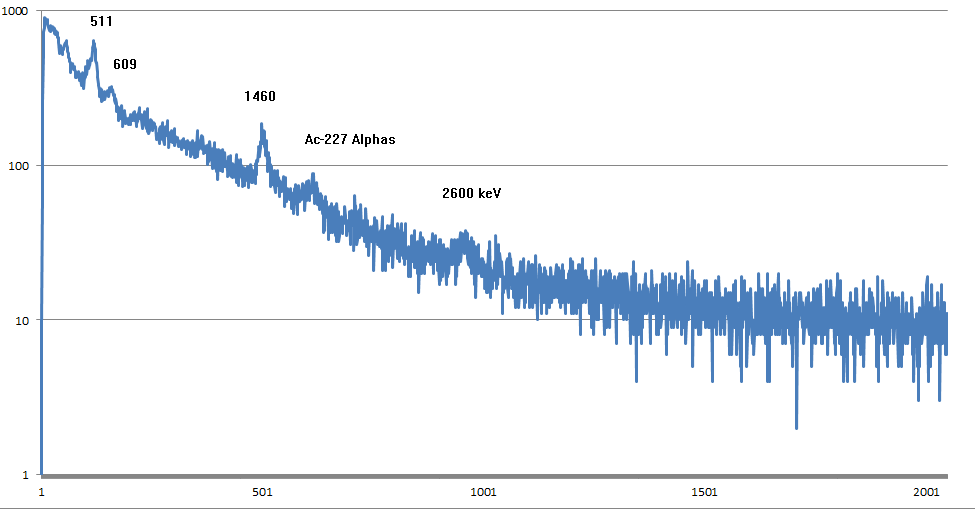
CeBr3 exhibits a very small intrinsic background arising from the presence of Ac-227 (actinium). This produces a cluster of peaks between 1500 and 2200 keV with a typical count rate of 0.002 c/s/cm³ (measured inside a 100 mm lead shield). While present, this background is substantially lower in intensity and narrower in spectral coverage than the La-138 continuum found in lanthanum halide scintillators.
Because CeBr3 contains no lanthanum, there is no La-138 contribution. La-138 (natural abundance 0.089%) is a beta/gamma emitter with a half-life of 1.05×10¹¹ years; in LaBr3 and LBC crystals it produces a broad internal background from roughly 0 to 2.2 MeV that can obscure low-activity environmental sources. CeBr3 avoids this entirely. The Ac-227 background, by contrast, is confined to a narrower energy window and is well-characterized in the literature.
Key references for the CeBr3 background characterization:
- Quarati et al., NIM A 729 (2013) pp. 596–604
- L.M. Fraile et al., NIM A 701 (2013) pp. 235–242
- U. Ackermann et al., NIM A 786 (2015) pp. 5–11
5Typical Applications
CeBr3 is selected when NaI(Tl) resolution is insufficient and LaBr3 background contamination is a concern. Typical deployment contexts include:
- High-resolution gamma spectrometry: Isotope identification in nuclear security, safeguards, and treaty-verification programs where clean spectral baselines are required above 200 keV.
- Environmental monitoring and low-activity measurements: Soil, water, and air sampling programs where the La-138 background from lanthanum halides would mask naturally occurring radionuclides.
- Medical radioisotope quality control: Assaying short-lived cyclotron-produced isotopes where fast decay and good resolution are both needed.
- Nuclear decommissioning and waste characterization: Surveys of contaminated material where complex multi-isotope spectra must be accurately deconvolved.
- Portal monitors and RIID: Field-deployable threat detection systems requiring high sensitivity and isotope discrimination in a compact detector.
- Academic and national laboratory research: Fundamental nuclear physics experiments requiring both fast timing (18–25 ns decay) and sub-5% resolution at mid-energy.
- Geophysical logging: Down-hole gamma logging where improved resolution aids lithological discrimination, particularly in formations with complex gamma signatures.
6Available Configurations
CeBr3 detectors are configured to order. Crystal dimensions, housing type, and readout technology are specified at the time of quotation. The parameters below describe the standard configuration envelope; contact Berkeley Nucleonics to confirm specific dimensions and assembly options for your application.
| Configuration Parameter | Option / Range | Notes |
|---|---|---|
| Crystal material | CeBr3 | Self-activated; no extrinsic dopant |
| Maximum crystal size | 127 mm diameter × 152 mm high | Smaller dimensions available; confirm via quote |
| Crystal housing | Hermetically sealed aluminum (standard); other materials verify | Required due to hygroscopicity |
| Optical window | Glass or quartz (verify) | Window material matched to readout spectral response |
| Readout options | PMT (bialkali, standard); SiPM array (verify) | 370 nm emission suits standard bialkali photocathode |
| Voltage divider / preamp | Matched to selected PMT (verify) | Specify HV polarity and signal output type |
| MCA / readout electronics | Compatible with ScintIQ TOPAZ-HR, bMCA, bPAD (see electronics datasheets) | verify specific interface for SiPM configurations |
| Custom configurations | Non-standard geometries, phoswich, arrays | Contact info@berkeleynucleonics.com |
Request a Quote or Discuss Your Application
CeBr3 detectors are configured to specification. Berkeley Nucleonics engineers can assist with crystal sizing, readout selection, housing design, and integration with ScintIQ electronics. Contact us to discuss your requirements.
Email: info@berkeleynucleonics.com
Phone: 800-234-7858