1Overview
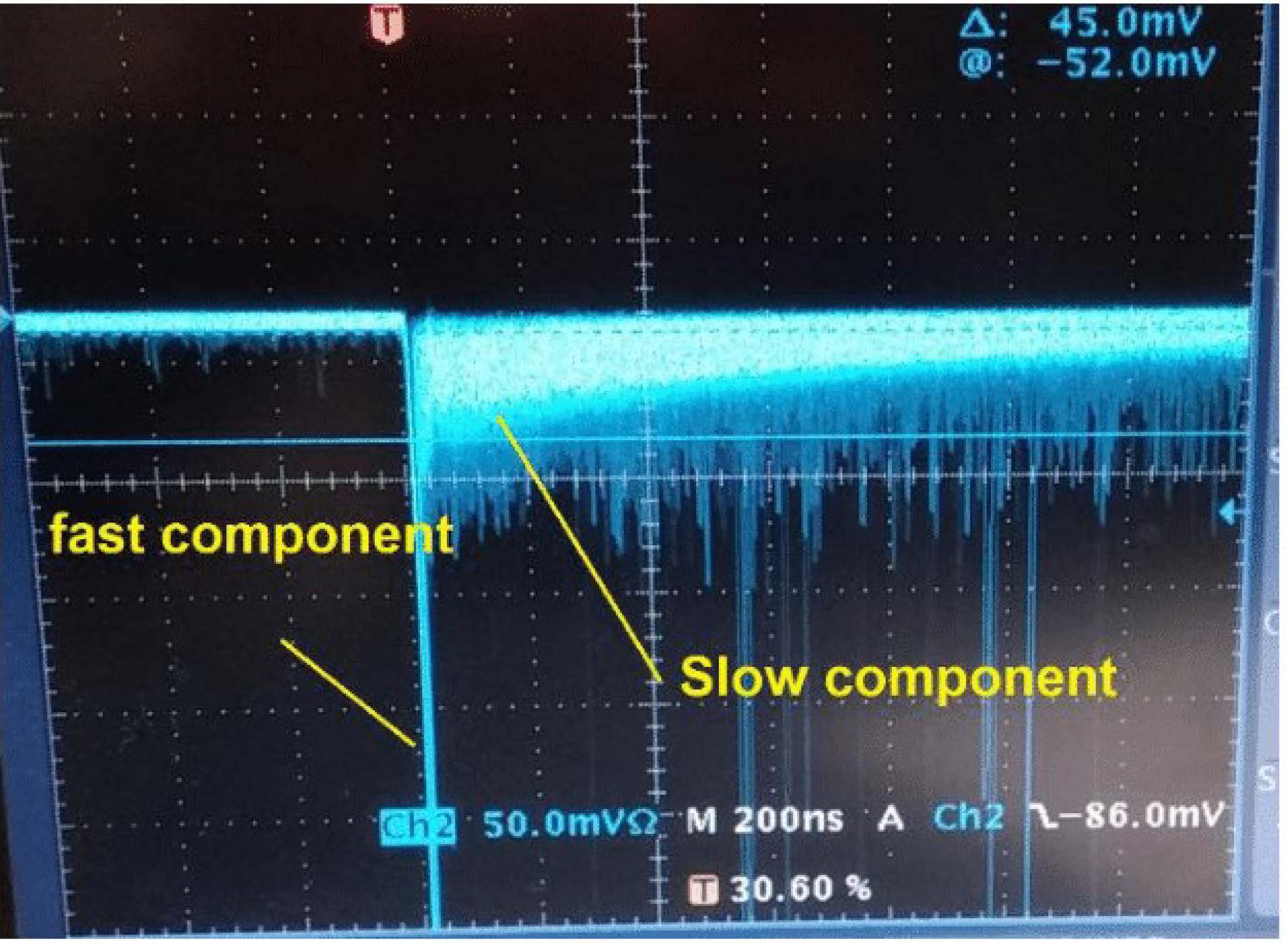
BaF2 is the workhorse of fast-timing nuclear physics. No common inorganic scintillator is faster. The crystal emits two distinct scintillation components: a fast UV band at 220 nm with a decay constant of just 800 ps, and a slower component at 310 nm with a decay constant of approximately 630 ns. The fast component is what sets BaF2 apart. It enables coincidence timing resolutions of 150 ps (FWHM) at 1 MeV per detector, a figure that competes with specialized organic scintillators while retaining the high effective atomic number and stopping power of an inorganic crystal.
The crystal is non-hygroscopic, eliminating the hermetic sealing complexity required for NaI(Tl), LaBr3, and similar materials. It is mechanically stable and straightforward to handle. The principal trade-off is light yield: the fast component contributes roughly 5% of the output relative to NaI(Tl), and the slow component brings the total to about 16%. For spectroscopic resolution, this is a limitation. For timing applications, the photon statistics of the fast component are more than adequate, and the low background count rate of BaF2 (no internal radioactive isotopes) is an asset in coincidence experiments.
Choose BaF2 when the requirement is sub-nanosecond timing, when spectroscopic energy resolution is secondary, and when a non-hygroscopic crystal is preferred. For applications demanding both fast timing and good energy resolution, consider pairing BaF2 with a ScintIQ LaBr3(Ce) or CeBr3 stop detector.
2Specifications
| Parameter | Value | Notes |
|---|---|---|
| Crystal composition | BaF2 | Undoped barium fluoride |
| Density | 4.88 g/cm³ | |
| Emission maximum (fast) | 220 nm | UV; requires quartz-window PMT |
| Emission maximum (slow) | 310 nm | Accessible with standard borosilicate-window PMT |
| Decay time (fast component) | 800 ps | Sub-nanosecond UV emission |
| Decay time (slow component) | ~630 ns | Verify exact value against production lot |
| Refractive index (220 nm) | 1.54 | |
| Refractive index (310 nm) | 1.50 | |
| Conversion efficiency (fast, rel. to NaI(Tl)) | 5% | Photoelectron yield, bialkali PMT basis |
| Conversion efficiency (slow, rel. to NaI(Tl)) | 16% | Combined fast + slow |
| Maximum diameter | 150 mm | Larger sizes: verify with factory |
| Hygroscopic | No | No hermetic sealing required |
| Pulse-shape discrimination | Possible | Fast/slow ratio separates neutrons from gammas |
| Typical timing resolution | 150 ps FWHM at 1 MeV | Per detector; coincidence pair halves this further (verify) |
| Cleavage planes | Verify | Crystal handling guidance available on request |
| Operating temperature range | Verify |
Readout note: Detection of the fast 220 nm component requires a PMT with a quartz (fused silica) entrance window. Standard borosilicate glass windows absorb below approximately 280 nm and will suppress the fast component. ScintIQ BaF2 detectors include a quartz-window PMT by default. If your application uses only the slow 310 nm component (where full timing performance is not required), a borosilicate-window tube is acceptable.
3Timing Performance
The 800 ps decay constant of BaF2's fast component is unique among inorganic oxide or halide scintillators. To put this in context: NaI(Tl) decays in 230 ns; CeBr3 in roughly 18 to 25 ns; BaF2 in under 1 ns. This is a difference of more than two orders of magnitude relative to NaI(Tl), and a factor of 20 to 30 even versus the fast lanthanide halides.
The consequence for coincidence timing is direct. A single ScintIQ BaF2 detector with a quartz-window PMT and a constant-fraction discriminator (CFD) will deliver approximately 150 ps FWHM timing resolution at 1 MeV. Coincidence timing resolution between two such detectors (the figure of merit in positron lifetime spectroscopy) follows from the single-detector value; exact coincidence resolution depends on the electronics chain, PMT transit-time spread, and CFD settings.
Component separation for PSD and coincidence gating
The fast and slow components of BaF2 are well separated in time, with a ratio of approximately 800 ps to 630 ns (a factor of roughly 800). This separation is large enough that a simple timing gate can isolate the fast component for coincidence purposes, while integrating only the slow component in a wider gate. This is the basis for pulse-shape-based neutron/gamma discrimination in BaF2 detectors (see Section 4).
4Pulse-Shape Discrimination
BaF2 supports neutron/gamma pulse-shape discrimination (PSD). The mechanism relies on the ratio of light emitted in the fast UV component versus the slow component. Neutron-induced nuclear recoils and gamma-induced electron recoils produce different fast-to-slow ratios, allowing digital or analog charge-comparison circuits to separate the two populations. The discrimination is described in the source specification as "well possible."
BaF2-based PSD is complementary to the approach used in CLYC or CLLBC (which exploit Ce3+ and core-valence luminescence components). BaF2 PSD is suited to high-rate physics environments where the speed of the detector outweighs the PSD figure of merit compared with dedicated dual-mode crystals. For applications where neutron/gamma separation is the primary specification, contact Berkeley Nucleonics to discuss CLYC or CLLBC alternatives.
5Typical Applications
- Positron lifetime spectroscopy (PALS): BaF2 is the standard material for start and stop detectors in positron annihilation lifetime systems. The 511 keV annihilation photons produce fast, well-defined pulses at 220 nm, enabling ps-level lifetime resolution in materials science, defect studies, and polymer physics.
- Fast coincidence timing: Any coincidence experiment requiring sub-nanosecond time resolution. Includes nuclear decay scheme measurements, time-of-flight (TOF) systems, and prompt gamma timing.
- High-energy physics (HEP) calorimetry (legacy and specialized): BaF2 was used in major HEP detectors for its combination of fast timing and moderate stopping power. Custom large-format crystals are available for ongoing or new experiments.
- Medical physics timing: Time-of-flight PET (TOF-PET) research applications, particularly where very fast timing is being studied at the crystal level. Production TOF-PET systems typically use LYSO for its superior light yield, but BaF2 is relevant for frontier timing R&D.
- Nuclear structure and reaction physics: Fast-timing arrays for measuring nuclear level lifetimes in the picosecond-to-nanosecond range.
- Neutron/gamma discrimination: Applications requiring PSD in fast, high-rate environments where the speed of BaF2 is more important than PSD figure of merit.
- Synchronization and trigger detectors: As a fast start trigger in multi-detector arrays alongside slower, higher-resolution materials (e.g., LaBr3, HPGe).
6Available Configurations
ScintIQ BaF2 detectors are built to order. Standard and custom configurations are available across a range of crystal sizes, housing types, and readout options. The table below describes the general configuration options. Contact Berkeley Nucleonics for specific sizes, custom geometries, or system-level integration.
| Configuration Element | Standard Options | Notes |
|---|---|---|
| Crystal diameter | Up to 150 mm | Larger sizes: verify with factory |
| Crystal length / geometry | Cylindrical; custom shapes | Verify available stock geometries |
| Readout (standard) | PMT with quartz (fused silica) window | Required for 220 nm fast component |
| Readout (slow component only) | PMT with borosilicate window; SiPM (verify UV response) | For applications not requiring full fast-timing performance |
| Housing | Aluminum alloy; custom housings available | Verify; non-hygroscopic crystal simplifies sealing |
| Reflector / optical coupling | Verify with factory | |
| Preamplifier / HV base | Optional; compatible with ScintIQ TOPAZ, bMCA electronics | Verify compatibility for fast-timing chains |
| Coincidence detector pairs | Matched pairs for PALS applications | Timing matched; contact for pairing criteria |
7Request a Quote
ScintIQ BaF2 detectors are configured to your timing and geometry requirements. To request a quote or discuss your application, reach Berkeley Nucleonics directly.
Contact Berkeley Nucleonics
Email: info@berkeleynucleonics.com
Phone: 800-234-7858
Web: berkeleynucleonics.com/products/custom-scintillation-detectors/
Provide crystal diameter, length, required timing resolution, readout preference, and quantity when requesting a quote. Matched pairs for coincidence systems are available; specify if PALS or coincidence gating is the application.