Capacitor Charging & Pulsed Power
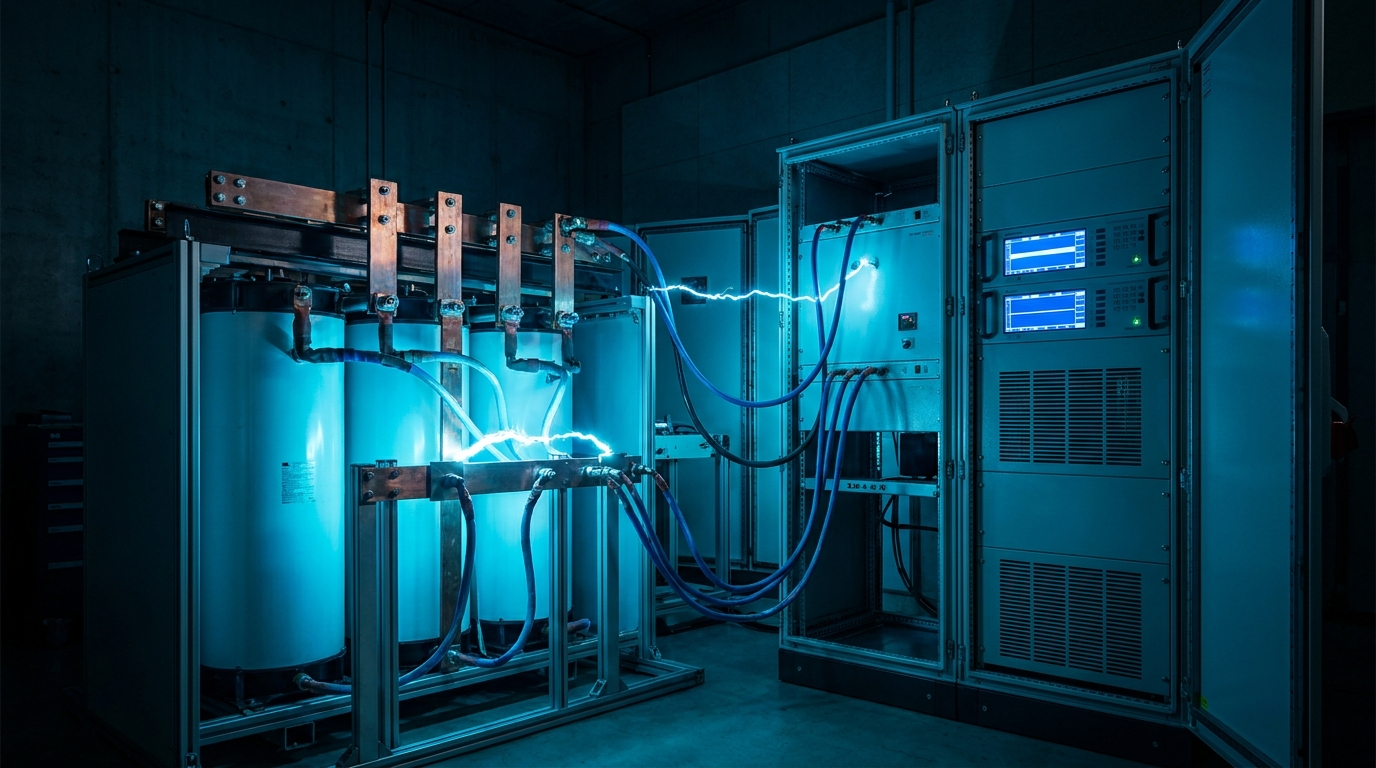
Pulsed-power systems store energy slowly and release it fast. A capacitor or capacitor bank charges over seconds, then dumps its energy into a load in microseconds. The charging supply sits at the front of that chain, and its behavior shapes everything downstream: how quickly the system can cycle, how repeatable each shot is, and how safely the bank handles the inevitable fault.
Charging a capacitor is not the same as driving a resistive load. At the start of a charge the capacitor looks like a short circuit, so the supply slams into its current limit and stays there until the voltage builds. A supply that cannot regulate cleanly through that constant-current phase, or that overshoots as the capacitor approaches its setpoint, makes the shot-to-shot energy unpredictable. Repeatability in pulsed power starts with a charge that lands on the same voltage every time.
The other defining feature of these setups is fault energy. A charged bank holds real stored energy, and a flashover or an unexpected load short has to be caught fast. Without quick detection and the ability to remove the source, a single arc can damage the bank, the switch, or the experiment. The charging supply is the first line of protection.
How the BNC PVP-Series line solves it
The Berkeley Nucleonics PVP-Series is a fully digitally regulated DC high-voltage supply with a microcontroller and FPGA control core, and that fast digital loop is what makes it a good capacitor charger. The regulation responds in under 1 millisecond to within 0.1 percent of nominal, so the supply handles the transition from constant-current charging to constant-voltage hold without overshoot, and it lands repeatably on the target voltage shot after shot.
The retrofittable ramp-control option is built for this work. It sets a defined gradient from 1 V/s up to ten times nominal volts per second, which lets an operator program a controlled rate of rise rather than charging at the bare current limit. A controlled ramp protects the dielectric, makes inrush predictable, and gives a repeatable charge profile that automated pulsed-power sequences depend on.
Arc detection is the safety half of the equation. The option detects and reports a flashover and can shut the output off, removing the source before a fault escalates. Combined with the time-tagged event log, that gives an operator both protection during the run and a record afterward. For throughput, the higher power classes reach up to 3 kW, so a bank charges quickly and the system cycles at a useful repetition rate. On-board Ethernet and RS232 with a SCPI command set let the supply run inside an automated shot sequence, and the wide-range single-phase input with active power-factor correction keeps it running from a standard lab feed.
Which PVP-Series models and options fit
For charging duty the model is chosen by the bank voltage and the charge rate the system needs. Higher power shortens charge time and raises the achievable repetition rate, so the 3 kW class is usually the right starting point where throughput matters.
| Charging profile | Recommended PVP-Series model | Output |
|---|---|---|
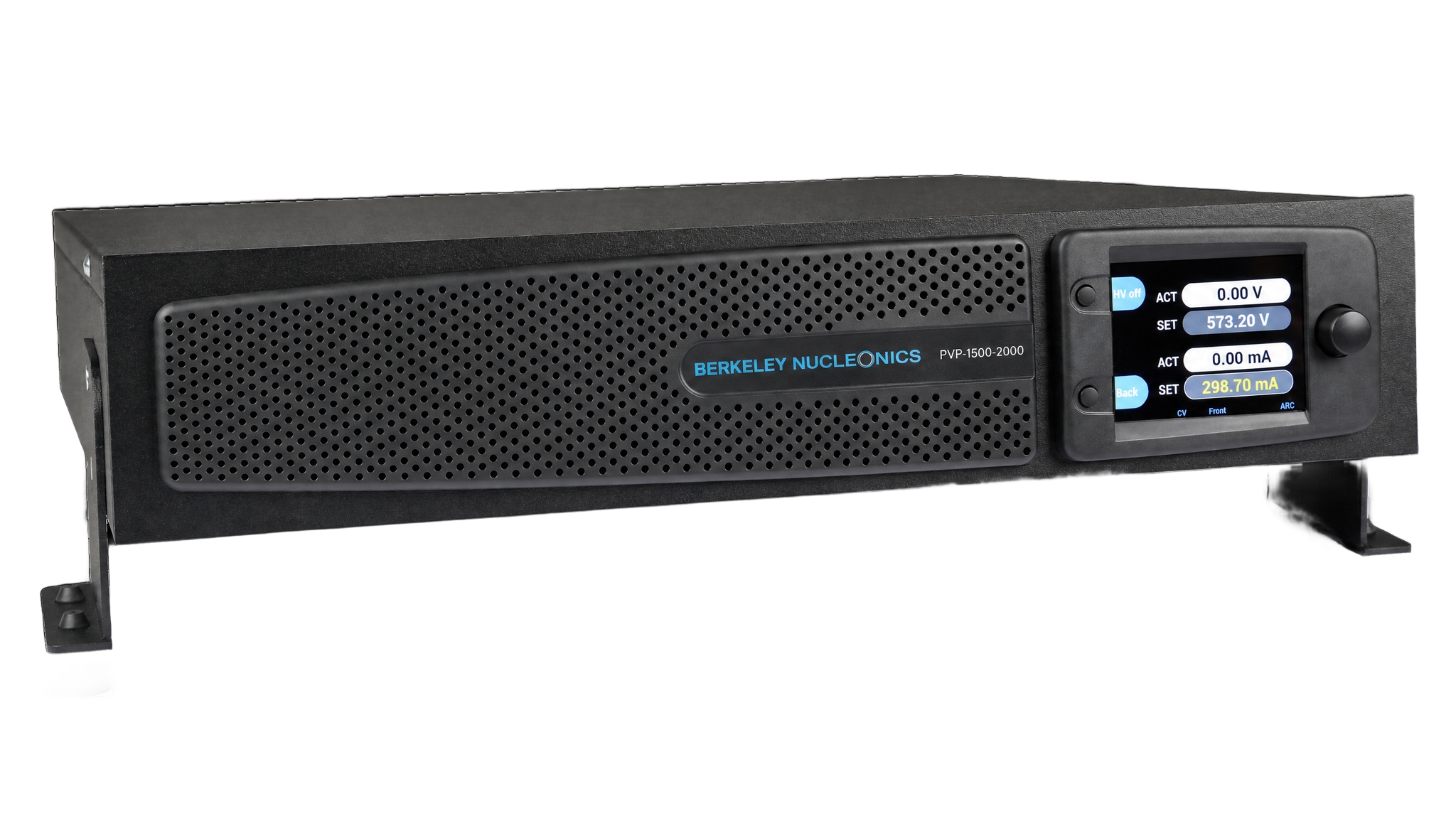
| Low-voltage bank, fast cycle | PVP-1500-2000 | 1.5 kV, 2000 mA, 3 kW |
| Mid-voltage bank, high throughput | PVP-5000-600 | 5 kV, 600 mA, 3 kW |
| High-voltage bank, high throughput | PVP-10000-300 | 10 kV, 300 mA, 3 kW |
| High-voltage bank, standard rate | PVP-10000-200 | 10 kV, 200 mA, 2 kW |
The two options to specify for this application are ramp control and arc detection, both retrofittable so a bench can add them later as a program grows. Polarity follows the part-number suffix, with 1 for positive, 9 for negative, and 5 for reversible, so a reversible 3 kW PVP-5000-600 orders as 00.210.144.5. For most charging work a fixed polarity matching the bank is all that is needed, which keeps the order straightforward.
Recommended configuration
A capable default for capacitor charging is the PVP-10000-300 (order ref 00.210.164.x) fitted with the ramp-control and arc-detection options. At 10 kV and 3 kW it charges a high-voltage bank quickly for a useful repetition rate, the fast sub-millisecond regulation keeps shot-to-shot energy repeatable, the programmable ramp protects the dielectric, and arc detection removes the source on a flashover. Drive it over Ethernet with SCPI so the charge cycle runs inside your pulsed-power sequence and every shot is logged.
Where the bank runs at lower voltage but needs fast cycling, the PVP-1500-2000 (order ref 00.210.114.x) delivers the same 3 kW with the same options at 1.5 kV. Both mount in a standard 19-inch rack at 2U or run on the bench with the integrated adapter, and both ship with a 10 ft high-voltage cable and HV connector. Confirm your bank's working voltage, capacitance, and target charge time with an applications engineer so the power class and ramp rate match the duty cycle.
For a quick question, chat with an engineer at berkeleynucleonics.com.