1Overview
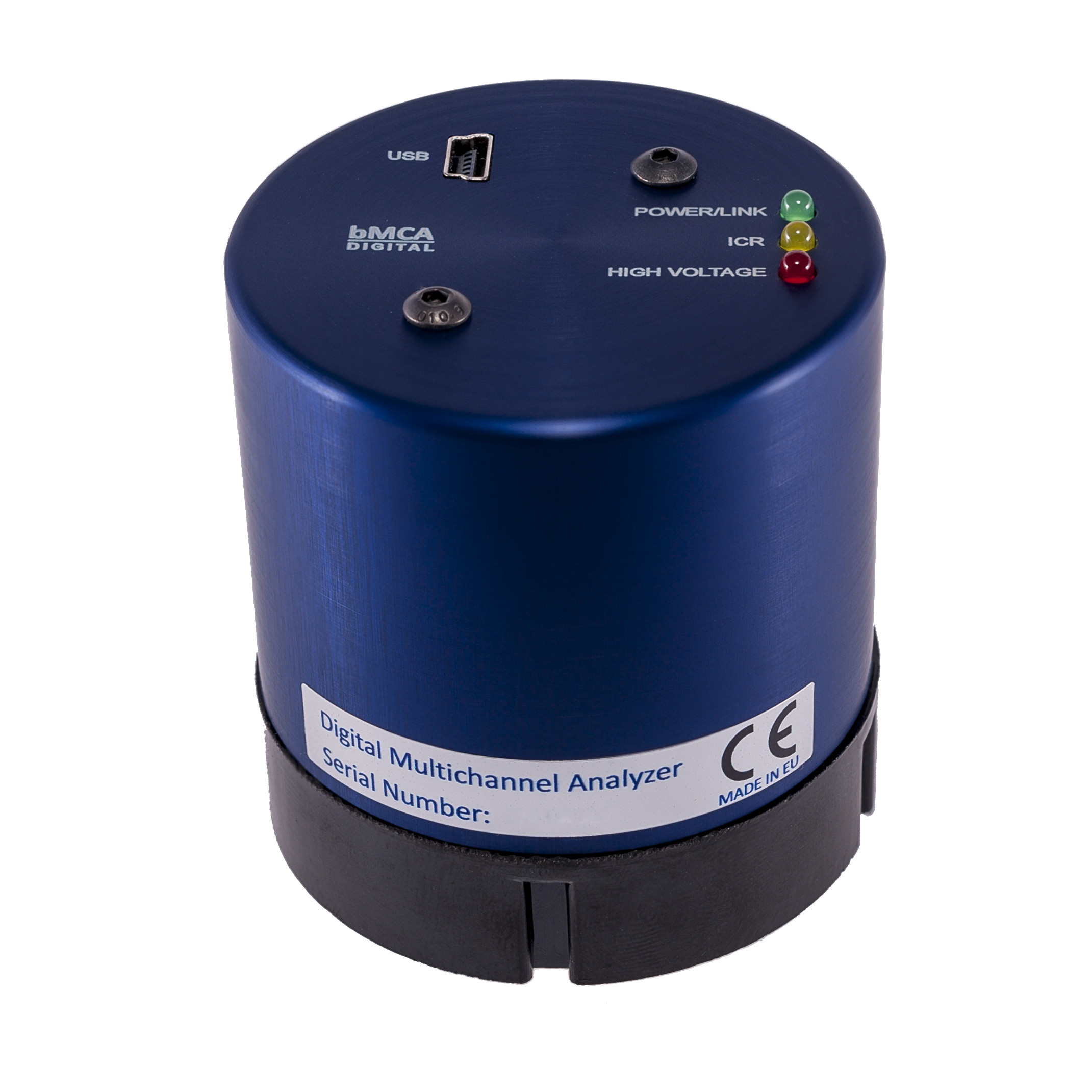
The bMCA-USB is a compact, fully digital Multi-Channel Analyzer designed to fit directly onto a standard 14-pin photomultiplier tube socket. It processes the analog pulse output of a PMT coupled to a scintillation detector, such as NaI(Tl), LaBr3(Ce), LaCl3(Ce), or CeBr3, and produces an energy spectrum stored in on-board memory for retrieval and analysis via a connected PC.
Connection to a host system is handled over USB 2.0. A standard 3-meter cable is included. The device draws power from the USB bus, eliminating external power supplies in most bench and field configurations. An embedded miniature high-voltage power supply delivers the bias voltage required by the PMT, including tubes used with larger scintillation detectors.
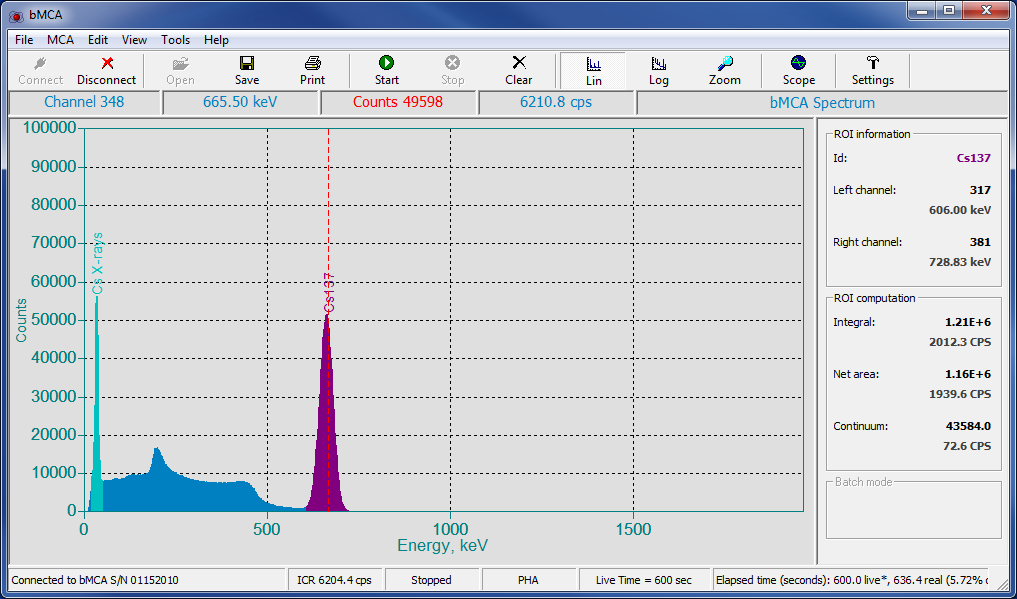
Berkeley Nucleonics supplies the bMCA-USB with a free basic software package for spectrum acquisition, device control, and visualization. Programming libraries for Windows and Linux are available on request, making integration into existing radiation measurement systems straightforward.
2Features
- Fully digital Multi-Channel Analyzer (MCA) built into a compact 14-pin photomultiplier tube socket
- Full Pulse-Height Analysis (PHA) and Multi-Channel Scaling (MCS) modes of data acquisition
- Up to 4096 channels for PHA and MCS acquisition
- Advanced electronic noise reduction algorithms
- Compact size: H 60 mm x D 55 mm
- USB 2.0 for data communication and device control
- Miniature design combining low-power consumption with low-noise operation
- Basic spectrum acquisition and device control software included (free download)
- Available programming libraries for Windows and Linux operating systems (upon request)
- LED indicators for communication status, device power, HV power, and incoming count rate (ICR)
- Miniature on-board high-voltage power supply (0 to 1500 V) for PMT bias
- CE compliant
3Description
Pulse-Height Analysis (PHA)
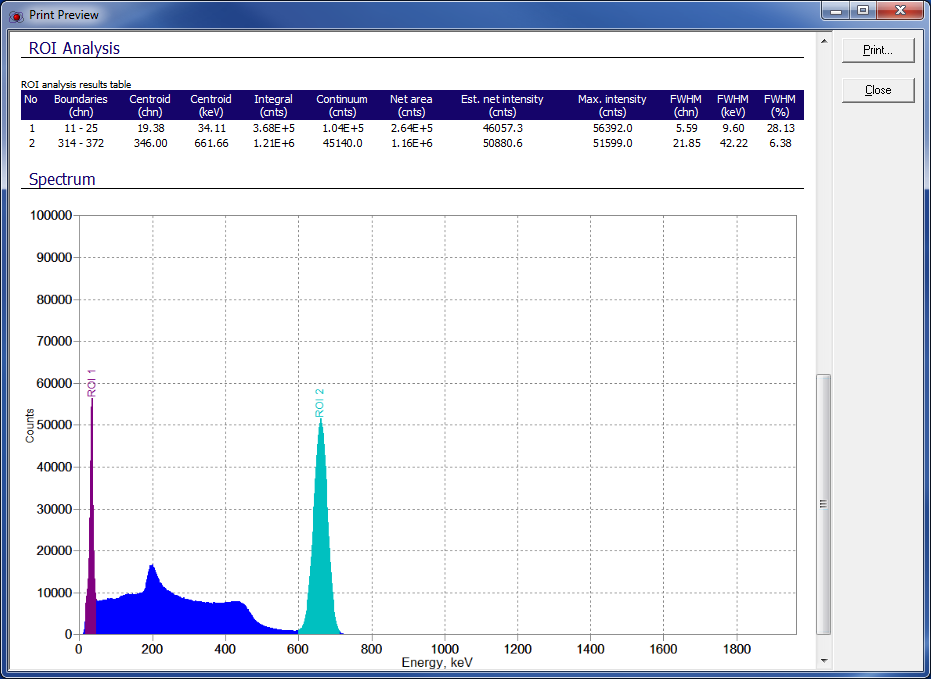
PHA mode is the standard operating mode for nuclear spectrometry and radiometry. The bMCA digitizes each incoming pulse from the PMT, sorts it into the appropriate channel based on pulse amplitude, and accumulates a histogram representing the energy spectrum of the detected radiation. Spectral memory is selectable at 256, 512, 1024, 2048, or 4096 channels. Acquisition can be preset to stop on live time, real time, counts in a region of interest (ROI), or any combination of those conditions.
Coarse gain is set in amplification steps of 1, 2, 4, and 8. Fine gain is continuously adjustable from 1.0 to 2.0 in increments of 1/4096, allowing precise energy calibration without restarting an acquisition. Upper and Lower Level Discriminators are configured in channel units. A Digital Base Line Restorer (BLR) and Pile-Up Rejector (PUR) are included to maintain spectral integrity at high count rates.
Multi-Channel Scaling (MCS)
MCS mode is suited to applications that track photon detections in a specific energy window as a function of time. The MCS channel represents a time bin rather than an energy bin. Dwell time is configurable from 0.1 seconds to "count-forever." Setup can be derived directly from ROI definitions or nuclide information. This mode finds use in both laboratory experiments and industrial monitoring systems that employ radioactive sources or scan for radioactive material.
Software and Programming Interface
The included acquisition software covers setup, control, data acquisition, and visualization. A digital oscilloscope function lets the operator monitor raw input pulses and filtered pulse shapes, supporting fine-tuning of shaping and threshold parameters. Spectrometry utilities include energy calibration, ROI analysis, and peak search. An automatic "discovery" function locates all connected bMCA units (USB or Ethernet variants) available on the local system.
For users building custom systems, programming libraries are available for both MS Windows and Linux. These libraries expose the full device API and allow the bMCA to be embedded in existing radiation measurement platforms with minimal development overhead.

4Technical Specifications
PHA Acquisition Mode
| Parameter | Value / Range |
|---|---|
| Spectral memory size | 256, 512, 1024, 2048, or 4096 channels (selectable) |
| Coarse gain | Amplification factors of 1, 2, 4, and 8 |
| Fine gain | 1 to 2 in steps of 1/4096 |
| Upper / Lower Level Discriminator | Set in channels |
| Acquisition presets | Live Time; Real Time; counts on a ROI; or combination of time and ROI counts |
| Digital Base Line Restorer | Yes |
| Pile-Up Rejector | Yes |
MCS Acquisition Mode
| Parameter | Value / Range |
|---|---|
| Spectral memory size | 256, 512, 1024, 2048, or 4096 channels (selectable) |
| Dwell time | 0.1 sec to count-forever |
| Setup method | From ROIs or nuclide information |
| Rise Time | 0.1 to 12 sec in steps of 0.2 sec |
| Flat Top | 0.1 to 8.0 sec in steps of 0.1 sec |
| Threshold | 1 to 255 |
High-Voltage Power Supply
| Parameter | Value |
|---|---|
| Type | Miniature HV power supply embedded in MCA assembly |
| Output voltage | 0 to 1500 V in 4096 steps |
Data Communication
| Parameter | Value |
|---|---|
| Interface | USB 2.0 |
| Cable | Included, standard 3 meters long |
| Connector | USB Type Mini B |
Environmental
| Parameter | Value |
|---|---|
| Operating temperature | -40 °C to +85 °C (industrial range) |
Physical
| Parameter | Value |
|---|---|
| Size | Height 60 mm, Diameter 55 mm |
| Weight | Approximately 120 grams |
| LED indicators | Red: detector high voltage; Yellow: incoming count rate (ICR); Green: power and communication status |
Software and Compliance
| Parameter | Value |
|---|---|
| Included software | Basic spectrum acquisition and device control (free download) |
| Programming libraries | Windows and Linux (available upon request) |
| Certifications | CE compliant |
5Applications
The bMCA-USB is well suited to any measurement task requiring a portable, low-power MCA connected to a 14-pin scintillation detector. Typical use cases include:
- Laboratory gamma-ray spectroscopy with NaI(Tl), LaBr3(Ce), CeBr3, and related scintillators
- Environmental monitoring and health-physics surveys
- Radiometry and radionuclide identification in field settings
- Industrial gauging and process-control applications using radioactive sources
- Search and detection systems for radioactive materials
- Nuclear R&D and university research setups
- Time-resolved counting studies using MCS mode
- Integration into custom multi-detector radiation measurement platforms
6Ordering & Contact
The bMCA-USB is available as a standalone unit or bundled with a ScintIQ scintillation detector assembly. Contact Berkeley Nucleonics to specify detector type, PMT, and housing requirements, or to request a custom configuration.
| Model | Description |
|---|---|
| bMCA-USB | Compact digital MCA, 14-pin PMT socket form factor, USB 2.0, on-board HV 0–1500 V, basic software included |
| bMCA-USB + Detector | bMCA-USB configured with a ScintIQ scintillation detector assembly (specify crystal, PMT, and housing); contact BNC for options |
Request a Quote or Application Discussion
Berkeley Nucleonics application engineers are available to help select the right MCA and detector combination for your measurement requirements.
Email: info@berkeleynucleonics.com
Phone: 800-234-7858
Berkeley Nucleonics Corporation · 2955 Kerner Blvd, San Rafael, CA 94901