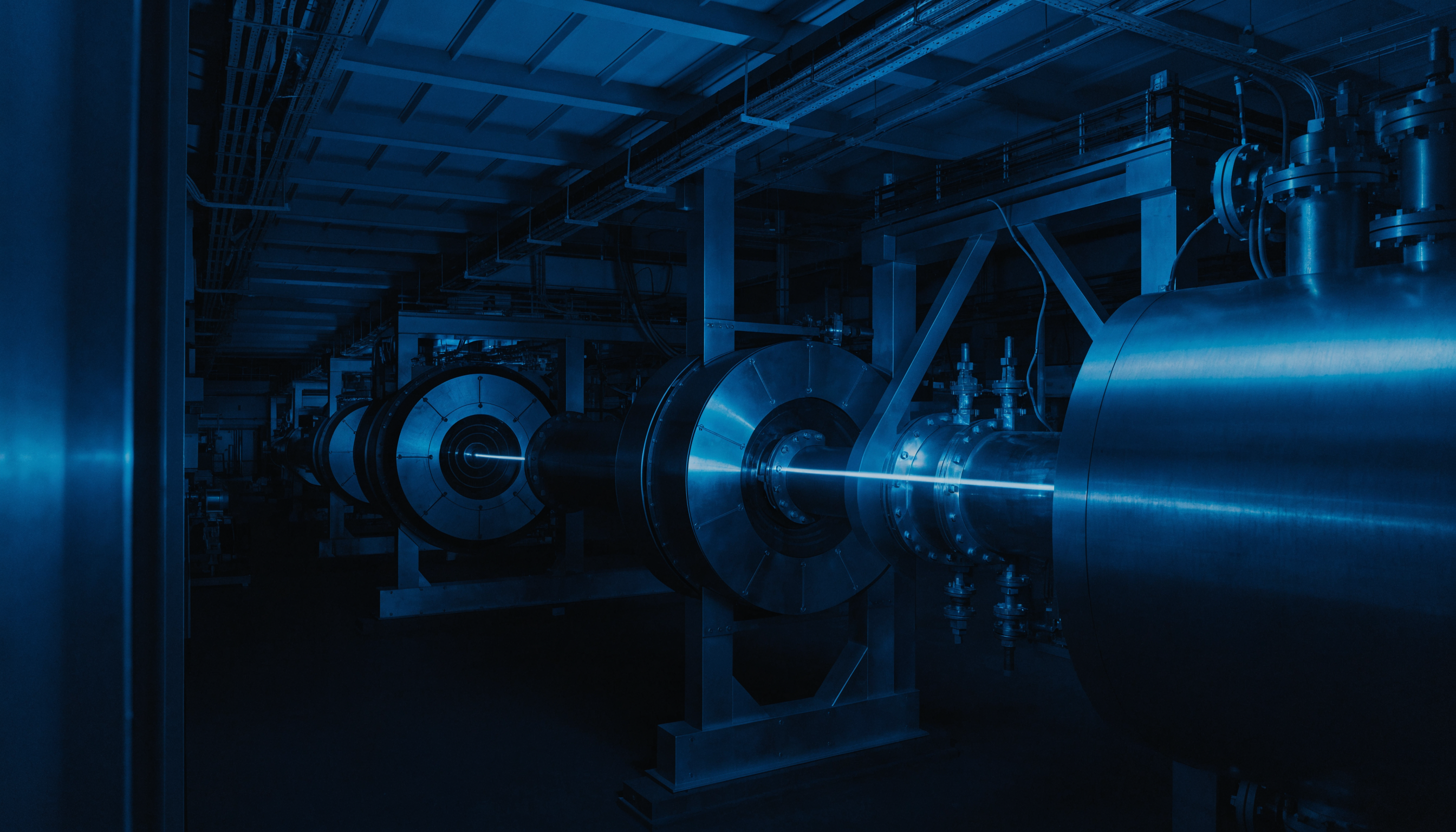
Particle Accelerators & Beam Kickers
In an accelerator or beamline, a kicker is a set of electrodes that deflects the beam on command. Pulse them at the right instant and a kicker injects a bunch into a ring, extracts it, dumps it, or steers it between branches of a transport line. The deflection has to happen in the gap between bunches, hold flat while the chosen bunch passes through, and return cleanly so the next bunch is undisturbed. The pulse generator that drives those plates is therefore a timing-critical, fidelity-critical part of the machine.
The plates look capacitive to the driver, and the requirement is a high-voltage pulse with a fast rise, a genuinely flat top for the duration of the passage, and a clean return, all placed precisely against the machine clock. Alongside the pulsed kickers, the beamline needs steady high-voltage bias for static deflectors, electrostatic optics, and the detectors that diagnose the beam. The two needs, pulsed deflection and stable bias, are best served by instruments built for each job and timed into one chain.
The Challenge
Flat-top fidelity is the defining requirement for a kicker pulse. While the selected bunch traverses the plates, the deflecting field must stay constant, because any droop, tilt, or ripple on the top of the pulse translates into a position or angle error on the beam. A pulse that rises fast but then sags across its flat region will kick the head of a bunch differently from its tail, and in a circulating machine that error compounds turn after turn. The driver has to source the current to hold the capacitive plates at a steady voltage for the full passage, not just reach the level briefly.
Synchronization to machine timing is the second hard requirement. The kick has to fire in the abort gap or the inter-bunch interval, which means the delay between the machine trigger and the HV edge must be both small and stable. Jitter on that delay smears the kick across the wrong part of the bunch train, so low trigger-to-output jitter is essential for clean injection and extraction. The rise and fall must also fit inside the available gap, which sets a hard edge-speed budget tied to the machine bunch spacing.
The static side has its own demands. Bias supplies for deflectors and detectors need low ripple and good stability, because noise on a bias electrode shows up directly in beam position or in detector baseline. A pulsed source and a quiet DC source are different instruments, and a well-built beamline uses each for what it does best.
The BNC Approach
For the pulsed kickers and deflectors, DEI pulse generators bring a capacitive-load-optimized output that holds a flat top under load. The half-bridge totem-pole stage actively drives the plates up and back, which keeps the rising edge fast and the flat region settled while the bunch passes, then returns the plates cleanly for the next interval. Programmable VHigh and VLow levels set the deflection geometry directly, and the design targets the low trigger-to-output jitter that synchronization to a machine clock requires. Built-in voltage and current monitors bring the real plate waveform to a scope so the kick can be verified against the timing system.
For the static bias, the PNC-Series high-voltage supplies provide stable, low-ripple DC for deflectors, electrostatic optics, and detector biasing, with very high voltage capability where the beamline calls for it. Pairing a DEI pulse generator on the kicker with a PNC-Series supply on the static electrodes lets one vendor cover both the pulsed and the steady sides of the deflection chain. Treat the figures here as capability targets and confirm them against the current published datasheets for your machine.
Recommended Instruments
For high-voltage kicker and deflector pulsing, the PVX-4110 supplies a bipolar output to plus or minus 10,000 V into capacitive plates, which suits the deflection levels common in injection and extraction electrodes. Where the required voltage is moderate and the priority is a fast, clean edge that fits a tight bunch gap, the PVX-4130 delivers plus or minus 6,000 V with the same flat-top, low-jitter behavior.
For the static electrodes and detector bias alongside the kickers, the PNC-Series supplies cover stable DC bias from modest levels up to the very high voltages used on electrostatic deflectors and detector stacks. The combination, a PVX pulse generator on the kicker and a PNC-Series supply on the static bias, gives a beamline a coherent, single-vendor high-voltage chain for both pulsed and steady deflection.
Getting Started
Start from the machine: the bunch spacing and abort-gap width that set the edge-speed budget, the bunch passage time that sets the flat-top duration, the deflection voltage your plates need, and the jitter your timing system can tolerate. Separately, list the static bias requirements for deflectors and detectors. The pulsed numbers point at a PVX model and the static numbers at a PNC-Series supply, and the built-in monitors let you verify the kick against the machine clock during commissioning.
Talk to a BNC applications engineer at info@berkeleynucleonics.com or 800-234-7858. Bring your bunch spacing, deflection voltage, flat-top requirement, and bias levels, and we will match a DEI pulse generator and a PNC-Series supply to your beamline.