
End-of-Line Production HV Test
End-of-line test is the last gate before a product ships. For anything that carries high voltage in service, that gate includes a withstand or dielectric strength check: apply a defined voltage across the insulation, hold it for a set time, confirm the leakage stays inside limits, and pass or fail the unit. It is a safety test and a quality test at once, and it has to run on every unit, not a sample.
The defining constraint is throughput. A production line has a takt time, and the high-voltage step has to fit inside it. The supply has to ramp to test voltage, dwell, evaluate, and discharge fast enough that it is not the bottleneck. It also has to do this thousands of times a day without operator intervention, which means it lives entirely under software control inside a larger test sequencer. There is no front-panel knob-turning on a production line.
Safety and traceability sit alongside speed. A unit that flashes over during test has to be caught instantly, the energy removed, and the event recorded, both to protect the operator and the fixture and to feed the quality record. The result for every unit, with its time stamp and the conditions applied, has to be logged so the line can prove what it tested and when. A station that cannot produce that record cannot support an audit.
How the BNC PVP-Series line solves it
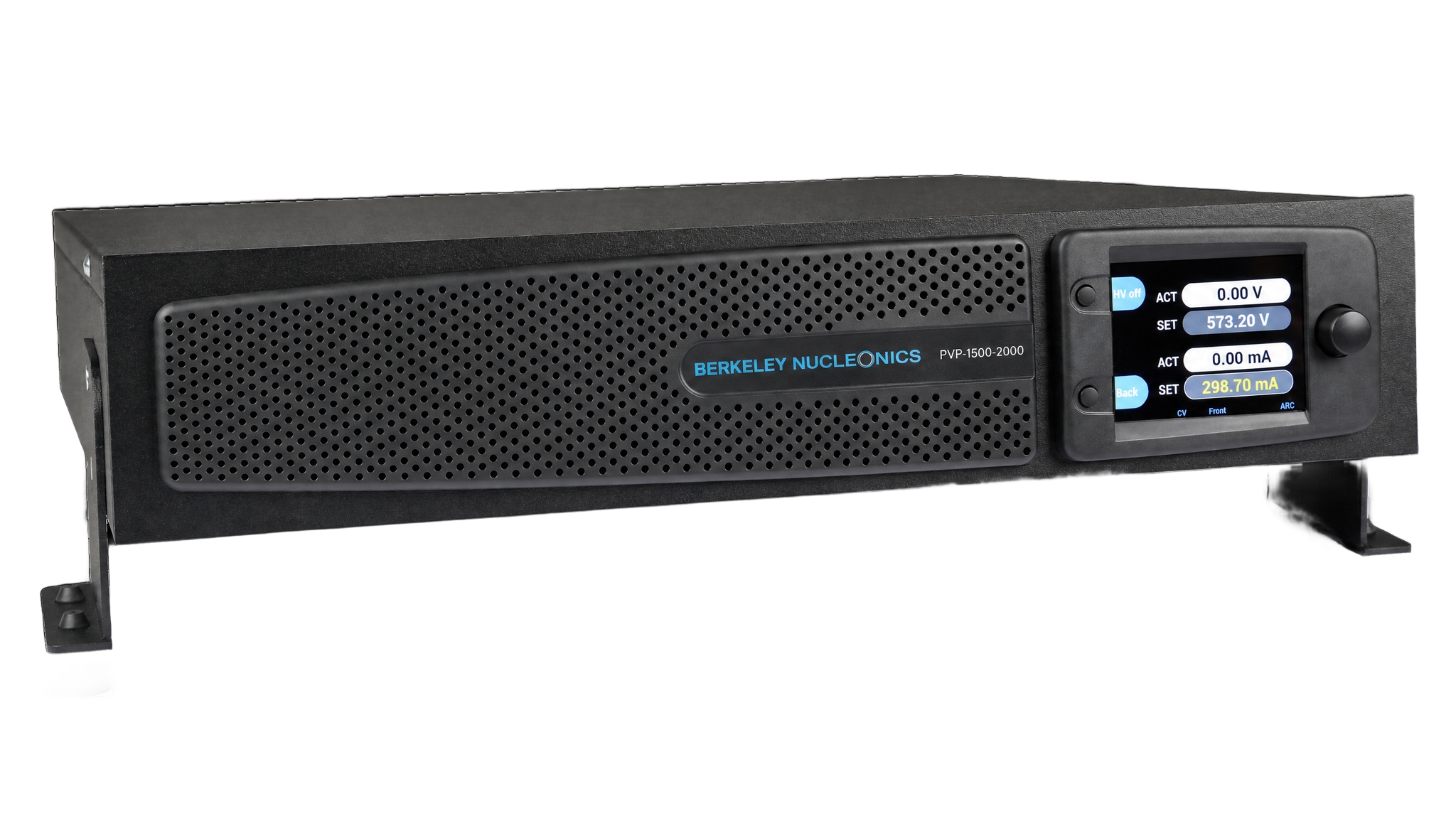
The BNC PVP-Series is built to drop into an automated line. Every function is reachable over Ethernet and RS232 through a standard SCPI command set, so the supply takes its voltage setpoint, ramp, dwell, and read-back commands from the station controller and reports state without a person in the loop. That is what lets the high-voltage step run at line cadence and stay synchronized with the rest of the sequence.
Two retrofittable options carry the safety and repeatability load. Arc Detection watches for flashover, reports it immediately, and can shut the output off the moment it sees one, which protects the operator and the fixture and flags the failing unit cleanly. Ramp Control applies the test voltage at a defined gradient, from 1 V/s up to ten times nominal per second, so every unit sees the same controlled rise and the test is repeatable across shifts and across stations. The no-load discharge time is specified under 60 seconds and is type-dependent, which keeps the reset between units tight.
The supply itself is fully digitally regulated, so the applied test voltage is accurate and stable: 16-bit setting resolution, line regulation tighter than plus or minus 0.01 percent of nominal, and quiet enough that a leakage read is meaningful. The front panel keeps a time-tagged event log, and configurable code protection locks the recipe so a line operator cannot alter it. The 2U enclosure racks into the test station.
Which PVP-Series models and options fit
The right model follows the withstand voltage the product requires. Pick the lowest class that clears the test level with margin, since lower-voltage units carry more current headroom for fast ramp and discharge.
| Withstand level | Recommended PVP-Series model | Rating |
|---|---|---|
| Up to ~1.5 kV, high cadence | PVP-1500-2000 | 1.5 kV, 2000 mA, reversible |
| Mid-voltage assemblies | PVP-5000-600 | 5 kV, 600 mA, reversible |
| High-voltage products | PVP-10000-300 | 10 kV, 300 mA, reversible |
| Extra-high-voltage withstand | PVP-20000-25 | 20 kV, 25 mA |
For end-of-line work, specify both options on every station. Arc Detection with output shut-off is the safety and pass/fail mechanism. Ramp Control gives the safe, repeatable voltage sequencing the recipe depends on. Use the reversible variant where the product is tested in both polarities; otherwise a fixed-polarity unit is sufficient and keeps the configuration simple.
Recommended configuration
For a typical line testing assemblies at a few kilovolts, a PVP-5000-600 is the practical anchor. It clears common withstand levels with margin and carries the current headroom to ramp and discharge quickly inside takt time. Add Arc Detection with output shut-off and Ramp Control, lock the recipe with the configurable code protection, and drive everything over Ethernet with SCPI from the station controller. Log the time-tagged event record the supply keeps for traceability.
Lines testing low-voltage, high-volume products should use the PVP-1500-2000 for its current headroom and fast cycle. Products that demand higher withstand levels move to the PVP-10000-300 or PVP-20000-25, accepting the lower current ceiling. Rack the 2U enclosure into the station and replicate the same configuration across parallel test cells so every gate behaves identically.
Talk to an application engineer
Berkeley Nucleonics can help you match a PVP-Series model and option set to your production test line. Call 800-234-7858 or email info@berkeleynucleonics.com.
For a quick question, chat with an engineer at berkeleynucleonics.com.