1Overview
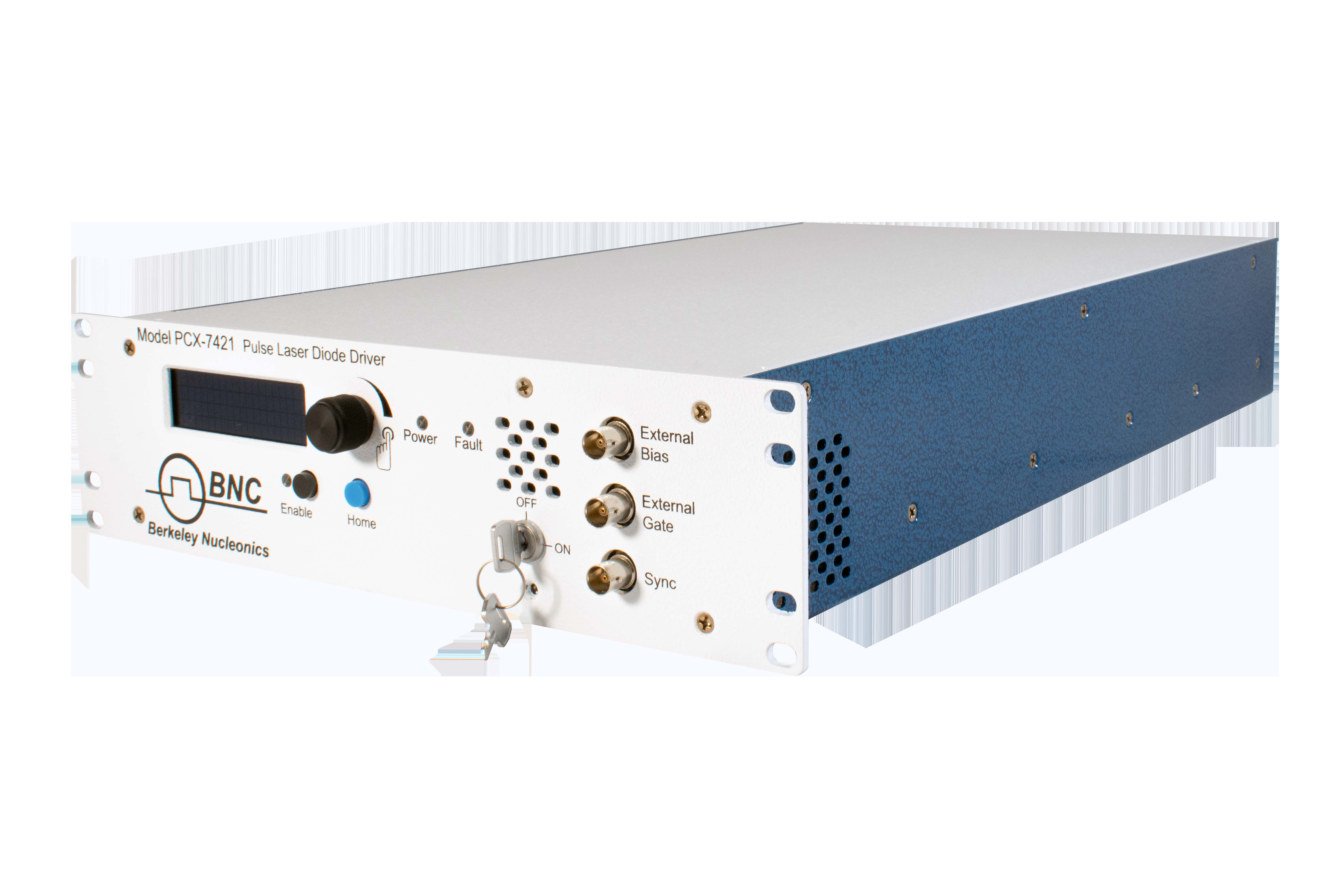
The PCX-7421 is an air-cooled, high-powered CW/QCW current source designed to drive diode lasers, bars, and arrays. The pulsed output current is adjustable from 50 mA to 21.5 A, the pulse width is adjustable from 50 ns to 500 ms, and the rise time is under 25 ns. The pulse repetition rate is selectable from 40 Hz to 100 kHz with the internal source, and from single-shot to 1 MHz with an external source.
The instrument provides both QCW (pulsed) and CW (DC) outputs. It serves as a CW driver at currents from 3.0 A to 5.8 A, and as a pulsed/QCW driver at currents from 50 mA to 21.5 A. The output may be biased to any CW current from 0.050 A to 5.8 A, then pulsed above that bias up to 15.7 A maximum. A bias-pulsing feature allows the bias current to be pulsed and triggered independently from the main current.
Directed Energy, Inc. is now a division of Berkeley Nucleonics. The PCX-7421 is the same design, built in California, with one support path. Operation runs from intuitive front-panel controls, and the OLED display confirms bias and pulsed current setpoints, internal trigger pulse width and frequency, and any error or fault messages.
2How It Works
A laser diode driver is a current source. The compliance voltage, 24 V on the PCX-7421, is the maximum voltage available to maintain the programmed current through the diode and the interconnect. Holding the current flat through the pulse is what preserves optical pulse shape, so every specification is measured with a low-inductance twisted-pair interconnect to the load.
The PCX-7421 separates the operating point from the pulse. A CW bias holds the diode anywhere from 0.050 A to 5.8 A, and the main current pulses above that floor up to 15.7 A in biased operation, or up to the full 21.5 A as a standalone pulsed/QCW source. Because the bias channel can be pulsed and triggered independently, the diode can be pre-conditioned and the main pulse fired with separate timing, which is useful for QCW thermal management and for shaping the leading edge of optical output.
3Pulse & Bias Amplitude
All specifications are measured with a low-inductance twisted-pair interconnect cable to a load. The PCX-7421 meets or exceeds these specifications.
| Pulse amplitude | Specification |
|---|---|
| Main current output range | 3.0 A to 15.7 A (biased); 50 mA to 21.5 A (pulsed/QCW); 3.0 A to 5.8 A (CW) |
| Setpoint resolution | 1 mA |
| Compliance voltage1 | 24 V |
| Rise time | Less than 25 ns |
| Polarity | Positive |
| Maximum output power | Up to 250 W at 100% duty cycle |
| Bias amplitude | Specification |
|---|---|
| Bias current output range | 50 mA to 5.8 A |
| Setpoint bias resolution | 1 mA |
4Trigger Specifications
| Internal trigger | Specification |
|---|---|
| Frequency range | 40 Hz to 100 kHz |
| Frequency resolution | 1 Hz (40 Hz to 300 Hz); 100 Hz (300 Hz to 5,000 Hz); 1000 Hz (5 kHz to 100 kHz) |
| Pulse width range | 100 ns to 500 ms |
| Pulse width resolution | 6400 ns (40 Hz to 300 Hz); 1600 ns (300 Hz to 5,000 Hz); 100 ns (5 kHz to 100 kHz) |
| Rise time | Less than 25 ns |
| Polarity | Positive |
| External trigger | Specification |
|---|---|
| Frequency range | 1 MHz or less |
| Minimum pulse width | 50 ns |
| Maximum pulse width | 100% duty cycle, up to 250 W |
| Termination | 50 ohm or 10,000 ohm |
| Connector | BNC |
| Input voltage levels | 0 V to 5.0 V; high = output to load, low = no output to load |
| Trigger sync output | Specification |
|---|---|
| Termination | 50 ohm |
| Connector | BNC |
| Output voltage levels | 0 V to 2.7 V |
5General Specifications
| Parameter | Specification |
|---|---|
| Power requirements | 47 Hz to 63 Hz; 100 VAC to 120 VAC plus or minus 10%, or 220 VAC to 240 VAC plus or minus 10% |
| AC connector type | NEMA C-14 |
| Size (H × W × D) | 8.9 cm × 28.5 cm × 53.4 cm; standard with rack-mount ears (33.6 cm wide at ears); requires 2U spacer |
| Weight | 8.4 kg |
| Operating temperature | 15 C to 40 C |
| Cooling | Air cooled, flow front to rear of unit |
| User interface | OLED display with front-panel controls |
6Output Protection & Safety
The PCX-7421 uses advanced circuitry to protect both the diode and the driver. At turn-on, and at any time the output is not enabled, the output is electronically shorted to ground so that no current flows through the diode. This short-on-disable behavior is the primary defense against accidental diode damage during connection and setup.
A front-panel interlock key gates the output. When the key is off, the output is disabled. To enable the output, the key must be on and the system enable must be made, either manually or through the computer interface. A remote interlock is also provided, so the driver can be tied into a larger safety chain.
7Control & Interfaces
The PCX-7421 is operated through intuitive front-panel controls, with an OLED display that gives immediate visual confirmation of every operating parameter, including bias and pulsed current setpoints, internal trigger pulse width and frequency, and error or fault messages.
For automated applications, complete control of the driver is provided through RS-232 and USB computer interfaces. Up to five system configurations can be stored in internal non-volatile memory, providing instant recall of frequently used setups. USB driver support covers Windows 7 through 10, Windows XP, Linux, and Mac OS X.
8Applications
The PCX-7421 fits applications that need high pulsed current with independent bias control, across CW, QCW, and pulsed modes.
- Diode lasers, bars, and arrays. Drive high-power single emitters, bars, and arrays with rise time under 25 ns and current up to 21.5 A.
- QCW pump sources. Pump solid-state and fiber lasers in quasi-CW mode, holding peak optical power high while keeping average power and junction temperature in range.
- LiDAR and rangefinding. Generate fast, large-amplitude current pulses for time-of-flight and ranging systems.
- Materials processing and research. Supply continuous or pulsed current for marking, micromachining, and laboratory diode characterization.
9Ordering Information
| Part number | Description |
|---|---|
| PCX-7421 | Precision Pulsed Current Source |
| 6100-0119 | Output Cable (twisted pair), requires 2 |
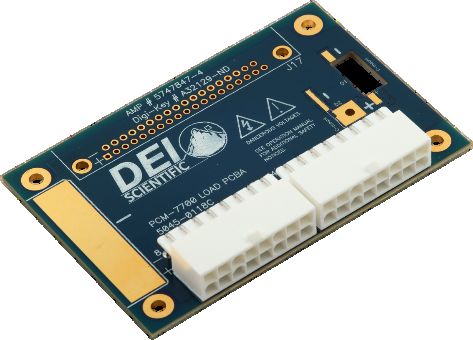
| 6045-0134 | Laser Output PCBA |
| PCA-9410 | BNC Shorting Connector |
Each PCX-7421 is delivered with two output twisted-pair cables, one laser output PCBA, and a BNC shorting connector.
Contact
For a quote, configuration help, or application support, reach the Berkeley Nucleonics team.
Email: info@berkeleynucleonics.com
Phone: 800-234-7858