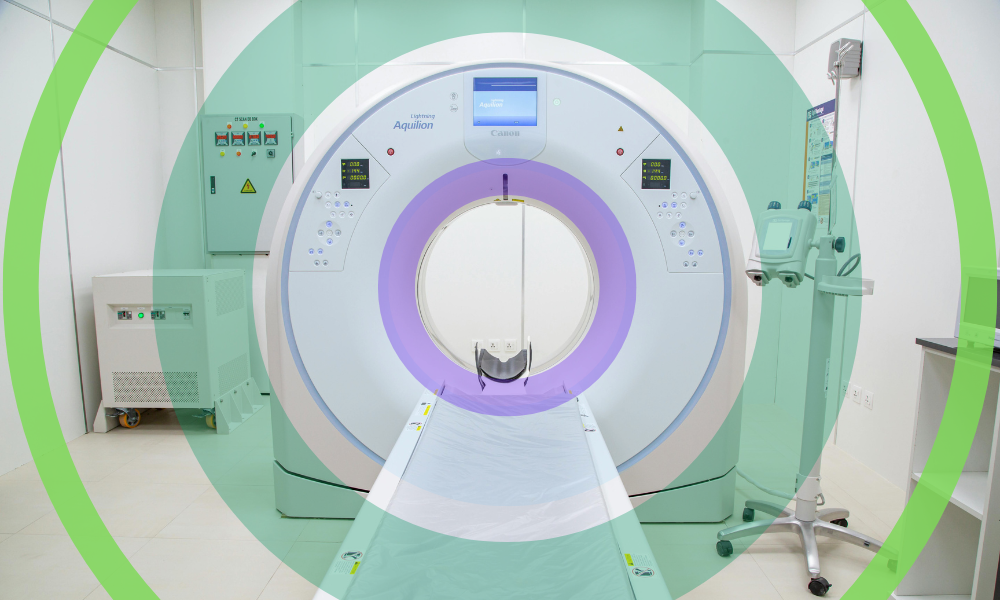
MRI & Medical Imaging
Magnetic resonance imaging turns a carefully orchestrated sequence of magnetic and radio-frequency events into a picture of the body. Inside the bore, gradient coils shape the spatial encoding while an RF chain excites and refocuses the spins, and image quality depends on how faithfully each of those signals is produced. Research and development labs pushing MRI forward, toward stronger high-field systems for clearer brain imaging and toward low-field systems that bring imaging to places that have none, build and validate these signal chains on the bench long before a system reaches a patient. The instrument that produces the drive waveforms and emulates the returns is part of that chain, not an accessory to it.
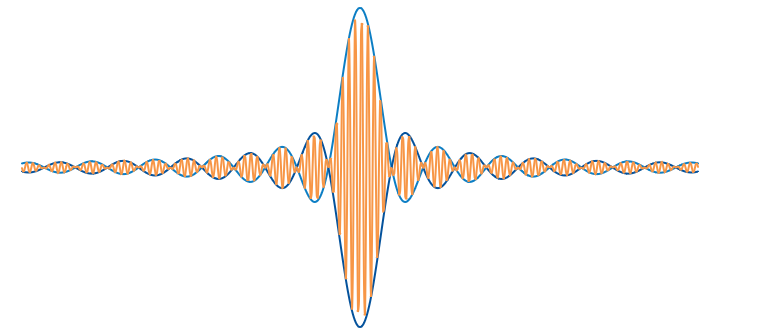
An MRI system relies on two distinct kinds of signal working together. RF waveforms act as the carrier source that excites the spins, and arbitrary waveforms serve as the modulation source that shapes the gradient and pulse envelopes around that carrier. The diagram below shows the relationship, with the RF carrier path and the arbitrary-waveform modulation path feeding the same sequence. Because MRI is performed on people, the bench also needs to confirm that delivered RF power stays within safe limits, which is why these labs pair waveform generation with calibrated RF power sensing. The waveform generator sits at the front of that arrangement, defining the shapes everything downstream has to reproduce.
Why an arbitrary waveform generator fits
MRI sequences are not single tones. A gradient waveform may ramp, hold, and reverse on a defined schedule, and an RF excitation may need a precisely shaped envelope such as a sinc or an adiabatic profile to rotate the spins the way the sequence intends. These are arbitrary shapes, defined point by point, and an arbitrary waveform generator exists to play exactly that: a user-defined sample stream rather than a fixed library function. That makes it the natural source for both the gradient drive and the RF modulation envelope, and the natural tool for emulating the signals a receive chain expects to see during development and test.
The demands are specific. Gradient and RF events have to land in a fixed relationship across the whole sequence, so timing has to be tight and repeatable from shot to shot. The envelopes have to be smooth and faithful, because a distorted RF pulse rotates the spins imperfectly and a noisy gradient blurs the encoding, both of which show up in the image. And the sequences are long, so the generator has to hold the full pattern rather than loop a short fragment. None of these stands alone. The same instrument has to deliver clean amplitude, fine timing, multi-channel coordination, and deep memory at once, which is what separates a generator suited to imaging work from a general-purpose source.
The capabilities that matter
Multi-channel synchronized waveforms. A sequence drives more than one line at once. Gradient channels, the RF envelope, and the trigger and gating signals all have to move together against a shared reference rather than drifting apart over a long acquisition. A generator that synchronizes its channels, and synchronizes multiple units when a setup outgrows one chassis, keeps the whole sequence aligned to a single definition of time.
Precise, low-jitter timing. The boundary between excitation, encoding, and readout is defined in time. Low trigger jitter and fine timing resolution let each event land where the sequence expects it, shot after shot, so the encoding stays consistent and the emulated returns stay coherent.
Arbitrary pulse shaping with clean amplitude. The point of an arbitrary waveform generator is the shape. High vertical resolution keeps amplitude steps small and the envelope faithful through the gradient amplifier or the RF modulator, so the spins see the profile the sequence designed rather than a quantized approximation of it.
Deep waveform memory. Imaging sequences are long and rarely repeat a short pattern. Deep memory lets the generator hold a full multi-step sequence and play it through without looping, which matters for faithful sequence reproduction and for emulating a realistic stream of returns.
Which models fit
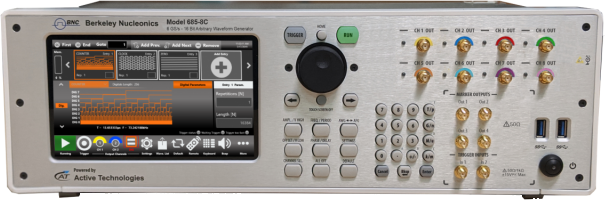
For gradient and RF envelope work where amplitude fidelity is the priority, the 16-bit Model 685 and Model 675 are the right starting point. Their finer vertical resolution keeps the envelope clean and finely graded through the modulator or gradient amplifier, which is what precise spin rotation and low-distortion encoding depend on. Both share the series architecture and synchronization scheme, so a bench can run gradient and RF channels on a common timebase and add channels as the sequence grows.
Where the work calls for the highest sample rate, the faster edges of short pulses or the emulation of higher-bandwidth returns, the Model 686 is the better fit. It trades the finest vertical resolution for speed, and because it shares the same synchronization scheme as the 685 and 675, a setup can mix a fast 686 with a high-resolution 685 or 675 on one reference when a sequence needs both clean envelopes and fast edges. Lock every unit to the same external clock so the full system shares one definition of time.
Talk to an application engineer
Berkeley Nucleonics can help you match a Model 685, Model 675, or Model 686 configuration to your MRI gradient, RF pulse, and signal-emulation bench. Call 800-234-7858 or email info@berkeleynucleonics.com.
For a quick question, chat with an engineer at berkeleynucleonics.com.