
1Overview
The Model 970 portable multi-channel analyzer couples a flexible architecture to a wide choice of detectors and processes gamma, neutron, and x-ray data in real time. It can serve as a process monitor, a benchtop laboratory instrument, or an integrated component inside an existing system. The modular design, compact packaging, and accessible software interface suit control systems that need sample automation or fast screening.
The instrument supports both spectroscopy and spectrometry. Spectroscopy covers radionuclide identification with qualitative results. Spectrometry covers quantitative activity measurement in Curies or Becquerel. That span lets one analyzer move from a quick field identification to a calibrated laboratory count without changing platforms.
2Key Features
- Standard libraries include 387 isotopes, fully editable.
- Multi-channel scaling mode for time-resolved counting.
- Peak search and identify for fast qualitative analysis.
- Quantification based on regions of interest or peak search.
- Dual-channel emulator using gas proportional or phoswich detectors as a gross alpha/beta counter-scaler.
- ASCII mode for user-defined applications and software.
- Ships with SNAP-MCA software, a carrying case, and a USB-serial adapter.
3MCA Architecture
The Model 970 provides 4096 channels, configurable down to 256, 512, 1024, or 2048 channels to match the detector and the analysis. Conversion gain follows the selected channel count, so an operator trades resolution against count rate and file size by choosing the configuration that fits the job.
Amplifier and shaping
Shaping time is adjustable from 0.25 to 10 us. Gain ranges from x1 to x25 through coarse and fine controls, which lets the analyzer match a range of detector outputs and energies.
Detector inputs
Two detector inputs are provided, with the active input selected in software. Input 1 uses a standard series "C" connector that joins the signal with the high voltage supply. Input 2 separates the connections, using an SHV connector for high voltage and a BNC connector for the signal. The inputs accept negative, positive, or pre-shaped positive signals.
High voltage supply
An internal bias supply delivers 0 to 2000 V positive at up to 0.5 mA. A negative high voltage version is available on request. An external connector provides +5 V, +12 V, and -12 V for external preamplifiers, plus two logic signals for external alarm device notification.
4Specifications
| Parameter | Specification |
|---|---|
| Channels | 4096, configurable for 256, 512, 1024, or 2048 |
| Shaping time | 0.25 to 10 us, adjustable |
| Gain | x1 to x25, coarse and fine controls |
| Detector inputs | Two inputs, software-selected; accepts negative, positive, or pre-shaped positive signals |
| Input 1 connector | Standard series "C" (signal joined with high voltage) |
| Input 2 connectors | SHV (high voltage) and BNC (signal) |
| High voltage supply | 0 to 2000 V positive, up to 0.5 mA; negative available on request |
| External connector | +5 V, +12 V, -12 V for external preamplifiers; two logic signals for external alarm |
| Controls | Power On/Off; Fast/Normal charge rate; internal charge-suppression switch for non-rechargeable batteries |
| Indicators | On/Off status LED; external power LED; fast charge LED |
| Minimum system | 486 PC running Windows 95 or higher; Windows Mobile device with serial connector |
| Shipping dimensions | 18 x 18 x 13 in |
| Shipping weight | 9 lb |
5Software
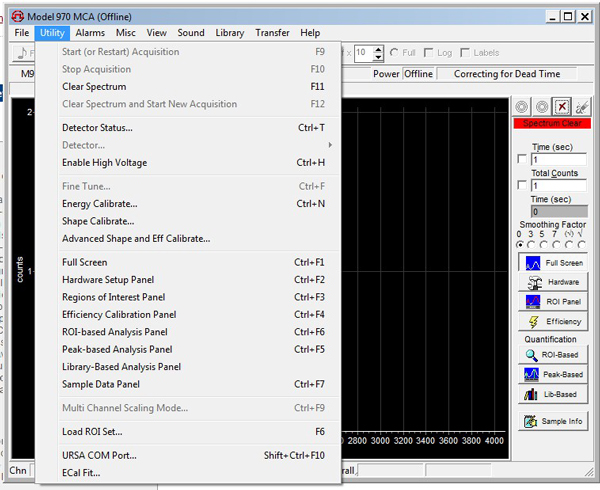
The Model 970 ships with SNAP-MCA, the Simple Nuclear Analysis Program. A single-user license is included. SNAP-MCA is a feature-rich nuclear spectroscopy package that reads data from the Model 970 and most other MCAs, then performs both quantitative and qualitative analysis through a familiar Windows-style toolbar interface.
A built-in data exporter sends spectra to N42 or Excel files for secondary review and spectroscopic analysis. The software runs on Windows 95 and higher, supports Windows Mobile devices such as the Jornada, iPAQ, and TDS Recon, and runs in the Windows CE environment. It is networkable across multiple sensor platforms, which suits distributed monitoring.
6Supported Detectors
The flexible architecture accepts several detector chemistries, so the same analyzer can be tuned for sensitivity, ruggedness, or resolution.
| Detector | Characteristics |
|---|---|
| Sodium Iodide, NaI(Tl) | Widely used scintillation crystal for standard gamma spectroscopy; high light output; excellent match to photomultiplier tube sensitivity |
| Cesium Iodide, CsI(Tl) | Rugged, non-hygroscopic, does not cleave; a durable alternative to NaI(Tl) for broad applications |
| Cerium Bromide, CeBr3 | High resolution with fast decay and low intrinsic background (<0.001 c/cc/s in the Ac-227 complex); about 4% FWHM at 662 keV |
| Lanthanum Bromide, LaBr3(Ce) | Excellent energy resolution; 2.6% FWHM for a 2 in diameter by 2 in crystal; enhanced version 2.2% FWHM at 662 keV |
7Applications
- Nuclear safeguards: area protection of special nuclear material, identification and movement detection, and integrated QC for fuel reprocessing.
- Food screening and analysis: quick qualitative identification of radionuclide contamination, plus quantitative activity determination with efficiency calibration and a defined geometry such as Marinelli.
- Health physics and bio sciences: personnel contamination checks, body scanning, blood and urine samples, automated sample changers, and decontamination verification.
- Environmental: air sampling, radioactivity analysis, post-remediation measurement, and sediment pollution analysis.
- Waste management: waste verification before shipping or disposal, HLW and LLW categorization, and automated isotope identification.
- Nuclear medicine: patient monitoring, QC analysis, overdose prevention, and eluate breakthrough interface to controllers.
- Reactor monitoring: material and storage process monitoring with real-time interface to HVAC and conveyor systems.
8Ordering
To configure a Model 970, select the channel configuration, the detector chemistry, and the high voltage polarity your application requires, then confirm the software and accessory set. For a quote, a demonstration, or help integrating the analyzer into an existing system, contact Berkeley Nucleonics at info@berkeleynucleonics.com or 800-234-7858.