
Drone Spectrum Monitoring
Some RF problems cannot be solved from the ground. A coverage gap on the far side of a ridge, an interferer somewhere across a sprawling industrial site, a signal that only shows itself a hundred meters up: these are hard to reach with a person and a handheld. The terrain is the obstacle, and walking it is slow, sometimes impossible.
Flying the measurement changes the geometry. From altitude, a single pass can survey what would take a ground team days, and it sees over the obstructions that block line of sight at street level. The catch is payload. A drone has a tight weight and power budget, and every gram of instrument trades against flight time and stability. Bolt a benchtop analyzer to a small UAV and it will not leave the ground.
So the requirement is specific and demanding. The sensor has to be light enough to fly, sip little enough power to last the mission, and still produce position-tagged spectrum data that holds up as a real map. It has to behave as a payload, not a passenger.
How the ICX-FieldHawk line solves it
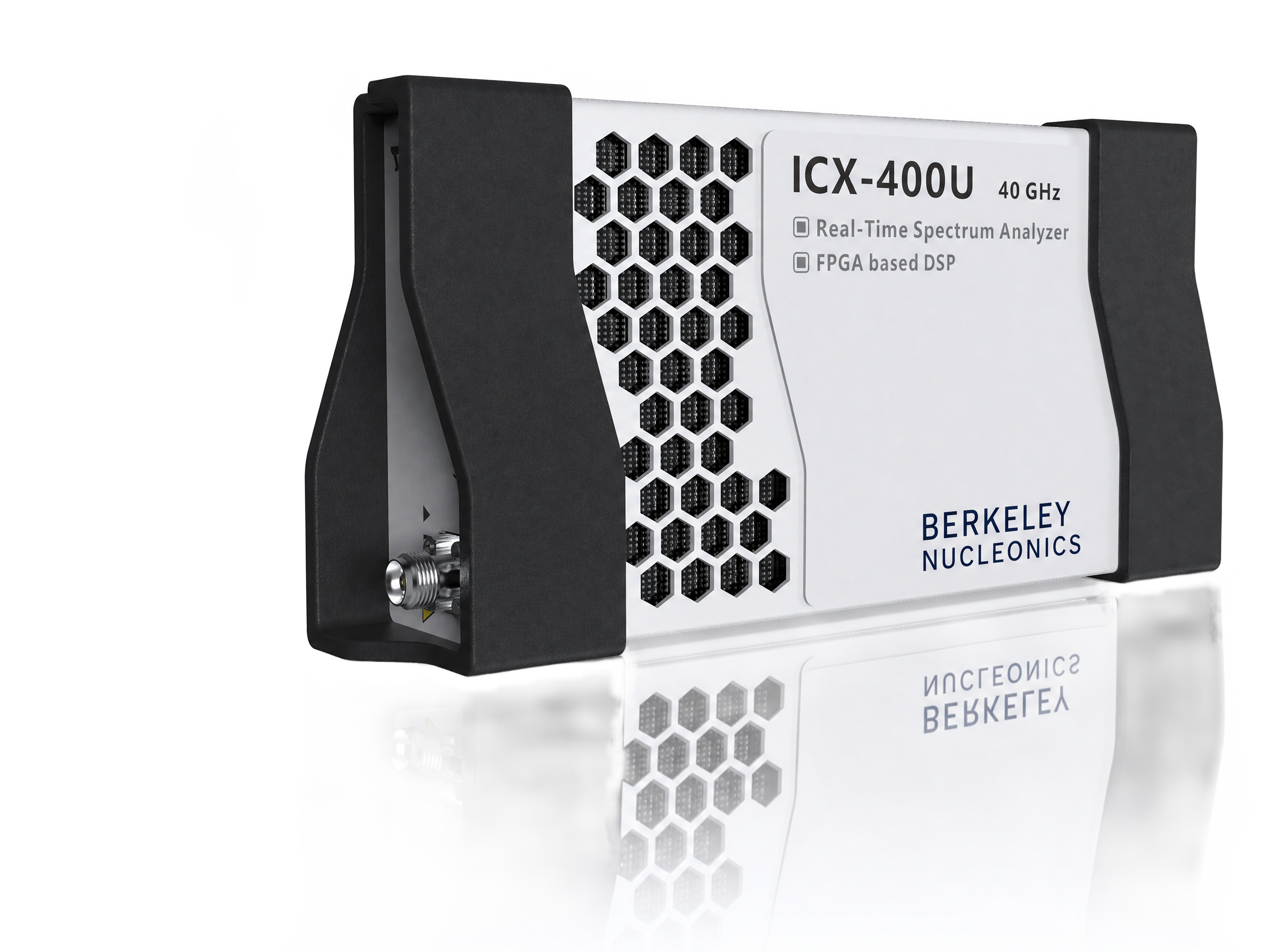
The ICX-FieldHawk-U is a USB core module rather than a boxed instrument, and that form factor is what makes airborne work practical. At well under 200 grams, it fits inside a UAV weight budget that a traditional analyzer would blow through immediately. Low power draw means it runs off the platform without draining the flight battery in minutes. The receiver becomes part of the aircraft, not a burden strapped to it.
Paired with a GNSS source, every measurement carries a position. The companion processor logs spectrum and coordinates together, so the output is not just a sweep but a geo-referenced layer ready for mapping. Fly a grid or a perimeter and the data assembles into a picture of where energy lives across the area, with altitude and location attached to each reading.
The SpecICX-gen3 firmware drives the capture, and its programmable interface lets the flight computer command the receiver, pull results, and stream them to a ground link. Because the same core feeds geolocation and mapping pipelines, the airborne dataset flows straight into the tools that turn points into heat maps and emitter fixes. Collect from the air, analyze on the ground, with no format gap in between.
Which models and accessories fit
For airborne spectrum monitoring, the clear fit is the ICX-FieldHawk-U. Its weight, power profile, and USB interface are exactly what a UAV integration needs, and nothing else in the line packs the real-time engine into a payload this small. It mounts to a companion computer such as a single-board Linux carrier, takes a GNSS feed, and reports position-tagged spectrum throughout the flight.
Antenna choice depends on the survey. A broadband omnidirectional element suits wide-area mapping, where the goal is to detect whatever is present across the footprint. When the mission shifts toward locating a specific emitter, the ANT-100G directional antenna adds gain and bearing, supporting airborne direction finding as the aircraft maneuvers. Mounting and weight should be checked against the platform, since directional elements add mass and wind load.
The receiver pairs naturally with mapping and geolocation software. Position-tagged sweeps become coverage layers, and repeated passes sharpen an emitter fix through changing geometry, something only flight makes easy. The ground-based ICX-FieldHawk handheld and ICX-FieldHawk-R rugged receivers complement the airborne kit for follow-up work once a survey narrows the search area.
| Requirement | Recommendation |
|---|---|
| Airborne RF sensor payload | ICX-FieldHawk-U USB core module |
| Wide-area coverage mapping | Broadband omnidirectional antenna |
| Airborne emitter location | ANT-100G directional antenna (verify mounting and weight) |
| Position tagging | GNSS source logged with spectrum data |
Recommended configuration
Start with an ICX-FieldHawk-U on a companion computer, fed by a GNSS source, running SpecICX-gen3 with geo-tagged logging enabled. Use a broadband omnidirectional antenna for wide-area mapping flights, and keep an ANT-100G on hand for directional passes when a target needs locating. This payload flies light, lasts the mission, and lands with map-ready, position-tagged spectrum data.
For a quick question, chat with an engineer at berkeleynucleonics.com.