1Overview / Introduction
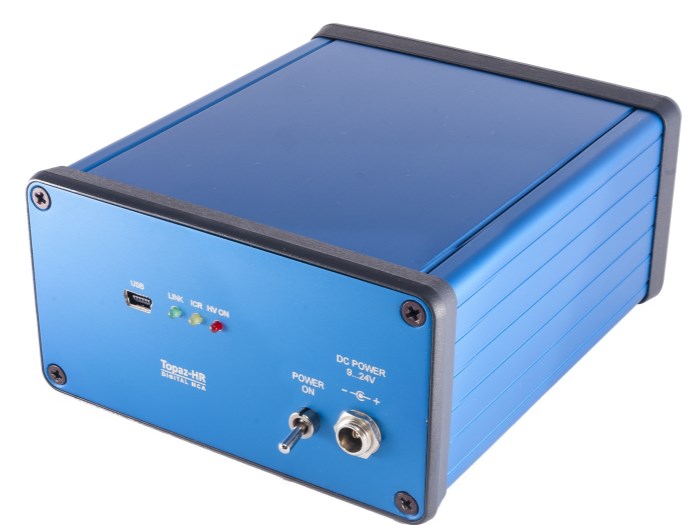
The TOPAZ-HR is a compact, stand-alone digital Multi-Channel Analyzer (MCA) designed to perform Pulse Height Analysis (PHA) of signals produced by high-resolution gamma-ray semiconductor detectors, including Hyper Pure Germanium detectors (HPGe). It is equally capable with scintillator detectors such as NaI(Tl), LaBr3, and CeBr3, making it a genuinely multi-purpose instrument.
High-resolution gamma-ray spectrometry is a core technique in advanced radio-analytical laboratories and in comprehensive nuclear analytical methods. The TOPAZ-HR brings together the digital signal processing depth of a laboratory-grade MCA in a form factor that fits a briefcase. A 14-bit flash ADC running at 50 Ms/s feeds a 100 MHz DSP and a 200 MHz CPU, giving the instrument the processing headroom to handle even demanding HPGe spectroscopy conditions cleanly.
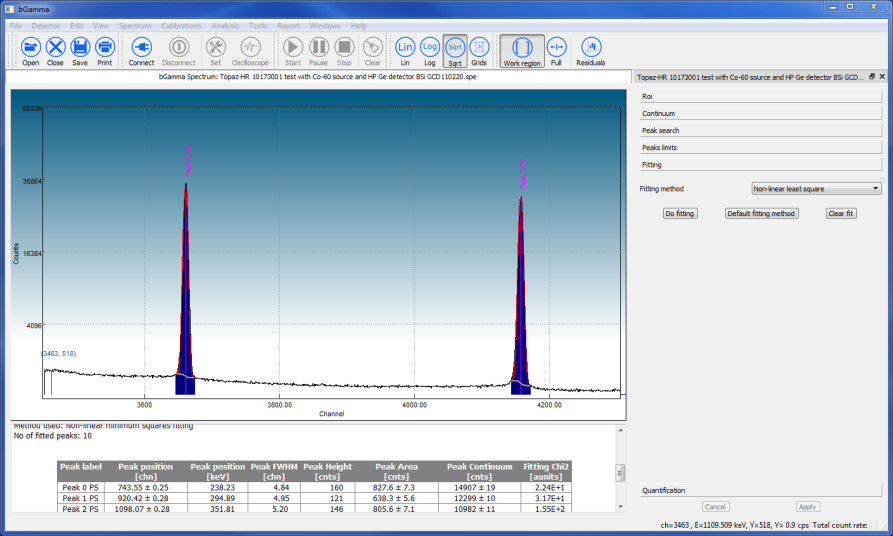
Out of the box, the TOPAZ-HR ships with a basic software package for device control, data acquisition, and spectrum visualization. That package includes an automatic "discovery" function that finds all BrightSpec MCAs connected to the PC or reachable on the local network. For facilities that require a complete analytical workflow, the instrument integrates with bGamma, Berkeley Nucleonics' full-featured gamma-ray spectrometry software. Within bGamma, users perform data acquisition, spectrum analysis, energy calibration, and radioactivity quantification per radionuclide, all in a single environment.
Programming libraries for Windows and Linux are available, allowing the TOPAZ-HR to be embedded in larger radiation measurement systems or custom software stacks. A bare PCB variant is available for OEM integration.
2Key Features
High-Performance ADC Core
14-bit flash ADC at 50 Ms/s sampling rate. 100 MHz DSP processor. 200 MHz CPU. Accurate pulse digitization from HPGe and scintillator detectors.
Four Acquisition Modes
PHA, MCS, LIST, and TLIST. In TLIST mode, each event carries an arrival time stamp with better than 30 ns resolution.
Deep Spectral Memory
Up to 16,384 (16K) channels of 32-bit depth, selectable in steps: 256, 512, 1024, 2048, 4096, 8192, or 16K.
Integrated 6 kV HV Supply
0 to 6000 V bias at 350 µA with automatic ramping and signal inhibit. Dual polarity, fixed at factory. External HV inhibit control input.
Preamplifier Power
Integrated preamp supply: ±24 V at 125 mA and ±12 V at 250 mA via DB9 connector. Supports RC and pulse-reset preamplifiers with automatic reset pulse detection.
High-Speed USB Transfer
USB 2.0 at up to 480 Mbit/s. A 3-meter USB cable is included. Compact and reliable data path to any Windows or Linux host.
Advanced Digital Shaping
Trapezoidal pulse shaper. Rise time 0.1 to 12 µs in 0.2 µs steps. Flat top 0.1 to 8.0 µs in 0.1 µs steps. Adjustable fast discriminator, digital BLR, pile-up rejection, and poles/zero cancellation.
Flexible Gain
Analog gain from x1 to x256. Coarse gain: 1, 2, 4, 8, 16, 32, 64, 128. Fine gain: 1 to 2 in steps of 1/16384 (approx. 0.000061).
Programmable GPIO
Two user-programmable I/O lines. Usable as external counters, external acquisition control, or general-purpose digital interfaces.
Compact Aluminum Enclosure
126 x 106 x 56 mm. Less than 200 grams including the box. Rugged machined aluminum construction.
bGamma Integration
Optional full-featured gamma-ray spectrometry software covers acquisition, analysis, calibration, and nuclide quantification. Package pricing available.
CE Certified
The TOPAZ-HR carries CE certification. Programming libraries for Windows and Linux are available upon request.
3Description
Digital Signal Processing Architecture
At the heart of the TOPAZ-HR is a 14-bit high-quality fast flash ADC running at 50 Ms/s, paired with a 100 MHz DSP processor and a 200 MHz CPU. This architecture enables accurate, low-noise digitization of the shaped pulses from high-resolution detectors, where precise peak centroiding determines the ultimate energy resolution delivered to the user.
The trapezoidal pulse shaper is fully configurable. Rise time and flat-top width are independently adjustable over wide ranges, allowing the instrument to be optimized for the specific detector type and counting rate environment. At high count rates, the pile-up rejector (PUR) and digital base line restorer (BLR) work together to maintain spectral quality. Poles/zero cancellation is analog and adjustable, with fine-tuning of dead time correction also available.
Acquisition Modes
Four acquisition modes cover most laboratory and field scenarios. PHA is the standard mode for energy spectrometry, filling the spectral histogram channel by channel. MCS (Multi-Channel Scaling) sweeps through channels sequentially in time, useful for counting rate versus time measurements. LIST mode records individual events in sequence without time stamps. TLIST mode adds a time stamp to every event with better than 30 ns resolution, enabling coincidence measurements, half-life determinations, and time-correlated spectroscopy.
Preset acquisition stops are flexible. Measurements can be terminated by preset real time, live time, count total in a region of interest (ROI), external control signal, or any combination of these conditions. Preset times range from 0.005 seconds to approximately 0.65 years.
High-Voltage and Preamplifier Supply
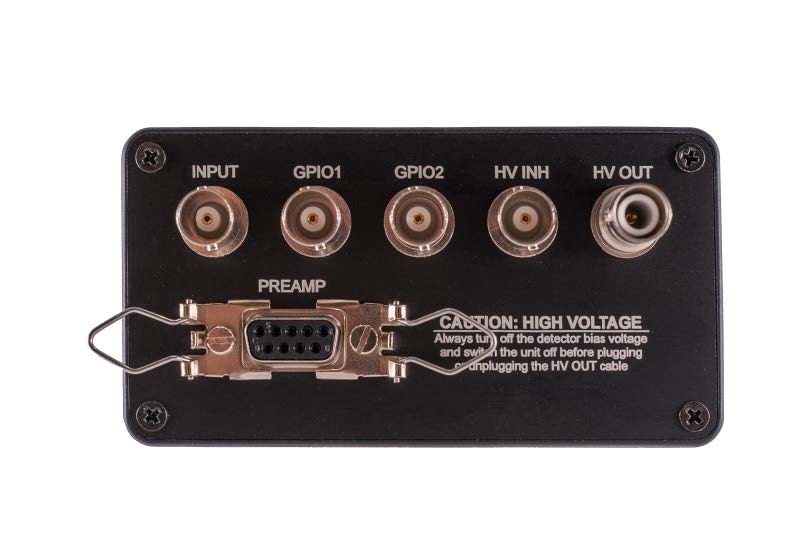
The integrated high-voltage module supplies 0 to 6000 V at 350 µA, with automatic voltage ramping on power-up and an external inhibit control line. Dual polarity is available but is set at the factory at order time. The separate preamplifier supply provides ±24 V at 125 mA and ±12 V at 250 mA through a DB9 connector on the back panel. Both RC-feedback and pulse-reset preamplifier topologies are supported, with automatic detection of the reset pulse in the latter case.
Connectivity and Physical Design
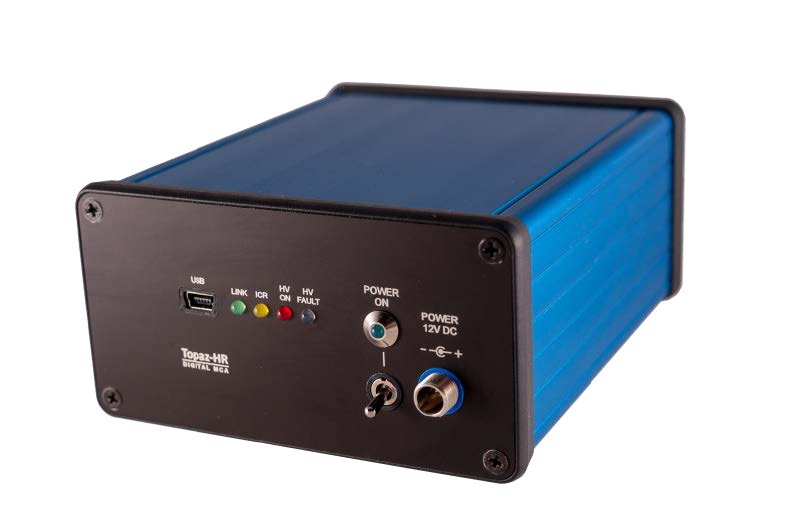
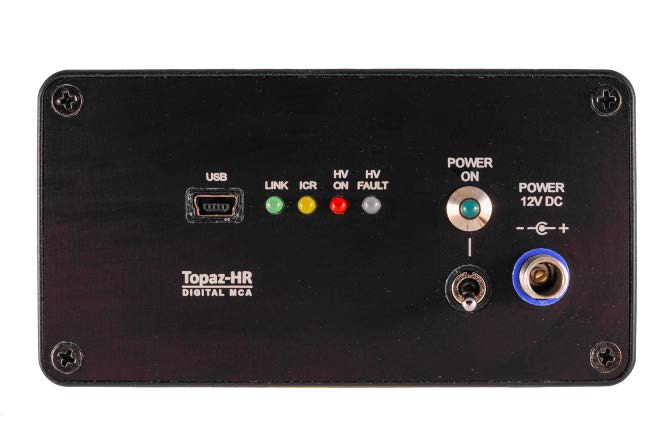
Data transfer to the host PC uses USB 2.0 at up to 480 Mbit/s. The front panel carries a DC barrel power input and a USB mini-B port. The back panel provides an SHV connector for the high-voltage output, three BNC connectors for signal input and GPIO, and the DB9 preamplifier power connector.
Four front-panel LEDs give immediate status at a glance: red for detector high-voltage status, yellow for incoming count rate, green for power and communications, and blue for HV inhibit active. A second blue LED on the power switch confirms power-on. The unit is powered by an included external low-noise AC/DC adapter (9 to 24 V, 15 W maximum).
Software Ecosystem
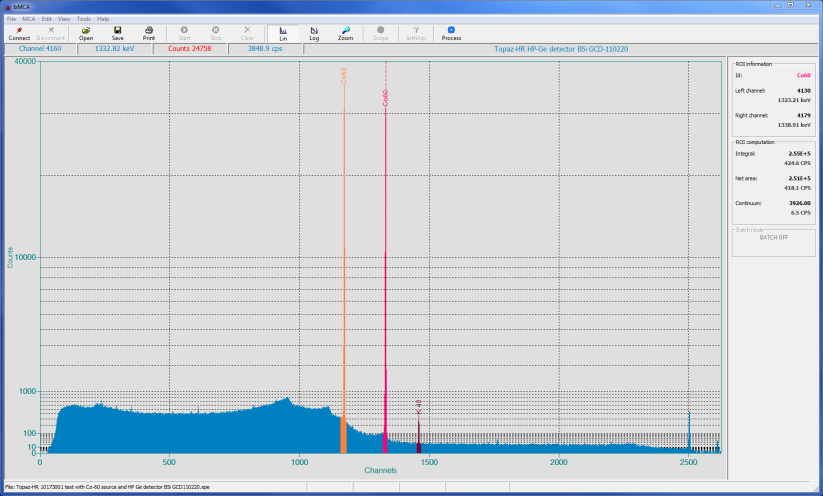
The included basic software handles device control, spectrum acquisition, and visualization. The automatic discovery function locates all BrightSpec-family MCAs connected via USB or on the local network, simplifying multi-instrument lab setups. For complete analytical capability, the TOPAZ-HR integrates with bGamma, which adds spectrum analysis, nuclide library matching, energy and efficiency calibration, and quantitative activity reporting. Programming libraries for Windows and Linux allow the MCA to be embedded in custom systems; the device is also available as a bare PCB for OEM applications.
4Technical Specifications

Device
| Parameter | Value |
|---|---|
| ADC Type | 14-bit high-performance flash ADC |
| ADC Sampling Rate | 50 Ms/s |
| DSP Processor | 100 MHz |
| CPU | 200 MHz |
| Certifications | CE compliant |
Data Acquisition
| Parameter | Value |
|---|---|
| Spectral Memory Sizes | 256, 512, 1024, 2048, 4096, 8192, 16,384 (16K) channels, 32-bit depth |
| Preamplifier Types | RC and pulse-reset; automatic reset pulse detection |
| Acquisition Modes | PHA, MCS, LIST, TLIST |
| TLIST Time Resolution | Better than 30 ns |
| Analog Gain Range | x1 to x256 |
| Coarse Gain Steps | 1, 2, 4, 8, 16, 32, 64, 128 |
| Fine Gain Range | 1 to 2 in steps of 1/16384 (approx. 0.000061) |
| Level Discriminators | Upper and Lower Level Discriminator (LLD/ULD), set in channels |
| Reset Pulse Detection | Automatic or via external signal |
| Preset Acquisition Time | 0.005 seconds to approx. 0.65 years |
| Preset Stop Modes | Real time, live time, counts in ROI, external control signal, or any combination |
MCS Mode
| Parameter | Value |
|---|---|
| MCS Memory Sizes | 256, 512, 1024, 2048, 4096, 8192, 16,384 channels, 32-bit depth |
| Dwell Time | 0.005 seconds to "count-forever" |
Digital Signal Processing Settings
| Parameter | Value |
|---|---|
| Pulse Shaper Type | Trapezoidal |
| Rise Time | 0.1 to 12 µs in steps of 0.2 µs |
| Flat Top | 0.1 to 8.0 µs in steps of 0.1 µs |
| Fast Discriminator | Adjustable threshold |
| Baseline Restorer | Digital (BLR) |
| Pile-Up Rejection | Yes (PUR) |
| Poles/Zero Cancellation | Analog, adjustable |
| Dead Time Correction | Yes, with fine-tuning capability |
Power Supply
| Parameter | Value |
|---|---|
| Device Power Input | External low-noise AC/DC adapter, 9 to 24 V (supplied), 15 W maximum |
| Preamplifier Supply Output | ±24 V at 125 mA; ±12 V at 250 mA |
| High Voltage Output Range | 0 to 6000 V |
| HV Output Current | 350 µA |
| HV Polarity | Dual polarity, fixed at factory |
| HV Ramping | Automatic on power-up |
| HV Inhibit | External control input |
GPIO
| Parameter | Value |
|---|---|
| User-Programmable I/O Lines | 2 |
| Typical Uses | External counters, external data acquisition control |
Data Communication
| Parameter | Value |
|---|---|
| Interface | USB 2.0 (High Speed) |
| Transfer Rate | Up to 480 Mbit/s |
| Cable (included) | 3-meter USB cable (mini-B) |
Physical
| Parameter | Value |
|---|---|
| Dimensions | 126 mm (L) x 106 mm (W) x 56 mm (H) |
| Weight | Less than 200 g (including enclosure) |
| Enclosure | Rugged machined aluminum |
Connectors
| Location | Connectors |
|---|---|
| Front Panel | EXT DC (barrel-type power input), USB mini-B |
| Rear Panel | SHV (high-voltage output), 3 x BNC (signal input and GPIO), DB9 (preamplifier power) |
Status Indicators
| LED | Function |
|---|---|
| Red | Detector high-voltage status |
| Yellow | Incoming count rate (ICR) |
| Green | Power and communications status |
| Blue (panel) | HV inhibit signal active |
| Blue (power switch) | Power on indication |
Software and Libraries
| Item | Details |
|---|---|
| Included Software | Basic acquisition, control, and visualization software with automatic MCA discovery |
| Optional Software | bGamma full-featured gamma-ray spectrometry software (package pricing available) |
| Programming Libraries | Windows and Linux (available upon request) |
| OEM Option | Bare PCB available for system integration |
5Applications
The TOPAZ-HR is suited wherever high-resolution or moderate-resolution gamma-ray spectrometry is required in a compact, laboratory-grade package. Primary use cases include:
- HPGe Spectrometry: The design target. Processes the semi-Gaussian pulses from hyper-pure germanium detectors with full digital shaping flexibility.
- Scintillator Spectroscopy: Compatible with NaI(Tl), CeBr3, LaBr3, and other scintillator detectors, covering a wide resolution range in a single instrument.
- Nuclear Analytical Laboratories: Radiochemical assay, environmental sample analysis, isotopic ratio measurements, and activation analysis workflows.
- Radioactivity Quantification: Combined with bGamma, supports per-nuclide activity quantification and full reporting, including calibration against reference standards.
- Coincidence and Time-Correlated Measurements: TLIST mode with sub-30 ns time resolution supports coincidence counting, angular correlation, and half-life measurements.
- Counting Rate Studies: MCS mode enables time-resolved count rate measurements for short-lived isotopes or pulsed-beam experiments.
- OEM and Custom Radiation Systems: PCB-only availability and SDK libraries allow tight integration into portal monitors, in-line assay systems, and automated laboratory instruments.
- University and Research Physics: An affordable, full-featured digital MCA for teaching laboratories and research groups requiring scripted or automated data collection.
6Ordering & Contact
The TOPAZ-HR is available as a complete boxed unit including the MCA, AC/DC power adapter, 3-meter USB cable, and basic acquisition software. Optional configurations are available at order time.
| Option | Description |
|---|---|
| TOPAZ-HR (standard) | Complete unit: MCA in aluminum enclosure, power adapter, USB cable, basic software |
| HV Polarity | Positive or negative; specify at order time (fixed at factory) |
| bGamma Software | Full-featured gamma-ray spectrometry software; package pricing when ordered with MCA |
| Programming Libraries | Windows and Linux SDK; available upon request |
| PCB (OEM) | Bare PCB for system integration; contact BNC for availability and documentation |
Request a Quote or Talk to an Engineer
Berkeley Nucleonics applications engineers can help you match the TOPAZ-HR to your detector, software workflow, and system integration requirements. Contact us to discuss configuration options, bGamma software packages, or OEM PCB availability.