1Five Numbers That Decide Quality
Two supplies set to the same voltage can give you very different results. The setpoint tells you where the output is aimed. It does not tell you how well the output holds when the mains sags, when the load changes, or after the supply has been running for hours. Five specifications govern that behavior: line regulation, load regulation, response time, ripple, and stability, with temperature coefficient close behind. Read them together, because a number that looks impressive alone can be undone by a weak partner.
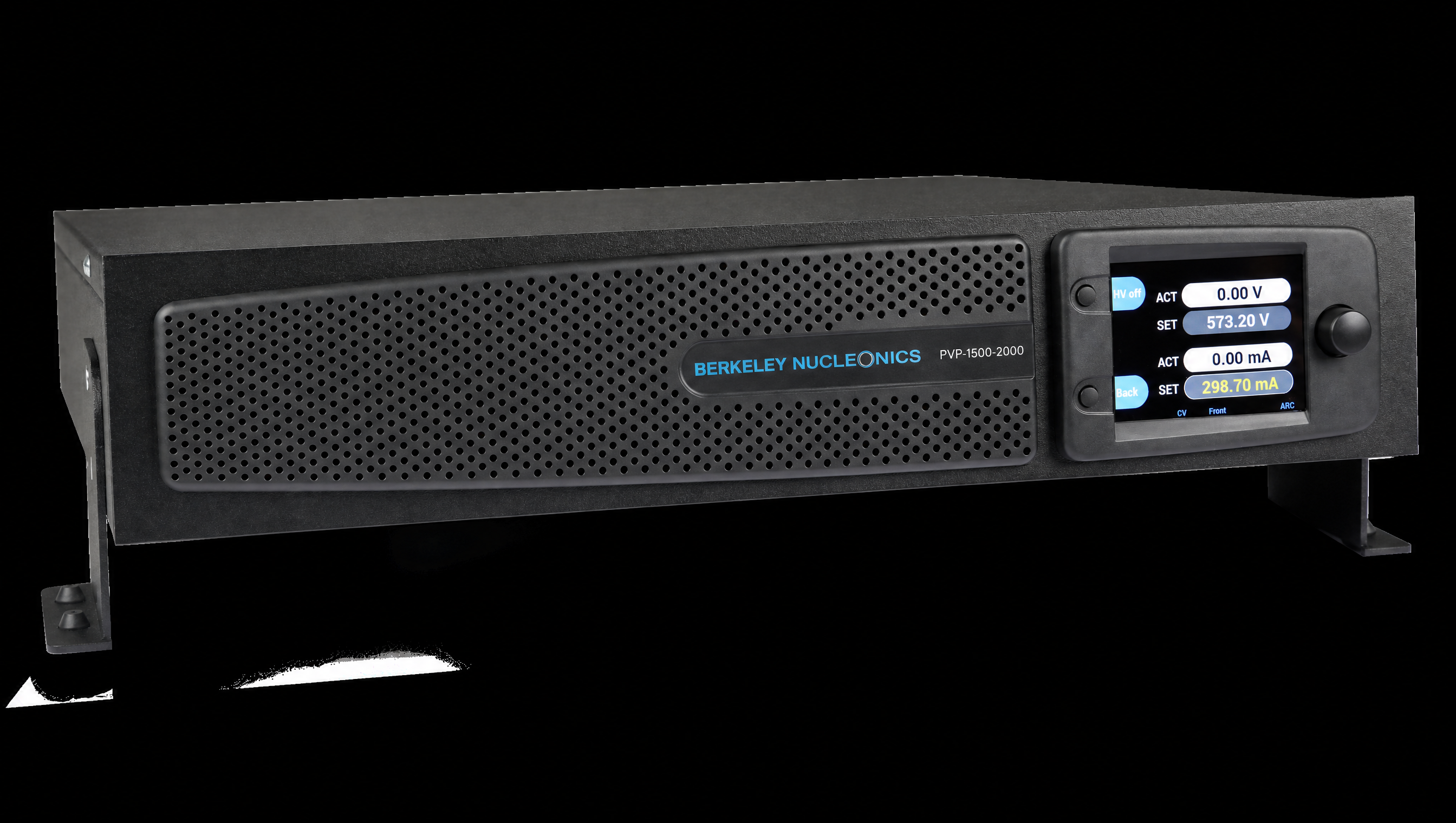
The PVP-Series is fully digitally regulated, with a microcontroller and FPGA closing the loop rather than an analog error amplifier alone. That architecture is what makes the numbers below tight and repeatable. The rest of this note explains each one in plain terms and what it means for your measurement.
2Line Regulation
Line regulation answers a simple question: if the AC mains moves, does the DC output move with it? In a real lab the mains is never perfectly steady. A large load switching on elsewhere in the building can sag the supply voltage by several percent. A good HV supply rejects that.
The PVP-Series holds line regulation tighter than +/-0.01% of nominal voltage across a +/-10% swing in the mains. On a 10 kV unit, a full 10% mains excursion moves the output by no more than about 1 V. For a calibration reference or a detector bias, that rejection is the difference between a measurement that drifts with the building and one that does not.
The input stage earns much of that rejection. The PVP-Series draws from a wide-range single-phase mains with active power factor correction, so it tolerates a soft or noisy supply line without passing the disturbance to the output. Where line regulation falls short, you see it as a slow wander on the output that tracks the building load: lights and motors switching on and off elsewhere on the same feed. A tight line-regulation figure means you can run a sensitive experiment during normal facility activity rather than waiting for a quiet shift.
3Load Regulation
Load regulation answers the partner question: if the load current changes, does the output voltage hold? Many loads are not constant. A capacitor draws heavy current while charging and almost none once charged. A gas tube draws a step of current when it strikes. Each of those events tugs on the output, and a supply with poor load regulation lets the voltage dip or overshoot.
The PVP-Series holds load regulation within 0.05% of nominal voltage for a load step from 10% to 90% of rated current. On a 5 kV unit, that is about 2.5 V of deviation across a large change in draw. The current channel is regulated to the same standard, so a constant-current setup is just as well behaved.
Load regulation and response time are best read as a pair. Load regulation sets how far the output departs from the setpoint when the draw changes; response time sets how long it stays there before the loop pulls it back. A supply can have excellent steady-state regulation and still misbehave during transients if it recovers slowly, and the opposite is also true. The PVP-Series keeps both tight, which is why it suits loads that switch hard rather than only loads that sit still.
4Response Time
Regulation tells you how far the output deviates. Response time tells you how long the deviation lasts. When the load steps, the output briefly departs from the setpoint, then the regulator pulls it back. The PVP-Series recovers to within 0.1% of nominal in under 1 millisecond. For a double-pulse test on SiC or GaN devices, or any setup where the load draws in bursts, a fast recovery keeps the bus voltage where you set it between events.
5Ripple
Ripple is the small AC residual riding on the DC output. No real supply produces perfectly flat DC. Some periodic content always survives the conversion and filtering. For many loads it does not matter. For a photomultiplier, an electron optic, a precision deflection plate, or a low-level detector bias, ripple shows up directly as noise in the result, because the load translates voltage variation into a measurable signal.
The PVP-Series keeps voltage ripple at or below 0.01% of nominal voltage plus 100 mV. The fixed 100 mV term matters at low settings and the percentage term matters at high settings, so the spec is read as the sum. On the current channel, ripple is at or below 0.01% of nominal current plus 100 mA below 20 kV, and at or below 0.02% of nominal plus 0.5 mA at 20 kV and above.
6Stability Over Time
Stability covers the slow drift that the regulation specs do not. A supply can reject the mains, hold against a load step, and still creep over a long run as components warm and age. The PVP-Series holds stability within 0.01% of nominal per 8 hours on both the voltage and current channels. For a measurement that integrates over a shift, or a calibration where the supply is the reference, that slow drift is often the limiting error, not the fast regulation. Pair it with the 16-bit setting resolution across roughly 0.01% to 100% of range, and you can place an operating point precisely and trust it to stay there.
7Temperature Coefficient
Temperature coefficient tells you how much the output moves per degree of ambient change. A lab that swings several degrees over a day will push any supply around, and the temperature coefficient sets how far. The PVP-Series holds at or below 0.01% of nominal per kelvin on both channels. If your environment is not tightly controlled, this number, combined with the 8-hour stability figure, predicts how much your reference will wander between calibrations. The PVP-Series is rated for operation from 32 to 104 degrees F (0 to 40 C).
8Reading the Spec Sheet Together
The table below collects the precision specifications in one place. Read across, not down. A measurement that needs a clean, steady reference cares about ripple and stability; a measurement with a bursty load cares about load regulation and response time. The right supply is the one whose weakest relevant number still clears your error budget.
| Specification | Voltage channel | Current channel |
|---|---|---|
| Setting range / resolution | ~0.01 to 100% U_nom, 16-bit | ~0.01 to 100% I_nom, 16-bit |
| Line regulation (+/-10% mains) | < +/-0.01% U_nom | < +/-0.01% I_nom |
| Load regulation (10 to 90% step) | ≤ 0.05% U_nom | ≤ 0.05% I_nom |
| Response time (to 0.1%) | < 1 ms | < 1 ms |
| Ripple | ≤ 0.01% U_nom + 100 mV | ≤ 0.01% I_nom + 100 mA (< 20 kV); ≤ 0.02% + 0.5 mA (≥ 20 kV) |
| Stability | ≤ 0.01% U_nom / 8 h | ≤ 0.01% I_nom / 8 h |
| Temperature coefficient | ≤ 0.01% U_nom / K | ≤ 0.01% I_nom / K |
9Talk to an Engineer
Specifications only matter against a real error budget. To work through which of these numbers limit your measurement, and which PVP-Series model clears them, contact Berkeley Nucleonics at 800-234-7858 or info@berkeleynucleonics.com.
For a quick question, chat with an engineer at berkeleynucleonics.com.