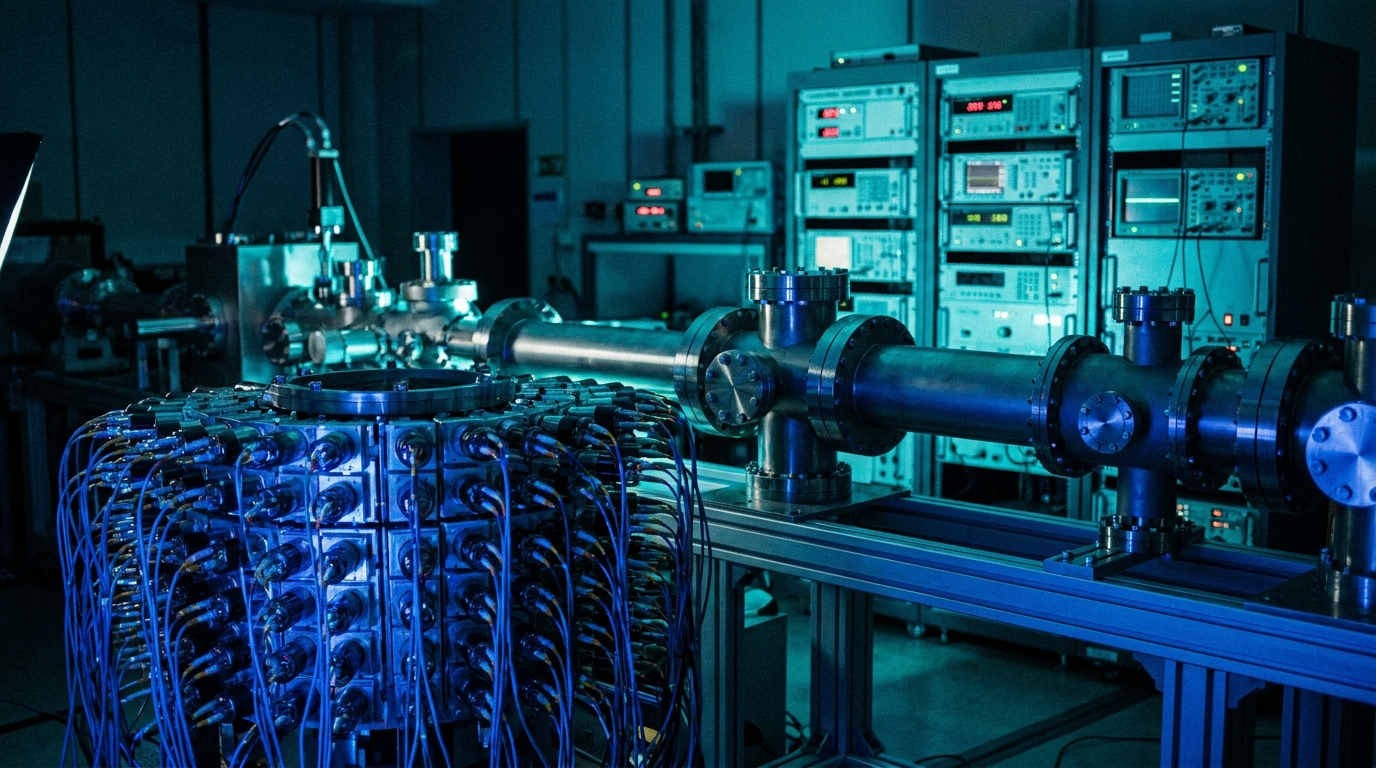
Detectors & Nuclear Instrumentation
Radiation detection is built on bias quality. A photomultiplier tube, a silicon photomultiplier, a proportional counter, a drift chamber, a wire chamber, or an accelerator beamline electrode all share one requirement: the bias voltage that sets the gain has to be clean and it has to stay put. This is the territory Berkeley Nucleonics has worked in for decades, and the demands are unforgiving. Ripple and noise on the bias rail couple straight into the signal chain and show up as detector noise, widening peaks and eroding energy resolution. Drift on the rail is worse in a slower way. As the bias wanders, the detector gain wanders with it, and the calibrated energy scale shifts out from under the spectrum. A measurement that was good in the morning no longer agrees with itself by afternoon.
The bias requirements follow directly. Detector work needs very low ripple and noise, excellent long-term stability with a low temperature coefficient, and fine setting resolution so the operating point can be placed exactly on the plateau or the gain curve. It needs low, well-defined current, because a detector draws very little and the supply has to regulate cleanly down at that level. It needs polarity flexibility, since photomultipliers and detectors run positive or negative depending on the design. It often needs a floating, potential-free output for stacked stages or dividers that do not sit at ground. And it needs a gentle, controlled ramp, because a hard step onto a biased detector or a charged divider string is a good way to damage an expensive device.
How the PVP-Series solves it
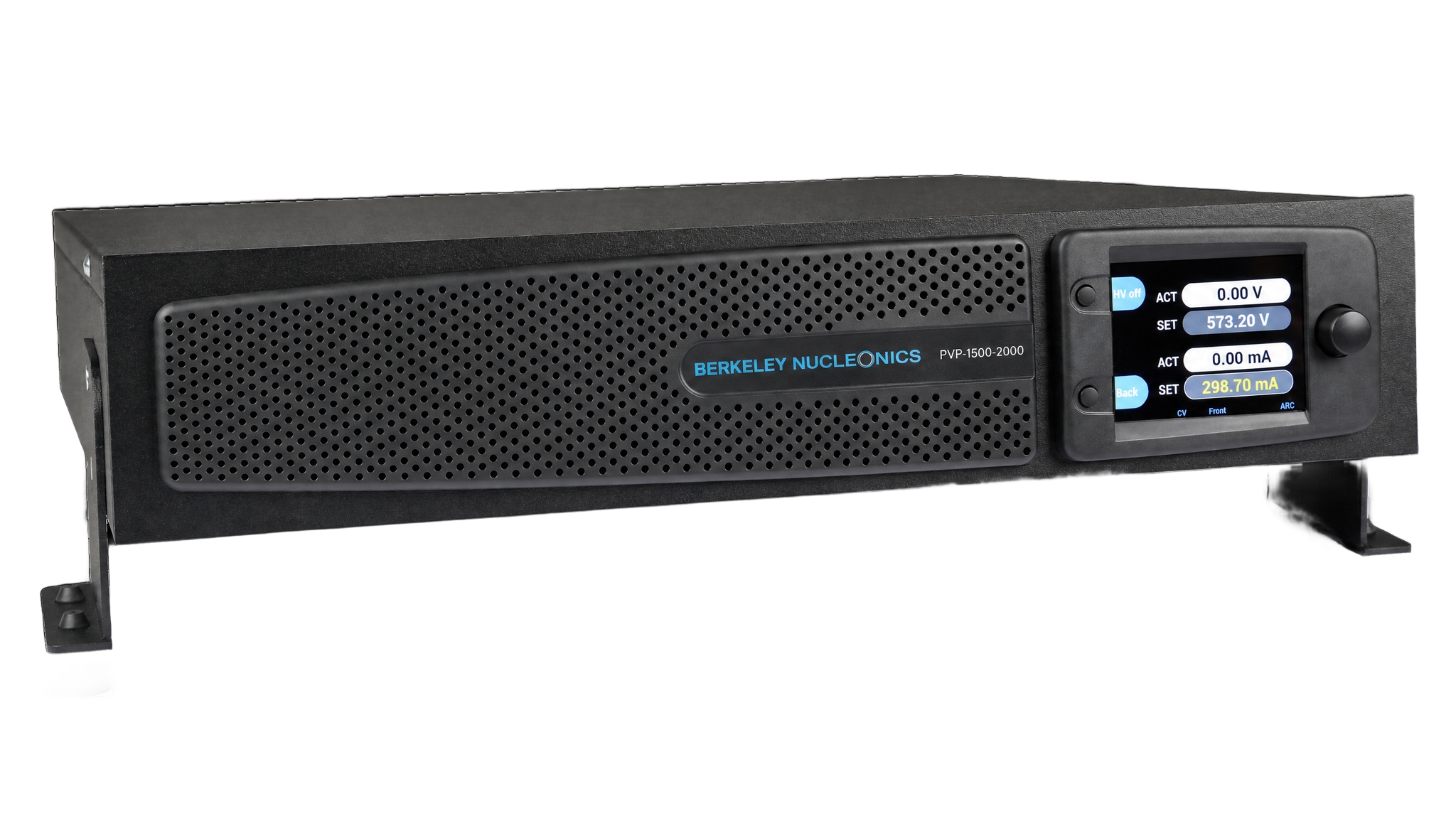
The PVP-Series is a fully digitally regulated DC high-voltage supply, built around a microcontroller and FPGA rather than an analog control loop. That digital regulation is what makes the bias rail behave the way detector work demands. Line regulation is tighter than plus or minus 0.01 percent of nominal across a 10 percent mains swing, stability holds within 0.01 percent of nominal over an eight-hour session, and the temperature coefficient is held to 0.01 percent of nominal per degree. Together those numbers mean the bias point set this morning is the same bias point this evening, so the calibrated energy scale stays where it was put and a long acquisition can be trusted from first event to last.
Ripple is specified at 0.01 percent of nominal plus a small fixed term, the kind of clean rail that keeps supply noise out of the energy resolution. Setting is 16-bit across roughly 0.01 to 100 percent of nominal, fine enough to walk a photomultiplier up its gain curve or sit a proportional counter precisely on its plateau. The supply responds to within 0.1 percent of nominal in under 1 millisecond, and current regulation is just as tight as voltage regulation, which matters when a detector draws only a small, well-defined bias current. Polarity is electrically reversible, positive or negative and earth-referenced, and floating potential-free variants are available for stages that cannot sit at ground. Ramp Control brings the bias up at a defined gradient instead of an inrush step, protecting the detector and the divider string on every power-up.
Control is automation-ready. Ethernet and RS232 with a standard SCPI command set let the supply take bias commands from the acquisition system, and the time-tagged event log records every run for the record. The 2U enclosure racks into a counting station or a beamline crate alongside the rest of the instrumentation.
Which PVP-Series models and options fit
Detector and nuclear instrumentation bias spans a wide range, from a few hundred volts on a silicon photomultiplier to tens of kilovolts on a beamline electrode. The common thread is low current, so the right model is usually set by voltage class.
| Need | Recommended PVP-Series model | Rating |
|---|---|---|
| PMT and detector bias, low current, low ripple | PVP-1500-1400 | 1.5 kV, 1400 mA, reversible |
| PMT, SiPM, and proportional counter bias | PVP-5000-400 | 5 kV, 400 mA, reversible |
| Higher-bias detectors, drift and wire chambers | PVP-10000-200 | 10 kV, 200 mA, reversible |
| Accelerator and beamline electrode bias | PVP-30000-17 | 30 kV, 17 mA |
| Potential-free, stacked, or floating stages | PVP-1500-1400 flo | 1.5 kV, 1400 mA, floating output |
For detector bias the two options that matter most are Ramp Control and Arc Detection. Ramp Control sets a defined voltage gradient on the way up, from 1 V/s to a steep rate, so a photomultiplier or a divider string is never hit with a bias step. Arc Detection watches for a flashover, reports it, and can shut the output off, protecting the detector and the front-end electronics if a stage breaks down. Choose the reversible variant where the design runs either polarity, and the floating-output variant where a stage cannot be referenced to ground.
Recommended configuration
For a general counting station running photomultipliers, silicon photomultipliers, and proportional counters, a PVP-5000-400 in the reversible configuration is the right center. Its 5 kV ceiling covers the great majority of photomultiplier and counter bias points, the 400 mA class is far more current headroom than a detector needs, and the low-ripple, high-stability rail keeps the energy scale calibrated through a long acquisition. Add Ramp Control as the standard power-up protection and Arc Detection with output shut-off as the fault protection.
Where bias stays under 1.5 kV, the PVP-1500-1400 gives the same clean rail at a lower voltage class, and its floating-output variant, the PVP-1500-1400 flo, covers stacked or potential-free stages. Higher-bias detectors, drift chambers, and wire chambers step up to the PVP-10000-200, and accelerator or beamline electrode bias uses the PVP-30000-17. In every case, drive the supply over Ethernet with SCPI from the acquisition system so bias state is logged with the data, and rack the 2U unit into the counting station or beamline crate.
Talk to an application engineer
Berkeley Nucleonics can help you match a PVP-Series model and option set to your detector or nuclear instrumentation bench. Call 800-234-7858 or email info@berkeleynucleonics.com.
For a quick question, chat with an engineer at berkeleynucleonics.com.