The Detection Challenge
Threats at a port of entry do not announce themselves. Shielded special nuclear material (SNM), improvised radiological devices, and smuggled medical isotopes all present weak, sometimes heavily scattered signatures. A detector that misidentifies a naturally occurring radioactive material (NORM) as a threat triggers costly false alarms. One that fails to flag a genuine weapon-grade source is a catastrophic gap.
Three capabilities define a credible homeland security detector. First, energy resolution: the sharper the gamma spectrum, the more confidently the algorithm separates Cs-137 from Ba-133, or U-235 from Ra-226. Second, neutron sensitivity: plutonium and weapons-grade uranium emit neutrons, and only a crystal that responds to both gammas and neutrons can confirm the full signature in a single instrument. Third, speed: a RIID carried by a first responder or mounted in a portal must reach a definitive identification in seconds, not minutes.
No single material is optimal for every scenario. Berkeley Nucleonics ScintIQ detectors are configured to match the mission: RIID hand-helds, walk-through portal monitors, vehicle search, backpack search systems, and fixed-site monitoring all place different demands on crystal size, resolution, and ruggedness.
Why Resolution and Neutron Capability Matter for Isotope ID
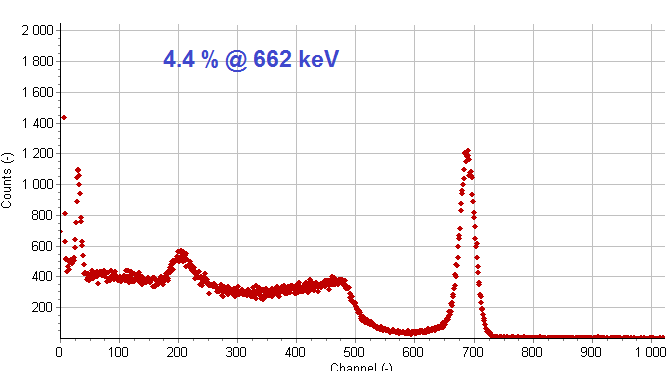
Gamma energy resolution is expressed as the full-width at half-maximum (FWHM) of a photopeak, given as a percentage of peak energy. NaI(Tl), the longstanding workhorse of radiation search, delivers roughly 7% resolution at 662 keV. That is adequate for broad categorization. But confirming the difference between Eu-152 and a shielded Am-241 device, or resolving the 185 keV U-235 line in the presence of Ra-226, requires better performance.
LaBr3(Ce) narrows that window to approximately 2.7% at 662 keV, roughly three times sharper than NaI. The gain is most significant at lower energies, where isotope-specific photopeaks cluster and overlap. A higher-resolution spectrum means the identification algorithm can run with higher confidence and lower false-positive rates, directly reducing alarm fatigue for operators.
Neutron detection is the other critical axis. Plutonium isotopes emit spontaneous fission neutrons; many improvised devices incorporate beryllium neutron multipliers alongside a gamma emitter. A detector sensitive only to gamma radiation cannot conclusively confirm or exclude these signatures. CLYC (Cs2LiYCl6:Ce) and CLLBC (Cs2LiLaBr4.8Cl1.2:Ce) are dual-mode crystals: the Li-6 content captures thermal neutrons, while the same crystal simultaneously records the gamma spectrum. Pulse-shape discrimination (PSD) cleanly separates neutron events from gamma events in the signal processing chain, with no need for a separate neutron detector module.
This matters operationally. A single compact CLYC or CLLBC detector replaces a gamma crystal plus He-3 tube (increasingly supply-constrained and expensive), reduces instrument size and weight, and simplifies the electronics chain. The neutron channel adds unambiguous confirmation that an anomaly contains fissile material, not merely a radioactive isotope with a similar gamma signature.
ScintIQ Materials for Homeland Security
Four crystal families address the range of homeland security use cases. Each has a distinct performance profile.
| Material | Density (g/cm³) | Energy Resolution @ 662 keV | Neutron Detection | Primary Role |
|---|---|---|---|---|
| CLYC | 3.31 | ~4% (verify) | Yes (Li-6, PSD) | RIID, SNM confirmation, dual-mode search |
| CLLBC | 4.08 | ~3% (verify) | Yes (Li-6, PSD) | High-resolution RIID, upgraded dual-mode |
| NaI(Tl) | 3.67 | ~7% | No | Portal monitors, wide-area search, vehicle scan |
| LaBr3(Ce) | 5.07 | ~2.7% | No | Precision RIID, isotope library confirmation |
CLYC: The Dual-Mode RIID Crystal
CLYC delivers a moderate gamma resolution alongside confirmed thermal neutron sensitivity through its Li-6 content (relative light yield 30 to 40 vs NaI = 100). Its tri-component decay time (1 ns, 50 ns, and 1 microsecond components) enables the pulse-shape discrimination that separates neutron events from gamma events in software. The result is a single crystal that satisfies both the gamma-ID and neutron-alarm requirements of modern RIID standards. CLYC is hygroscopic and requires hermetic packaging, standard for field-deployed detectors.
CLLBC: Higher Resolution, Same Dual-Mode Capability
CLLBC pushes the dual-mode concept further. By substituting lanthanum and bromine into the lattice (Cs2LiLaBr4.8Cl1.2:Ce), the crystal achieves a light yield around 70 (relative to NaI = 100) and correspondingly sharper gamma resolution. This makes CLLBC the preferred choice when a RIID must resolve closely spaced isotope lines while still confirming neutron presence. The density of 4.08 g/cm³ also improves stopping power relative to CLYC. CLLBC is hygroscopic; appropriate detector housings are required.
NaI(Tl): Large-Format Search and Portal Monitoring
NaI(Tl) remains the dominant crystal for systems where detection efficiency matters more than resolution. Its light yield of 100 (the reference standard), low cost per volume, and mature production base make it practical in large-area panel configurations, vehicle portal monitors, and hand-held search instruments. A 7% resolution at 662 keV is sufficient for the gross isotope categorization (NORM vs. SNM vs. medical) that portal algorithms require. NaI(Tl) is hygroscopic; all ScintIQ NaI assemblies ship in sealed aluminum or stainless housings with hermetic optical coupling.
LaBr3(Ce): Precision Spectroscopy in the Field
Lanthanum bromide brings laboratory-grade resolution to field instruments. At approximately 2.7% FWHM at 662 keV (versus 7% for NaI), LaBr3 produces spectra tight enough to resolve isotope doublets that would otherwise merge. Its fast decay time (16 to 20 ns) allows high count-rate operation without pile-up, useful at checkpoints with high cargo throughput. The intrinsic La-138 background emission (at 1436 keV and 789 keV) is a known artifact, well-characterized and easily accounted for in isotope ID libraries. LaBr3 is hygroscopic and is supplied in sealed detector assemblies.
Mission Profiles and Detector Matching
Homeland security detection spans several distinct operational contexts. The crystal choice follows from the mission.
Radiation Isotope Identification Devices (RIIDs)
A RIID is a hand-held instrument carried by CBP officers, first responders, and military EOD teams. It must identify an isotope in seconds while the user is moving. The highest-value configurations pair CLLBC (for dual-mode, high-resolution spectroscopy) or LaBr3 (for maximum gamma resolution) with compact SiPM readout electronics. CLYC is a cost-effective alternative when budget constrains the choice between resolution and dual-mode neutron capability.
Portal Monitors and Fixed-Site Systems
Vehicle portals and pedestrian walk-throughs require large sensitive volumes and fast throughput. NaI(Tl) panel arrays are the standard configuration. Typical panels range from 2 to 4 liters of crystal volume per side. ScintIQ NaI(Tl) detectors are available in custom rectangular and cylindrical geometries (maximum dimensions verify with factory) to match existing portal frame designs. For upgraded portals where isotope identification is required beyond simple alarm triggering, LaBr3 modules can supplement NaI panels as secondary confirmation detectors.
Backpack and Standoff Search
Mobile search teams at large events or wide-area surveys use backpack-form detectors that must balance sensitivity with wearable weight. NaI(Tl) in 2-inch cylindrical or 3x3 inch geometries is typical here. For missions where neutron detection is specifically needed (SNM interdiction sweeps), CLYC in a compact housing provides simultaneous gamma and neutron mapping without requiring a separate He-3 instrument.
Radiological Emergency Response
First-responder teams assessing a suspected radiological dispersal device need to characterize the source quickly and from a safe standoff. LaBr3 detectors, with their fast decay and sharp resolution, allow shorter integration times at distance. CLYC or CLLBC adds the neutron channel for confirming whether fissile material is present, guiding the initial protective action decision before the full HAZMAT team arrives.
Berkeley Nucleonics engineers work with program managers and system integrators to specify crystal geometry, readout, housing, and electronics for each application. Contact us to discuss RIID-grade CLYC or CLLBC assemblies, large-format NaI portal configurations, or LaBr3 precision ID modules.
Email: info@berkeleynucleonics.com · Phone: 800-234-7858