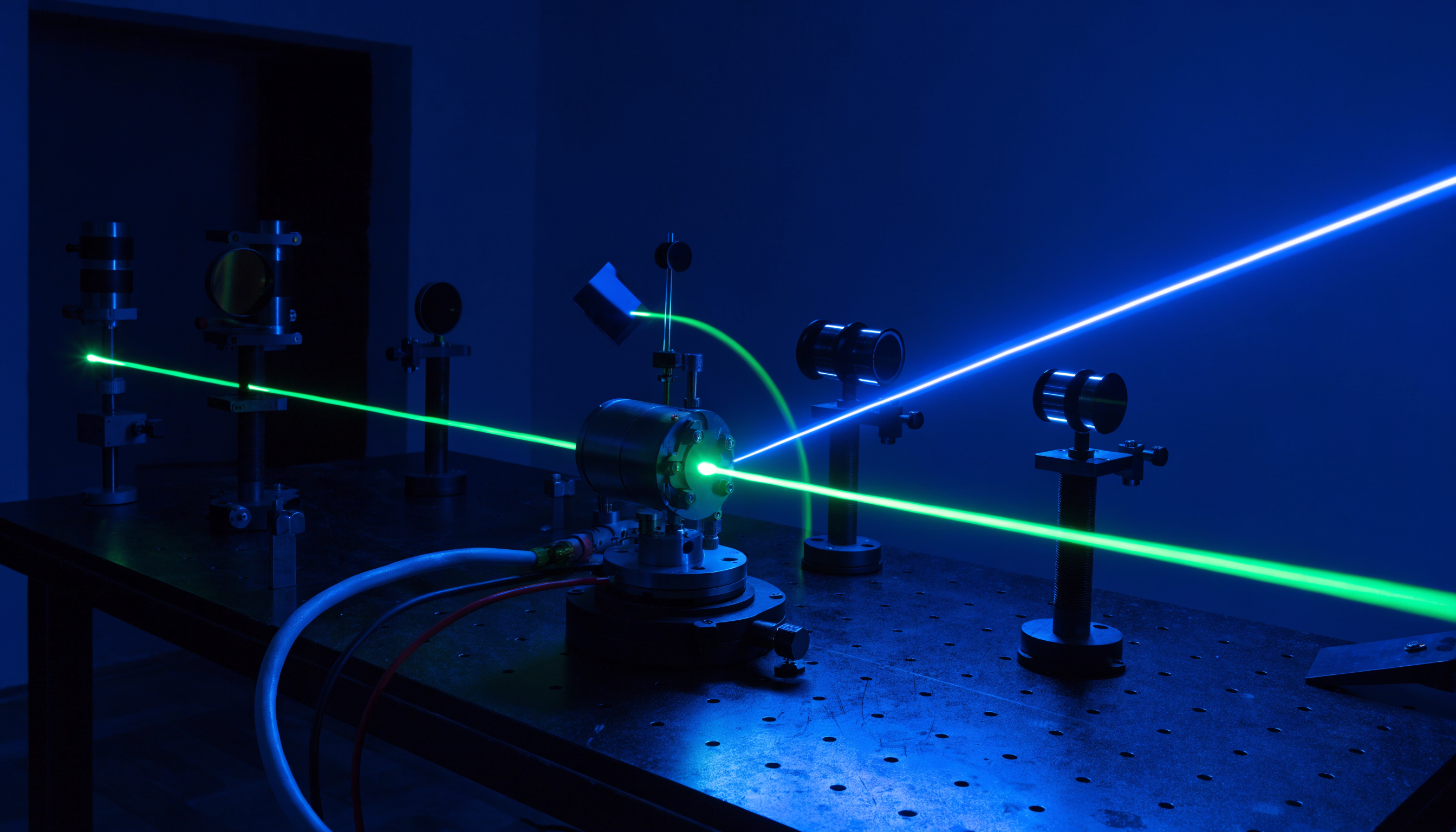
Pockels Cell & Q-Switch Driving
A Pockels cell is an electro-optic crystal whose polarization response changes with applied voltage. Place one inside a laser cavity, hold it at the right potential, and it becomes a fast optical switch: the cavity can be held below threshold while energy builds in the gain medium, then switched open in nanoseconds to dump a giant pulse. That is the heart of active Q-switching and cavity dumping, and the quality of the optical pulse is set almost entirely by the quality of the high-voltage pulse that drives the crystal.
The crystal presents a small but real capacitance to the driver, typically a few to tens of picofarads. Switching it cleanly means moving kilovolts across that capacitance in nanoseconds, on command, at exactly the right instant relative to the pump and the cavity. The driver therefore has to deliver a fast HV edge into a capacitive load and place that edge in time with very little jitter, because in a Q-switched cavity the timing of the switch sets the timing and the energy of the emitted pulse.
The Challenge
Rise time is the first constraint, and it couples directly to cavity timing. The switch has to open faster than the cavity can build or dump its energy, otherwise the optical pulse is smeared and the peak power suffers. A driver whose edge is slow relative to the cavity round-trip compromises the very pulse it is meant to create, so a fast, clean transition into the crystal is not a luxury, it is the specification.
Jitter is the second constraint, and it is where cavity dumping is most demanding. Dumping requires the switch to fire at a precise moment in the intracavity build-up, and any shot-to-shot variation in that moment translates into variation in output energy and timing. For systems that synchronize the laser to an external event, an amplifier chain, a probe pulse, a machine clock, low jitter between the trigger and the HV edge is what makes the laser usable as a timed source rather than a free-running one.
Repeatability ties the two together. A driver that produces a slightly different edge or a slightly different delay on each shot makes every pulse a little different, which is unacceptable for precision machining, ranging, or scientific work. The crystal will not forgive an edge that overshoots or rings either, so the flat, settled level after the transition matters as much as the speed of the transition itself.
The BNC Approach
DEI pulse generators are designed for exactly this load: a small capacitance that needs a fast, clean kilovolt transition placed precisely in time. The half-bridge totem-pole output actively drives the crystal in both directions, so the rising edge that opens the switch and the falling edge that closes it are both fast and both settle without the ringing that would distort the optical pulse. The programmable VHigh and VLow levels let the driver hold the crystal at its bias point and switch to the half-wave or quarter-wave voltage on each trigger, which is the natural way to operate a Pockels cell.
Low timing jitter between the external trigger and the output edge is the property that makes these drivers suited to cavity dumping and to synchronized Q-switching. The built-in voltage and current monitors let the laser engineer observe the real edge into the real crystal, verify the switching level, and confirm that the flat top is settled before the optical pulse is generated. Use the figures below as capability targets and confirm them against the current published datasheet for your crystal and configuration.
Recommended Instruments
The PVX-4141 is a strong default for Pockels-cell and Q-switch driving, pairing a 3,500 V output with a fast edge near 25 ns and very low timing jitter, on the order of a few hundred picoseconds, across single-shot to roughly 30 kHz operation. For cavities that need higher switching voltage, the PVX-4130 extends the bipolar, capacitive-load approach to plus or minus 6,000 V.
When the cavity demands the fastest possible transition rather than the highest voltage, the PVM-1001 targets very fast rise times, on the order of 8 ns, which suits short cavities and high-rate switching where the edge has to clear the round-trip time with margin. The PVX-4150 serves lower-voltage cells at high repetition rate, where the priority is rate and edge fidelity rather than absolute amplitude. The right choice follows from the crystal half-wave voltage, the cavity timing, and the repetition rate of the laser.
Getting Started
Begin with the crystal: its half-wave or quarter-wave voltage, its capacitance, and the polarity of the bias your cavity uses. Add the cavity timing requirement, the round-trip time and the build-up window for dumping, and the repetition rate. Those four numbers point directly at a model and at the rise-time and jitter targets that matter. The VHigh/VLow operating model maps onto the bias-then-switch behavior of a Pockels cell, and the built-in monitors let you confirm the switching edge into your actual crystal during bring-up.
Talk to a BNC applications engineer at info@berkeleynucleonics.com or 800-234-7858. Bring your crystal capacitance, half-wave voltage, cavity timing, and repetition rate, and we will match a DEI pulse generator to the switching precision your laser requires.