The Challenge of Neutron Detection
Neutrons carry no charge. They pass through most materials unimpeded and interact only via nuclear reactions, which makes their detection fundamentally different from gamma or charged-particle measurement. The detector cannot simply collect ionization in the conventional sense. Instead, the neutron must first be converted to a secondary particle, charged ion, or gamma photon that a scintillator can respond to.
For decades, helium-3 (He-3) proportional counters were the default solution for thermal neutron detection. They are sensitive, reliable, and selective. The problem is supply: He-3 is a scarce byproduct of tritium decay, and its cost and availability have constrained detector programs across homeland security, nuclear safeguards, and research. Solid scintillator alternatives now match or exceed He-3 performance in several key applications, and they are manufacturable at scale.
A second challenge is the field environment. Most neutron sources of practical interest (special nuclear material, reactor-adjacent positions, cosmic-ray spallation products) are accompanied by intense gamma backgrounds. A neutron detector that cannot reject gamma events reliably will saturate in those environments. Pulse-shape discrimination (PSD) is the principal tool for separating neutron and gamma signals in a single detector, and the crystal's intrinsic scintillation physics determines how cleanly PSD works.
ScintIQ Materials for Neutron Detection
Berkeley Nucleonics offers three ScintIQ crystal families suited to neutron work. Each brings a distinct tradeoff among sensitivity, energy resolution, PSD figure of merit, and environmental robustness.
CLYC (Cs2LiYCl6:Ce)
Dual-mode neutron and gamma detection. Excellent PSD separation. Fast components at 1 ns and 50 ns; slow component near 1 microsecond. Density 3.31 g/cm³. Hygroscopic, requires hermetic housing. Emission peak at 370 nm, PMT or SiPM compatible.
CLYC Data SheetCLLBC (Cs2LiLaBr4.8Cl1.2:Ce)
High-resolution dual-mode neutron and gamma detection. Higher relative light yield (~70 vs NaI=100) than CLYC. Density 4.08 g/cm³. Faster decay components at 120 ns and 500 ns. Hygroscopic. Emission peak at 420 nm, well matched to bialkali PMTs.
CLLBC Data Sheet6Li-glass
Thermal neutron detection via the 6Li(n,alpha)3H reaction. Non-hygroscopic, mechanically rugged, fast decay (~60 ns). Density 2.6 g/cm³. Low relative light yield (4-6 vs NaI=100) but high thermal neutron cross section. No hermetic housing required.
6Li-glass Data Sheet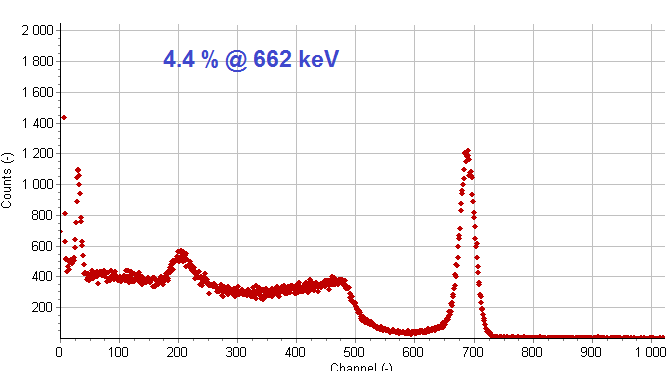
Thermal vs. Fast Neutrons: What Each Material Provides
Thermal Neutron Detection
Thermal neutrons (energies below ~0.5 eV) react efficiently with 6Li via the reaction 6Li + n produces alpha + triton, releasing 4.78 MeV of kinetic energy. Both CLYC and CLLBC contain lithium enriched in 6Li, giving them high thermal neutron detection efficiency. 6Li-glass shares the same nuclear reaction and adds the option of position-sensitive detector arrays: thin glass tiles can be stacked or arranged to cover large areas with no hermetic packaging requirement.
In practice, a thermalized moderator (polyethylene shielding around the detector) increases thermal neutron flux at the crystal face and improves detection efficiency for fast-neutron sources such as californium-252 or weapons-grade plutonium. The moderator design is application-specific and is discussed in the neutron-gamma discrimination technical note referenced below.
Fast Neutron Sensitivity
Fast neutrons (MeV range) interact differently. In CLYC and CLLBC, fast neutrons can scatter protons from hydrogen-containing materials in the housing or produce reactions with the chlorine and lanthanum nuclei in the crystal. The resulting recoil events generate scintillation pulses with decay profiles distinguishable from gamma events and, to a degree, from thermal neutron captures. The figure of merit for PSD in CLYC is well established in the literature. CLLBC extends this with higher light yield, improving statistical separation at lower event energies.
For instruments that need intrinsic fast-neutron sensitivity without a moderator (neutron scatter cameras, cosmic-ray neutron sensors, reactor near-field monitors), CLYC and CLLBC are the recommended ScintIQ options. 6Li-glass is primarily a thermal neutron material and has limited fast-neutron utility without moderation.
Gamma Spectroscopy Alongside Neutron Counting
One of the most important attributes of CLYC and CLLBC is that they deliver usable gamma energy resolution in addition to neutron detection. CLLBC in particular achieves gamma energy resolution competitive with mid-grade NaI(Tl) detectors, with the added capability of neutron discrimination. This makes a single detector head sufficient for both isotope identification and neutron threat detection, which matters for handheld RIID instruments and portal monitors where size, weight, and cost all constrain the system.
The practical result: a CLLBC detector can identify Cs-137 and Co-60 peaks in a gamma spectrum while simultaneously flagging neutron counts above a threshold, without separate detector modules. The same readout electronics handle both channels.
Typical Applications
- Radiological Identification Devices (RIIDs): CLYC and CLLBC are established materials for handheld and backpack-carried instruments requiring combined neutron and gamma identification. Replacing He-3 tubes with a scintillator crystal reduces volume and eliminates pressurized-gas handling.
- Portal and Vehicle Monitors: Large-area neutron detection for border crossings and checkpoint portals. 6Li-glass tile arrays provide scalable active area; CLLBC provides higher resolution for confirmatory identification within the same footprint.
- Nuclear Safeguards and Materials Accounting: Neutron counting from fissile material (plutonium, uranium) at nuclear facilities. PSD capability allows operation in mixed gamma-neutron fields without external gamma shielding.
- Reactor Instrumentation: Near-core and ex-core neutron flux monitoring. CLYC and CLLBC offer radiation-hardened operation (verify specific fluence limits with Berkeley Nucleonics engineering).
- Cosmic-Ray Neutron Sensing: Ground-level soil moisture sensing and atmospheric neutron spectroscopy. CLYC and CLLBC handle the mixed thermal/fast cosmic-ray neutron spectrum without moderation in some configurations.
- Research and University Labs: Neutron activation analysis, beam-line experiments, and cross-section measurements where simultaneous neutron and gamma data improve experiment efficiency.
Selecting the Right ScintIQ Material
| Requirement | Recommended Material | Notes |
|---|---|---|
| Thermal neutron detection, no hermetic housing | 6Li-glass | Rugged, fast, scalable to large areas. Limited fast-neutron and gamma capabilities. |
| Dual-mode neutron + gamma with PSD | CLYC | Established PSD figure of merit. Hygroscopic, requires hermetic can or sealed housing. |
| Dual-mode neutron + gamma, higher gamma resolution | CLLBC | Better light yield and gamma energy resolution than CLYC. Hygroscopic. Slightly higher density. |
| Neutron detection + high-resolution gamma spectroscopy in one head | CLLBC | Best combined performance. Suitable for advanced RIID and safeguards instruments. |
| Large active-area portal, lowest cost per cm² | 6Li-glass | Tiles are manufacturable in large panels. Confirm panel dimensions with engineering. |
All three materials are available as bare crystals or as assembled ScintIQ detector modules with PMT or SiPM readout, preamplifier, and housing. Detector assembly options, maximum crystal dimensions, and readout configurations are documented on the individual data sheets. For applications requiring a complete counting system, Berkeley Nucleonics offers the TOPAZ-HR and bMCA digital MCA platforms as companion electronics.
Talk to an Engineer
Neutron detector selection depends on source geometry, moderator design, gamma background level, and the PSD algorithm implemented in your readout chain. The Berkeley Nucleonics engineering team works through these tradeoffs with customers before recommending a crystal size and readout configuration.
Contact us to discuss your measurement geometry, throughput requirements, and budget. We can quote bare crystals, hermetically sealed detector heads, and complete counting systems depending on your integration stage.