1Overview
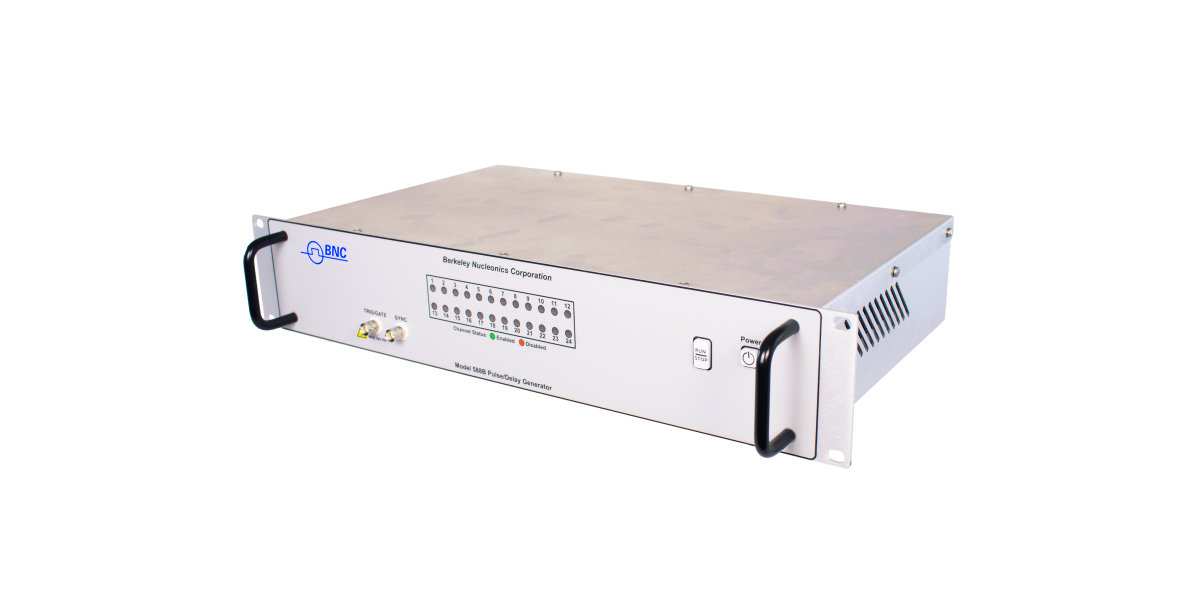
The Model 588B is the highest-channel-count member of the Berkeley Nucleonics pulse and delay generator family. It is available with twelve or twenty-four independent channels, and advanced configurations extend it to as many as thirty-six independent outputs. All of that fits in a 2U rackmount chassis.
The 588B pairs high density with precision. Delay resolution is 250 ps, delay accuracy is 1 ns plus 0.0001 times the period, and channel-to-channel jitter stays below 5 ps RMS. A system timer works alongside per-channel timers to build complex multi-channel waveforms, which is exactly what high-density timing work asks for: many edges, tightly synchronized, from one box.
2Key Features
- Twelve or twenty-four independent channels, up to thirty-six outputs
- 2U rackmount chassis
- 250 ps delay resolution
- Channel-to-channel jitter below 5 ps RMS
- Delay accuracy of 1 ns + 0.0001 times the period
- System timer plus per-channel timers for complex waveforms
- Dual inputs: gate/trigger or optional dual trigger
- External clock reference input
- Normal, single-shot, and burst modes
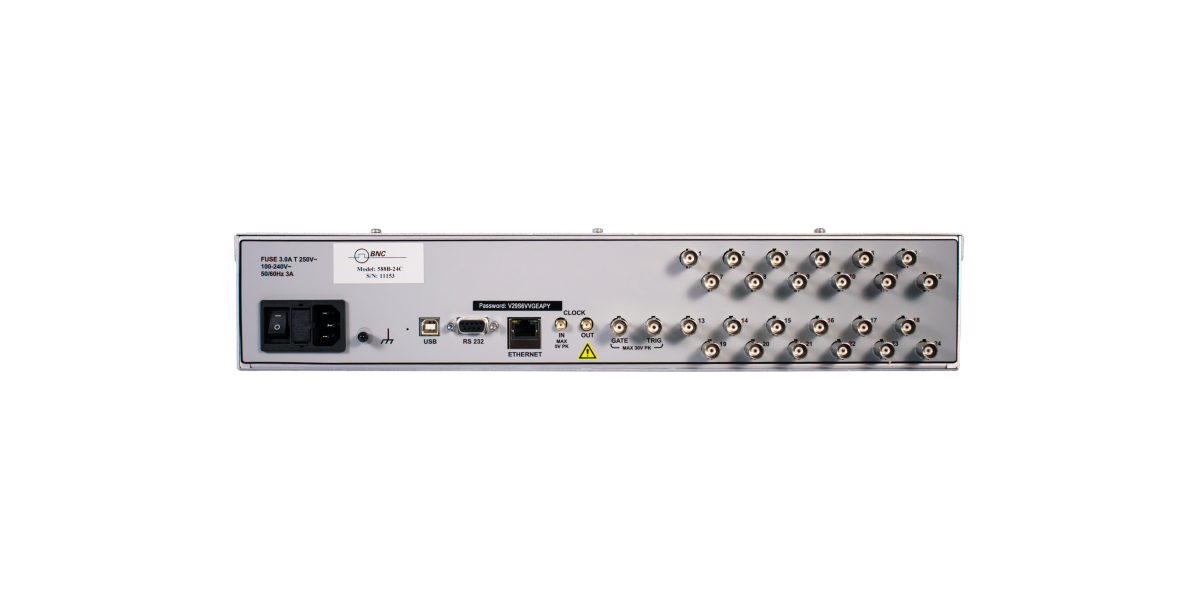
- USB, RS-232, and Ethernet interfaces
3Channels & Timing Architecture
The 588B is built around a system timer with independent per-channel timers. Each channel sets its own delay and width, so a single instrument can drive a dozen or two dozen precisely timed edges across one experiment. The case for high density is straightforward: where a four-channel or eight-channel instrument would need three units to reach twenty-four edges, the 588B does it in one 2U chassis, and every channel shares the same low-jitter time base.
Delay covers 0 to 2,000 s and width covers 10 ns to 2,000 s, both at 250 ps resolution. An external clock reference input lets the instrument lock to a system clock, keeping all channels coherent with the rest of the setup. The ultra-low jitter below 5 ps RMS is what makes the high channel count usable for precision synchronization rather than just count.
4Specifications
Delays
| Parameter | Value |
|---|---|
| Channels | 12 or 24 independent (up to 36 outputs) |
| Delay range | 0 to 2,000 s |
| Width range | 10 ns to 2,000 s |
| Accuracy | 1 ns + 0.0001 x delay |
| Resolution | 250 ps |
| Channel-to-channel jitter | < 5 ps RMS |
| Pulse inhibit delay | < 120 ns typical |
| Output inhibit delay | < 50 ns typical |
Output Module, TTL/CMOS Mode
| Parameter | Value |
|---|---|
| Output impedance | 50 Ω |
| Rise time | 3 ns typ (10% to 90%) |
| Slew rate | > 0.5 V/ns |
| Jitter | 50 ps RMS channel to channel |
Output Module, Adjustable Mode
| Parameter | Value |
|---|---|
| Output | 2.0 to 20 VDC into 1 kΩ; 1.0 to 10.0 VDC into 50 Ω |
| Output resolution | 10 mV |
| Current | 200 mA typ, 400 mA (short pulses) |
| Rise time | 15 ns typ @ 20 V (Hi-Z); 25 ns typ @ 10 V (50 Ω), 10% to 90% |
| Slew rate | > 0.1 V/ns |
| Overshoot | < 100 mV + 10% of pulse amplitude |
General
| Parameter | Value |
|---|---|
| Dimensions | 19 x 10 x 1.75 in (6/12 ch); 19 x 10 x 3.50 in (12/24 ch) |
| Weight | 8 lbs |
| Power | 100 to 240 VAC, 50/60 Hz, < 3 A |
| Fuse | (Qty 2) 630 mA, 250 V time-lag |
5Triggering & I/O
The 588B accepts a gate or trigger input, with an optional dual-trigger input for setups that need two independent triggers. Output modes include normal, single-shot, and burst. An external clock reference input keeps the instrument locked to a system time base, and remote control runs over USB, RS-232, or Ethernet.
| Parameter | Value |
|---|---|
| Inputs | Gate/trigger; optional dual trigger |
| Output modes | Normal, single-shot, burst |
| External clock | Reference input for system locking |
| Interfaces | USB, RS-232, Ethernet |
6Options & Configurations
- Twelve or twenty-four independent channels, up to thirty-six outputs with advanced configurations
- Dual inputs: gate/trigger or optional dual trigger
- TTL/CMOS or adjustable output modules
The full options and ordering chart is not published on the product page and should be confirmed with Berkeley Nucleonics when configuring a unit (verify).
7Applications
- ICCD and PIV testing
- Laser triggering and gating
- Pulsing devices under test and pump lasers
- Radar and sonar simulation
- High-speed photography
8Ordering / In the Box
Specify channel count (twelve or twenty-four), output-module type, and input options when ordering. The instrument ships as a 2U 19-inch rackmount unit with power cord and a calibration certificate.
| Item | Detail |
|---|---|
| Model 588B, 12-channel | Twelve independent channels, 250 ps resolution |
| Model 588B, 24-channel | Twenty-four independent channels, up to 36 outputs |
To configure or quote, contact Berkeley Nucleonics at info@berkeleynucleonics.com or 800-234-7858.