1Overview
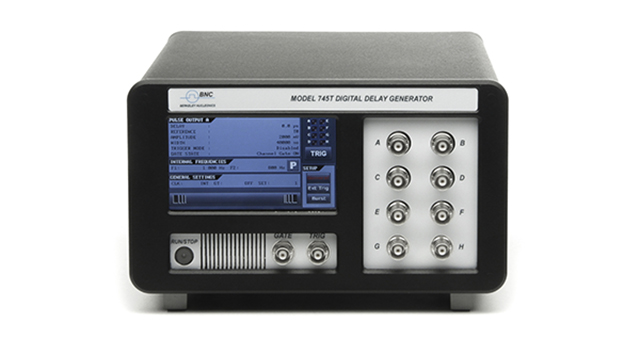
The Model 745T is an ultra-fast digital delay generator that resolves delays to 1 picosecond with jitter of roughly 5 picoseconds, placing it in femtosecond-class territory for a benchtop instrument. It is the highest-precision timing instrument Berkeley Nucleonics offers in this family, inspired by the classic Model 7095 of 25 years ago but built with modern features at a fraction of legacy cost.
Where most delay generators settle in the nanosecond or tens-of-picoseconds range, the 745T is designed for work that lives at the edge of measurable time: synchronizing large laser systems, sequencing pump-probe experiments, and driving automated test equipment that needs picosecond-accurate edges. It delivers up to 8 independent delay channels with fast rise times and 5 V output into 50 ohm.
A 0.05 ppm timebase, sync to an external 10 MHz or 80 MHz clock, and embedded web, LabVIEW, SCPI, and USB control make the 745T straightforward to fold into an existing laboratory timing chain.
2Key Features
- 1 ps delay resolution. Femtosecond-class timing on a benchtop instrument.
- Low jitter. Below 25 ps RMS external trigger to channel, reaching roughly 5 ps at short delays in grouped configurations.
- 4 or 8 channels. Four high-precision front-panel channels (rise time <2 ns), plus an optional four rear-panel channels (rise time <5 ns).
- Wide delay range. 0 ps to 20 seconds.
- External clock sync. 10 MHz, 80 MHz, or custom 10 to 80 MHz.
- 0.05 ppm timebase stability.
- Fast 5 V outputs. 5 V into 50 ohm with fast rise and fall times.
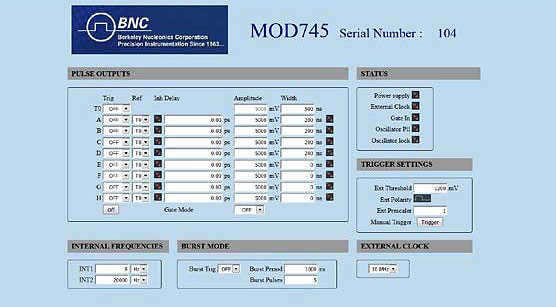
- Modern control. Ethernet (SCPI), embedded web interface, LabVIEW drivers, USB.
3Channels & Timing Architecture
The Model 745T provides four high-precision delay channels on the front panel, labeled A through D, each with a rise time under 2 ns and 1 ps delay resolution. An optional rear-panel module adds four more channels, E through H, with 1 ns resolution and rise times under 5 ns, for a total of eight independent channels.
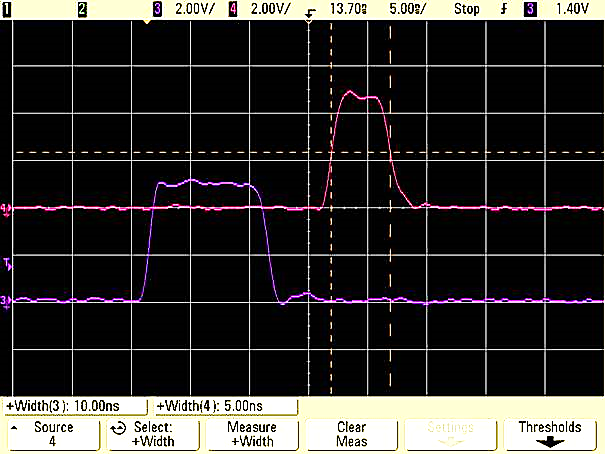
Delays span 0 ps to 20 seconds. Accuracy is below 250 ps plus delay times 10 to the minus 8, and jitter from T0 to any output is 25 ps plus delay times 10 to the minus 8. For internal trigger at delays under 100 ns, jitter drops to 2 ps. Channel grouping enables rise times below 1 ns and pulse widths down to 10 ns, achieving jitter below 5 ps with 250 fs delay and width resolution, which is the configuration that earns the femtosecond label.
Two independent internal timers run from 0.25 Hz to 1 MHz. The timebase holds 0.05 ppm and can lock to an external 10 MHz or 80 MHz clock, or a custom rate between 10 and 80 MHz. T0 outputs a fixed 5 V into 50 ohm; channel outputs are adjustable from 2 to 5 V into 50 ohm.
4Specifications
| Parameter | Specification |
|---|---|
| Channels | 4 or 8 independent channels (A to D standard; E to H optional) |
| Delay resolution | 1 ps (A to D); 1 ns (E to H optional) |
| Delay range | 0 ps to 20 s |
| Accuracy | <250 ps + delay x 10⁻⁸ |
| Jitter, RMS (T0 to any output) | 25 ps + delay x 10⁻⁸ |
| Jitter, internal trigger, delay <100 ns | 2 ps |
| Jitter, external trigger, delay <100 ns | 25 ps |
| Output amplitude (T0) | 5 V into 50 ohm (fixed) |
| Output amplitude (A to D) | 2 to 5 V into 50 ohm (adjustable) |
| Rise time | <2 ns (A to D); <5 ns (E to H optional) |
| Fall time | <2 ns |
| Pulse width (T0, A to D) | 100 ns to 100 µs |
| Pulse width (E to H) | 10 ns to 25 µs (optional) |
| Minimum trigger delay | <65 ns |
| Internal rate generator | Two independent timers, 0.25 Hz to 1 MHz |
| Clock input | 10 MHz, 80 MHz (custom 10 to 80 MHz available) |
| Clock output | 10 MHz square, about +7 dBm |
| Timebase stability | 0.05 ppm |
| Trigger modes | External (pos/neg slope), internal, remote asynchronous single-shot |
| Trigger level range | 0.1 V to 5.0 V |
| Burst mode | 2 to 2¹⁶-1 pulses; 1000 ns to 1 s period |
| Memory storage | 12 slots |
| Interface control | Front panel, LAN (web page or SCPI), USB |
| Connectors | BNC |
| Package | Rackmount 19 in, 2U; 300 mm depth |
| Dimensions | 8.5 in W x 9.6 in H x 5.3 in D |
| Power | 90 to 220 VAC / 0.5 A |
| Shipping weight | 20 lb |
5Triggering & I/O
The Model 745T triggers externally on a positive or negative slope, internally from either of two independent timers, or from a remote asynchronous single-shot command. Trigger level is adjustable from 0.1 V to 5.0 V, and minimum trigger delay is under 65 ns. Burst mode fires 2 to 2 to the 16th minus 1 pulses with periods from 1000 ns to 1 second, and a trigger prescaler divides incoming triggers by 1 to 2 to the 16th minus 1.
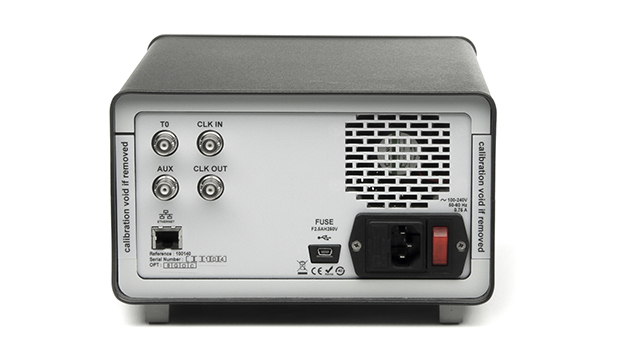
Outputs use BNC connectors. T0 is fixed at 5 V into 50 ohm; channels A to D adjust from 2 to 5 V into 50 ohm. A clock input accepts 10 MHz or 80 MHz for synchronization to an external reference, and a 10 MHz clock output lets the 745T act as the master reference. Control is available from the front panel, over LAN through the embedded web page or SCPI, and over USB, with LabVIEW drivers provided.
6Options & Configurations
The Model 745T is ordered as a 4-channel or 8-channel instrument, with optional rack hardware and electrical-optical conversion modules for fiber-coupled timing distribution.
| Model | Description |
|---|---|
| 745T-4C | Standard touchscreen model, 4 high-precision channels |
| 745T-8C | Standard touchscreen model, 4 high-precision plus 4 standard channels |
| 745-RM | Rack mount system, accommodates one or two Model 745T units |
| GFT101 | Electrical to optical converter (2.5 to 10 V input, 1310 nm, 1 ns rise time, 30 ps RMS jitter) |
| GFT200 | Optical to fast electrical pulse (1310 nm at -15 dBm input, 10 V output, 30 ps RMS jitter) |
| GFT632 | High voltage module (32 V amplitude, <3 ns rise time, up to 20 m remote; 70 V option available) |
7Applications
- Femtosecond resolution timing
- Large laser system timing control and synchronization
- High-precision timing research
- Automated test equipment (ATE)
- Components testing and quality control
8Ordering
To configure a Model 745T, choose the 4-channel (745T-4C) or 8-channel (745T-8C) model and add rack mount or optical conversion modules as needed. For pricing and lead time, contact Berkeley Nucleonics.
Berkeley Nucleonics Corporation · info@berkeleynucleonics.com · 800-234-7858