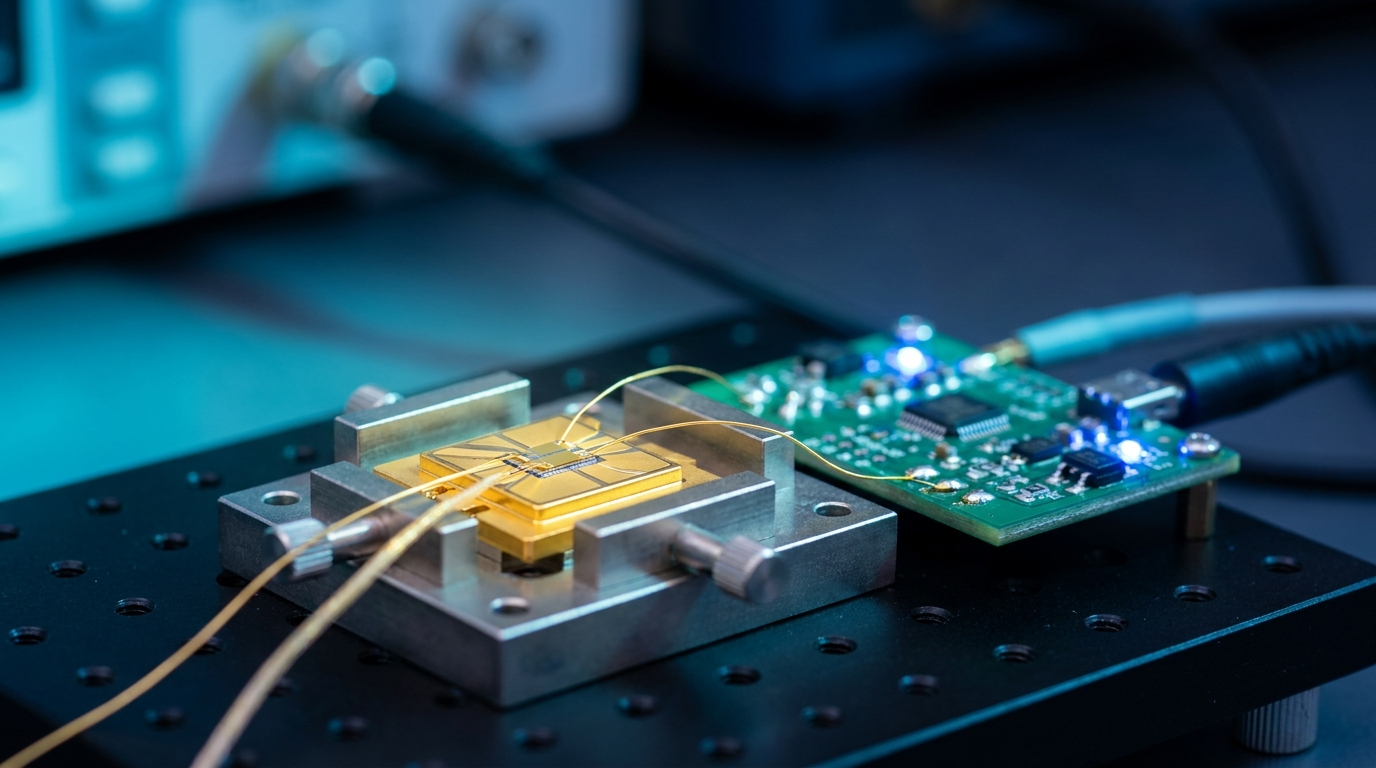
Pulsed Laser Diode Test
Pulsed laser diode work sits at the center of photonics research and semiconductor device manufacturing. LIDAR transmitters, time-of-flight ranging, optical communication links, and fluorescence lifetime systems all depend on diodes that emit clean, repeatable optical pulses on a nanosecond and sub-nanosecond scale. To characterize one of these diodes, the bench has to do two things at once. It has to present a precisely shaped electrical waveform so the optical output matches a known reference, and it has to deliver enough drive current to bring the diode through threshold and into emission. Both have to land on the same time base, pulse after pulse, with no drift between them.
That dual requirement is where the traditional bench gets complicated. A laser diode test setup has historically called for two separate instruments. One is a sub-nanosecond shaped-pulse generator chosen for waveform accuracy and edge control. The other is a high-current pulser chosen to push real drive current into the diode. Each instrument is its own purchase, from its own vendor, on its own support path, with its own firmware release cadence. Worse, they live on separate trigger and timing chains that have to be aligned by hand and re-aligned every time the setup changes. The engineer ends up managing two SKUs, two integration efforts, and a synchronization problem that adds noise to the measurement rather than removing it. The complexity is not in the physics. It is in the plumbing between two boxes that were never meant to act as one.
How the Model 686 consolidates the bench
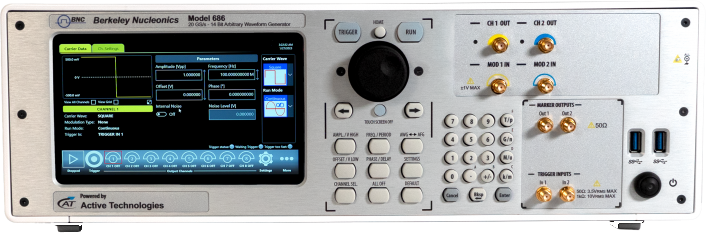
The Berkeley Nucleonics Model 686 collapses both roles into a single arbitrary waveform generator. It produces sub-nanosecond Gaussian pulses at 5 Vpp into 50 ohm, which gives the bench the clean, fast-edged waveform that diode characterization depends on. In the same instrument it delivers up to 100 mA sub-nanosecond current pulses for direct diode drive, so the same box that defines the pulse shape also supplies the current that puts the diode into emission. There is no second instrument to buy, integrate, or synchronize.
Edge performance is where laser diode work lives, and the Model 686 holds sub-nanosecond rise and fall on both the voltage waveform and the current pulse. That matters because the optical pulse can only be as crisp as the electrical drive behind it. Slow or asymmetric edges smear the emitted pulse and corrupt the timing measurement the bench exists to capture. Arbitrary pulse shaping extends the same control to diode conditioning, letting the engineer pre-shape the drive to compensate for diode response, suppress overshoot, or sequence a conditioning profile that a fixed-function pulser cannot produce.
The single largest gain is the unified trigger and timing chain. Because waveform generation and diode drive originate in one instrument, they share one time base and one trigger by design. There is no inter-instrument skew to calibrate out, no cable-length matching between two boxes, and no drift between two clocks over a long acquisition. The optical pulse the diode emits traces back to one source of timing truth, which is exactly what a measurement bench needs.
Recommended configuration
For a pulsed laser diode bench, the Model 686 is the instrument. Specify it as the single source for both the shaped drive waveform and the diode-drive current. Configure the channel for sub-nanosecond Gaussian output at 5 Vpp into 50 ohm for waveform-accuracy work, and use the same instrument's current-pulse capability, up to 100 mA at sub-nanosecond edges, to drive the diode directly. Where the diode needs conditioning, build the conditioning profile in the arbitrary pulse-shaping engine rather than adding external hardware.
Drive the Model 686 from the bench sequencer so the same script that controls the diode fixture and the optical detector also sets the waveform and the drive current. With one trigger and one time base, the sequence is deterministic from the first pulse.
One instrument, one vendor
Consolidating the bench into the Model 686 changes more than the rack count. It collapses two vendors into one support relationship, so a question about waveform behavior and a question about drive current go to the same application team. It collapses two firmware release cycles into one, which removes the version-matching exercise that two-instrument benches inherit every time either vendor ships an update. And it simplifies integration to a single instrument on a single interface, which shortens bring-up, reduces the cabling and triggering surface that can introduce error, and makes the bench easier to reproduce across a fleet or hand off between teams.
For photonics research groups and semiconductor device manufacturers, the practical result is a bench that is faster to stand up, easier to trust, and cleaner to maintain. The engineer spends time on the diode under test, not on the synchronization between two instruments that should have been one.
Talk to an application engineer
Berkeley Nucleonics can help you configure a Model 686 for your pulsed laser diode bench. Call 800-234-7858 or email info@berkeleynucleonics.com.
For a quick question, chat with an engineer at berkeleynucleonics.com.