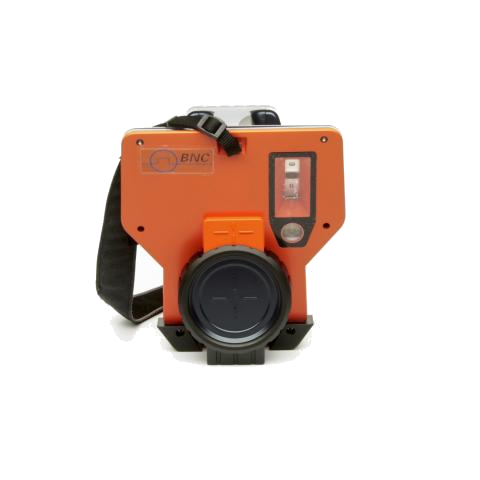
1Safety & Handling
The SAM 950 is a radiation measurement instrument intended for use by trained personnel. Before operating the unit, confirm that you are authorized to perform radiation survey and identification work and that you understand your organization's radiation safety protocols. The instrument measures radiation; it does not shield the operator from it.
The SAM 950 is ruggedized and built water and shock resistant to an IP65 rating. Even so, handle it as precision field equipment. Avoid dropping the unit, do not immerse it beyond its rating, and keep the detector face clear of physical damage. When a strong source is suspected, follow time, distance, and shielding principles to limit your own exposure, and treat any unidentified elevated reading as significant until it is resolved.
Operate the unit within its rated environmental limits: an operating temperature of -15 C (5 F) to 50 C (122 F) and relative humidity of 10 to 80 percent, non-condensing. Charge and store the lithium-ion battery according to standard practice for lithium-ion cells. Do not attempt to open the enclosure or service internal components in the field.
2What's in the Box
Unpack the SAM 950 carefully and confirm that all items are present before deployment. A typical shipment includes the following.
- The SAM 950 ruggedized isotope identifier with the ordered detector configuration installed.
- Rechargeable lithium-ion battery.
- AC adapter rated 12 V, 3 A for charging and bench operation.
- USB Micro USB 2.0 cable for data transfer and connection to a host computer.
- Printed quick-start material and any ordered options or accessories.
The shipping carton measures approximately 20 x 17 x 10 inches with a shipping weight near 25 pounds. Retain the original packaging for transport and for any return or service shipments. If any item is missing or damaged, contact Berkeley Nucleonics before placing the unit into service.
3Controls & Display
The SAM 950 is operated through a 5 inch touch-screen display with gesture control. Most workflows, including search, measurement, identification, and data review, are driven directly from the touch interface rather than from physical keys. The touch-screen approach keeps the operator focused on the screen while wearing gloves or working in the field.
The instrument integrates several support features that aid measurement in real conditions. An LED flashlight illuminates the target area for inspection in low light. An integrated multimedia capability ties a 13.0 MP CMOS camera, audio, and video to measurement events so that context is captured alongside the spectrum. A built-in waterproof speaker rated 84 dB (1 W at 0.5 m) provides audible feedback and alarms.
Because the SAM 950 uses a patented PDA-based handheld design, the operating environment presents readings, controls, and results on a single touch surface. Familiarize yourself with the layout of the search, measurement, and identification screens before field use so that you can move between them quickly.
4Getting Started
Power on
Confirm the lithium-ion battery is installed and adequately charged, then power on the SAM 950. A fully charged battery supports more than 8 hours of operation. For bench use or charging, connect the supplied 12 V, 3 A AC adapter.
Battery
Charge the battery fully before extended field work. Monitor the charge state on the display during use and plan deployments around the rated runtime. Carry a spare or the AC adapter for long shifts.
Stabilization and calibration check
The SAM 950 performs automatic real-time calibration and stabilization using the natural K-40 background. This means the instrument continuously holds its energy calibration during normal operation without a separate manual calibration step in the field. Allow the unit to settle after power on so that stabilization can establish before you rely on identification results. If readings appear inconsistent, give the instrument additional time to stabilize and verify that the detector face is clear and undamaged.
5Taking a Measurement
Search mode
Use search mode to locate and approach a source. Move the SAM 950 across the area of interest and watch for rising count rate as you near elevated radiation. Audible feedback from the waterproof speaker supports search work when your attention is on the surroundings rather than the screen.
Dose rate
The SAM 950 reports dose rate across a wide range. The NaI detector covers 0 to 10 mR/h, and an internal GM channel extends the measurable range from 10 mR/h to 10 R/h so that the instrument remains useful in higher fields where the scintillator alone would saturate. Watch the dose rate reading to gauge field intensity as you work.
Count rate
Count rate indicates the gross detection activity at the detector and rises as you approach a source. Use count rate together with dose rate to confirm that you are positioned to acquire a clean spectrum for identification. Hold the instrument steady near the source to let the measurement accumulate.
6Isotope Identification Workflow
Acquire
Position the SAM 950 close to the source and hold it steady to acquire a gamma spectrum. A longer, steadier acquisition produces better counting statistics and a more confident identification. Use search and count rate to confirm good positioning before you commit to an acquisition.
Identify
The instrument analyzes the acquired spectrum and performs nuclide identification per ANSI N42.34. Identification runs on the unit itself, so a result is available in the field without an external connection.
ANSI category result
The SAM 950 reports an isotope, category, and confidence result consistent with the ANSI N42.34 framework. Use the reported confidence to judge whether the result is firm or whether a longer acquisition is warranted. Treat low-confidence results as a prompt to reacquire or to escalate through reach-back.
Save and store spectrum
Save the spectrum and its associated event data to the on-board database. The SAM 950 maintains a database protocol for log files and alarm events, and its blackbox replay capability lets you review what the instrument recorded. Saved spectra can later be transmitted for review or archived for the record.
7Connectivity & Data
The SAM 950 is built for connected operation in a reach-back workflow. Its one-click reach-back feature automatically transmits a file to a remote expert or system, by email or to RadResponder, so that a field measurement can be adjudicated by a specialist without delay. The unit is RadResponder enabled and integrates into that network for coordinated response.
For connectivity, the SAM 950 provides WiFi, Bluetooth, GPS, and USB. WiFi and Bluetooth support wireless transfer and reach-back, the built-in GPS tags measurements with location for mapping and survey work, and the USB Micro USB 2.0 port supports wired data transfer to a host computer. The on-board database stores log files and alarm events for later export.
Web-based training is available to help operators and program managers learn the connectivity and data workflow before deployment. Configure network and reach-back destinations according to your organization's procedures so that transmissions reach the correct recipients.
8Options & Accessories
The SAM 950 can be configured to match the mission. Detector options span several sizes and crystal materials, and neutron detection can be added where dual gamma and neutron capability is required.
- Gamma detector crystals: NaI(Tl) standard, with LaBr3 and CeBr3 available as options for higher energy resolution.
- Detector sizes: 1.5 x 1.5 inch, 2 x 2 inch, and 3 x 3 inch, which trade sensitivity against size and weight.
- Neutron detection: an optional solid-state or 3He neutron detector for combined gamma and neutron operation.
- Web-based training to support operator readiness.
Detector choice affects both weight and energy resolution, so select the configuration that fits your mission profile. See section 10 and the SAM 950 datasheet for the resolution associated with each crystal.
9Maintenance & Care
The SAM 950 is designed for field service with minimal routine maintenance. Keep the enclosure and the touch-screen clean, and keep the detector face free of damage and debris. Wipe the unit down after use in dirty or wet conditions, observing the IP65 rating rather than exceeding it.
Maintain the lithium-ion battery with standard care for lithium-ion cells: charge it before storage at a sensible state of charge, and replace it when runtime falls noticeably below the rated 8 hours. Because the instrument stabilizes automatically against the K-40 background, no manual field calibration step is required for normal operation. Store the unit within its rated environmental limits when not in use.
Do not open the enclosure or attempt internal repair in the field. For service, recalibration verification, or repair, return the unit to Berkeley Nucleonics through the standard RMA process.
10Specifications Summary
The values below are drawn from the SAM 950 dossier. For the complete specification set, refer to bnc-sam-950-datasheet.html.
| Parameter | Specification |
|---|---|
| Detection | Gamma, with optional neutron |
| Detector sizes | 1.5 x 1.5 in, 2 x 2 in, 3 x 3 in |
| Crystals | NaI(Tl) standard; LaBr3 optional; CeBr3 optional |
| Neutron option | Solid-state or 3He |
| Energy range (gamma) | 20 keV to 3 MeV |
| Energy resolution | NaI(Tl) 2 x 2 and 3 x 3 in <7% @ 662 keV; LaBr3 2 x 2 in <3% @ 662 keV; CeBr3 2 x 2 in <4% @ 662 keV |
| MCA | 10 bit, 1024 channel |
| Dose rate range | 0 to 10 mR/h (NaI); 10 mR/h to 10 R/h (GM) |
| Stabilization | Automatic real-time using K-40 |
| Nuclide identification | Per ANSI N42.34; isotope, category, and confidence report |
| Battery | >8 hours, lithium-ion |
| Display | 5 inch touch screen |
| Camera | CMOS 13.0 MP |
| GPS | Built-in |
| Speaker | 84 dB (1 W / 0.5 m), waterproof |
| USB | Micro USB 2.0 |
| Ingress protection | IP65 |
| AC adapter | 12 V, 3 A |
| Dimensions (W x D x H) | 192 x 356 x 214 mm |
| Weight | 4.3 kg (9.5 lb) with 3 x 3 in NaI(Tl); 3.2 kg (7 lb) with 2 x 2 in NaI(Tl); 2.9 kg (5 lb) with 1.5 x 1.5 in LaBr3 / CeBr3 / NaI |
| Shipping dimensions | 20 x 17 x 10 in |
| Shipping weight | 25 lbs |
| Operating temperature | -15 C (5 F) to 50 C (122 F) |
| Relative humidity | 10 to 80%, non-condensing |
| Standards | ANSI N42.34 |
11Support
For technical support, service, application guidance, or replacement parts for the SAM 950, contact Berkeley Nucleonics directly.
- Email: info@berkeleynucleonics.com
- Phone: 800-234-7858
For warranty service or repair, use the standard RMA process. The SAM 950 supports web-based training to help your team get to operational readiness, and reach-back through email or RadResponder connects field operators with expert review when a measurement needs adjudication.