1Safety & Handling
The SAM 945 is a measurement instrument, not a shield. It tells you what is present and at what dose rate, but it does not protect you from a radiation field. Always observe the radiation safety principles of time, distance, and shielding. Minimize the time spent near a source, keep as much distance as the task allows, and use available shielding.
The SAM 945 is built around a detachable interface for exactly this reason. The internal detector can be positioned toward a suspect item while you read results on the smartphone from a safer standoff. The instrument follows ALARA practice (As Low As Reasonably Achievable): use the remote monitor and control function to keep your own exposure down while still completing the identification.
Handle the unit within its rated operating temperature of -20 C to 50 C. The enclosure is rated IP65 and is built to survive a 1 meter drop, but it remains a precision detector. Avoid unnecessary shock, do not immerse it, and keep connectors clean and dry. Charge only with an approved Berkeley Nucleonics adaptor or charger.
2What's in the Box
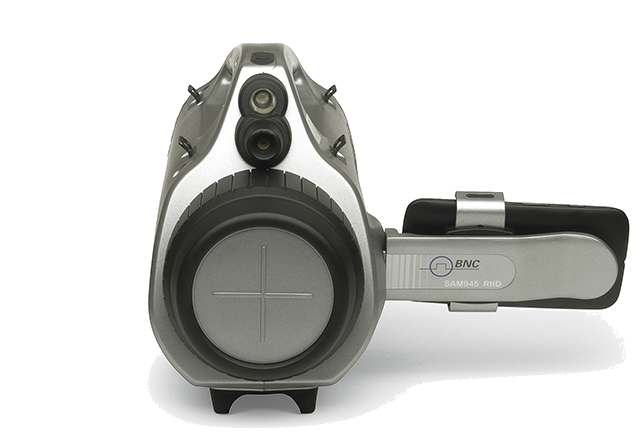
A standard SAM 945 system ships with the identifier (containing the internal detector), the detachable smartphone interface preloaded with the PeakAbout app, and the charging and cabling needed to operate the system. Contents vary with the configuration and options ordered.
Typical items include:
- SAM 945 identifier with internal detector (detector type per the model ordered).
- Smartphone interface running the PeakAbout app, with GPS, camera, and voice recorder.
- AC adaptor and charger for the identifier and smartphone lithium ion batteries.
- USB to microUSB cable for wired data transfer.
- Shoulder strap and any ordered accessory kit, travel bag, or case.
- Thumbdrive with the PeakAbout app and manuals.
Inspect every item on receipt. If anything is missing or damaged, contact Berkeley Nucleonics before placing the unit in service.
3Controls & Display
The SAM 945 uses the smartphone interface as its primary control surface and display. Rather than a fixed keypad, operation runs through the PeakAbout app, so the controls follow familiar touchscreen conventions. The identifier houses the detector and battery; the smartphone houses the display, controls, GPS, camera, and voice recorder.
The PeakAbout app presents the core functions of the instrument:
- Background: establish and monitor the ambient radiation baseline.
- Dose and dose rate: read current exposure and rate of exposure.
- Isotope ID: acquire a spectrum and identify the isotopes present.
- Search: sweep an area to locate elevated count rate.
PeakAbout supports two operational modes, user and administrator, so a supervisor can lock configuration while operators run measurements. Alarms can be appended with notes, images, videos, and a voice memo, which keeps the record of an event with the event itself.
4Getting Started
Power on
Confirm both batteries are charged before deployment. The identifier and the smartphone each carry a lithium ion battery rated for more than 8 hours of operation. Power on the identifier, power on the smartphone, and launch the PeakAbout app. The app pairs to the identifier over Bluetooth so the two halves operate as one system.
Battery and charging
Charge from the AC adaptor, or from a DC source such as a vehicle adaptor when working in the field. Using a Bluetooth earpiece, the system supports more than 8 hours of operation. Keep a charged spare battery or charger on hand for extended shifts.
Stabilization and calibration check
The SAM 945 performs auto-calibration across its full operating range of -20 C to 50 C, with built-in energy stabilization and real-time background correction. These run automatically so the energy scale stays aligned as temperature and background change. Allow the unit a short period to settle after power on and after a significant change in temperature, then confirm a stable background before you begin measuring.
5Taking a Measurement
Search mode
Use search mode to find the source. Move the identifier through the area at a steady pace and watch the count rate. Real-time background correction holds the baseline so a genuine increase stands out against normal variation. As the count rate climbs, you are getting closer to the source; sweep methodically to localize it.
Dose rate
Dose rate tells you how strong the field is at your current position. Watch it as you approach, and use it to decide how close you can safely work. The SAM 945 reports dose and dose rate alongside the isotope result, so the operational picture and the safety picture stay together.
Count rate
Count rate reflects how many events the detector is registering. The digital signal processing handles very high throughput, from 250,000 to 400,000 CPS for Cs-137, with a usable maximum measurement rate of 100,000 to 150,000 CPS depending on background and the number of energy peaks present. High count rate confirms proximity to a source and supports a fast, confident acquisition.
6Isotope Identification Workflow
Acquire
Position the identifier toward the suspect item and start an acquisition in PeakAbout. The internal detector collects a gamma spectrum across an energy range of 20 keV to 3.0 MeV. A higher count rate shortens the time needed for a confident result. Hold the geometry steady while the spectrum builds.
Identify
The SAM 945 analyzes the spectrum against its onboard library and reports the isotopes present along with a confidence level. The standard library covers 115 isotopes and is expandable to 393 isotopes. Identification uses Wavelet Spectroscopy and runs with the full processing of the system available through wireless communication to the smartphone.
ANSI category result
Results are color coded by ANSI category so the meaning is clear at a glance. Categories include SNM (special nuclear material), NORM (naturally occurring radioactive material), Medical, Industrial, and User-defined. An expandable USER library is available as an option for sources specific to your mission. The classification scheme is ANSI 43.34 compatible.
Save and store the spectrum
Save each event to the onboard memory, which holds over 10,000 reviewable events with user notes. Each saved event can carry its ID, confidence level, dose rate, and the notes, images, videos, or voice memo you appended, along with GPS position from the smartphone. This builds a complete, reviewable record for reachback and adjudication.
7Connectivity & Data
PeakAbout smartphone app
PeakAbout is the free smartphone app included with the SAM 945. It manages data and reporting, drives acquisition and identification, and uses the smartphone's GPS, camera, and voice recorder to enrich each event. Operational modes for user and administrator let you separate routine operation from configuration.
ALARA remote monitor and control
Because the interface is detachable, you can monitor and control the 945 remotely over Bluetooth. Place the detector near the item, step back to a safer distance, and run the full identification from the smartphone. This is the practical expression of ALARA: complete the measurement while keeping your own exposure low.
USB and wired transfer
For wired transfer, connect the supplied USB to microUSB cable. Communication is supported over both Bluetooth and USB, so you can move data by whichever path suits your network and security posture.
N42.42 data transmission and analysis tools
The SAM 945 transmits data as XML in the ANSI N42.42 compliant format. Reports include the ID, confidence level, dose rate, and related event detail. Saved spectra and reports are compatible with the DOE analysis package and standard tools including SAM-Viewer, Cambio, and Peak Easy, which lets your reachback team review spectra in the software they already trust.
8Options & Accessories
The SAM 945 is available in several detector configurations and supports a range of accessories. Detector options include NaI (general purpose, standard), CeBr (SNM enhanced, high resolution), Lanthanum LaBr3, and Large Volume Cerium, plus an optional 3He neutron detector and a standard GM tube for high dose rates.
System models follow the detector scheme: 945-G, 945-GN, 945-LG, 945-LGN, 945-CG, 945-CGN, 945-C2G, and 945-C2GN, where G is gamma, N adds neutron, L is lanthanum, C is cerium, and C2 is large volume cerium.
Representative accessories include:
| Part number | Accessory |
|---|---|
| P/N7100 | Spare AC adaptor / charger |
| P/N7101 | Vehicle adaptor / charger |
| P/N7104 | Tripod with 1/4-20 shoe |
| P/N7106 | Earbuds |
| P/N7108 | USB to microUSB cable |
| P/N7112 | Thumbdrive (PeakAbout app and manuals) |
| P/N7113 | Accessory kit |
| P/N7115 | Hard case |
Additional items such as the tripod adaptor (P/N7102), spare shoulder strap (P/N7103), smartphone or PDA (P/N7105), and padded travel bag (P/N7114) are also available. Contact Berkeley Nucleonics to confirm the configuration and accessory list for your order.
9Maintenance & Care
The SAM 945 is designed to operate with minimal routine maintenance. Auto-calibration and auto-stabilization keep the energy scale aligned in the field, so day to day care is mostly about keeping the unit clean, charged, and undamaged.
- Wipe the enclosure with a soft, slightly damp cloth. Do not immerse the unit even though it carries an IP65 rating.
- Keep connectors and the charging contacts clean and dry.
- Charge the batteries fully before storage and recharge periodically during long storage.
- Store within the rated temperature range and avoid prolonged exposure to extreme heat or cold.
- Verify a stable background and a known check source response on a schedule that matches your program's quality requirements.
Send the unit to Berkeley Nucleonics for periodic calibration and service per your program's interval. Do not open the enclosure or attempt internal repair.
10Specifications Summary
The values below are confirmed from the SAM 945 dossier. For complete specifications, refer to bnc-sam-945-datasheet.html.
| Parameter | Specification |
|---|---|
| Energy range | 20 keV to 3.0 MeV |
| Detectors | NaI (standard, general purpose); CeBr (SNM enhanced, high resolution); Lanthanum LaBr3 (configuration); Large Volume Cerium (configuration); 3He neutron (optional); GM tube (standard, high dose rates) |
| DSP throughput | 250,000 to 400,000 CPS (Cs-137) |
| Maximum count rate | 100,000 to 150,000 CPS (depending on background and number of energy peaks) |
| Isotope library | 115 isotopes standard, expandable to 393; ANSI categories (SNM, NORM, Medical, Industrial, User-defined); ANSI 43.34 compatible |
| Data format | XML, ANSI N42.42 compliant |
| Memory | Over 10,000 reviewable events with user notes |
| Battery | Identifier more than 8 hours, lithium ion; smartphone more than 8 hours, lithium ion |
| Communication | Bluetooth, USB |
| Enclosure | IP65; 1 meter drop test |
| Dimensions | 10 x 5 x 6 in |
| Weight | 6 lbs (with standard detector) |
| Operating temperature | -20 C to 50 C |
| Standards | ANSI N42.42 compliant; ANSI 43.34 compatible; DOE analysis package compatible (Cambio, Peak Easy, SAM-Viewer) |
11Support
Berkeley Nucleonics supports the SAM 945 through the full service lifecycle, from configuration and training to calibration, repair, and reachback questions. For help with operation, options, or service, reach the team directly.
Email: info@berkeleynucleonics.com
Phone: 800-234-7858
For the latest published specifications, downloads, RMA requests, and warranty information, visit the Berkeley Nucleonics support hub. Always confirm critical values against the latest released datasheet before relying on them for a compliance or procurement decision.