1Safety
Read this section before assembling the kit. The Model 971 uses a lead Marinelli shield that surrounds the detector to lower background. Lead is heavy and the assembled kit weighs roughly 110 lbs, so use safe lifting practices and a stable surface.
General precautions
- Lift the shield components with care. Wash hands after handling lead, and keep lead surfaces away from food samples and food-contact containers.
- The Model 970 MCA supplies detector bias voltage. Connect and disconnect the detector only with the MCA powered off.
- Use the included palmRAD 907 survey meter to confirm the working area background before measuring low-activity samples.
- Keep the detector, MCA, and computer dry. Set up on level ground out of direct rain.
- Place the kit in its transport case for moving. The case rides on wheels, which reduces lifting strain in transit.
2Kit Contents & Assembly
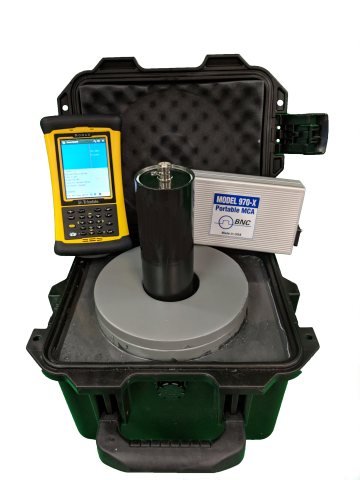
The Model 971 Food-SSAFE kit ships in a large hard case with the detector, shielding, sample containers, MCA, scale, and computer system. Two configurations are offered.
Configuration variants
- Model 971-2N Food-SSAFE KIT: base configuration with the 2 inch by 2 inch NaI detector.
- Model 971-2N1C Food-SSAFE Kit plus CeBr: adds the 1 inch by 1 inch CeBr detector for higher resolution work.
What's in the case
- One 2 inch by 2 inch NaI detector with a 3 foot coaxial cable
- Lead Marinelli shield case
- Marinelli beaker with a K40 reference standard
- Model 970 portable MCA running Food-SSAFE software
- TDS Nomad 900LE display with bar code scanner and serial boot
- 5000 g tempered digital scale
- Sieve for sample collection
- palmRAD 907 survey meter
- iM3075 Storm Case on wheels
- 1 inch by 1 inch CeBr detector with C-C connector (Model 971-2N1C only)
Assembly
- Place the lead Marinelli shield case on a level, load-bearing surface.
- Seat the NaI detector inside the shield and route the 3 foot coaxial cable out to the Model 970 MCA. For the 971-2N1C, use the 1 inch by 1 inch CeBr detector with its C-C connector instead, where higher resolution is needed.
- Connect the detector cable to the Model 970 MCA and connect the MCA to the TDS Nomad 900LE display.
- Power on the MCA and the Nomad, then launch the Food-SSAFE software.
3Setup in the Field
The Model 971 is built to deploy quickly at a field site. Its shielded detector and real-time processing give a faster, more cost effective alternative to HPGe counting of food and water samples.
- Choose a stable, level setup location and assemble the shield, detector, MCA, and display as described above.
- Survey the area with the palmRAD 907 to confirm a low and stable background before counting low-activity samples.
- Verify system response using the Marinelli beaker with the K40 reference standard. This confirms the detector and MCA see a known source as expected.
- Select the geometry for your sample type. Use Marinelli geometry for soil, water, and bulk samples, and the 2 inch filter geometry for wipes and air samples.
4Food & Environmental Measurement Workflow
The Model 971 analyzes spectroscopic data in real time and reports contamination information for immediate disposition. It accommodates liquids and solids, including milk, meat, fish, grains, fruits, soil, water, and fertilizer.
Sample preparation
- Collect the sample and pass solids through the sieve to produce a uniform fill.
- Weigh the sample on the 5000 g digital scale and record the mass. Accurate mass underlies the activity-per-mass result.
- Fill the Marinelli beaker to a consistent level so the sample geometry matches the system response. For wipes or air filters, use the 2 inch filter geometry instead.
- Place the filled container into the shielded detector well.
Counting
- Start the count in the Food-SSAFE software. Count long enough to build adequate statistics for the target activity level. Lower activity requires longer count times.
- The system targets an approximate 10 Bq/l detection limit, and can measure to 10 Bq/kg with proper shielding.
- The kit identifies Iodine 131, Cesium 134, and Cesium 137, the isotopes of primary interest for food and environmental contamination after a radiological event.
5SNAP-MCA Software
The Model 971 runs Food-SSAFE software on its Model 970 MCA, with the SNAP-MCA spectroscopy package available for deeper review and analysis. SNAP-MCA reads data from the Model 970, presents a Windows-style toolbar interface, and supports both qualitative and quantitative analysis.
Working with spectra
- Acquire the sample spectrum through the Food-SSAFE workflow on the connected MCA.
- Define regions of interest around the I-131, Cs-134, and Cs-137 peaks to quantify activity in each band.
- Confirm the energy calibration is current using the K40 reference standard so peaks land on their expected energies.
- Export results for archiving and secondary review. SNAP-MCA includes a Data Exporter that sends spectra to N42 or Excel files.
6Interpreting Results
Results are presented in Bq/l or Bq/kg depending on the geometry used. The system analyzes data in real time and provides nuclear contamination information for immediate disposition.
- Liquids and bulk samples measured in Marinelli geometry report in Bq/l or Bq/kg against the calibrated geometry.
- Identified isotopes: the kit flags Iodine 131, Cesium 134, and Cesium 137. Review each peak against its region of interest before recording a result.
- Detection limit: the system targets approximately 10 Bq/l, and can reach 10 Bq/kg with proper shielding. Readings near the detection limit need longer counts to confirm.
- Use the K40 reference and a clean background measurement as comparison points when judging whether a sample is above background.
7Maintenance
The Model 971 needs straightforward care to stay accurate between deployments.
- Clean the Marinelli beaker and sample containers between samples to prevent cross contamination.
- Inspect the detector cable and connectors for wear before each session. Damaged cabling degrades resolution.
- Verify response with the K40 reference standard at the start of a measurement campaign and after transport.
- Keep the lead shield components clean and intact. Handle lead with care and wash hands after handling.
- Charge and check the TDS Nomad 900LE and Model 970 MCA before fieldwork, and store the full kit in the iM3075 Storm Case.
8Specifications Summary
| Parameter | Specification |
|---|---|
| Primary detector | 2 inch by 2 inch NaI detector with 3 ft coaxial cable |
| Optional detector | 1 inch by 1 inch CeBr detector with 3 ft coaxial cable |
| Typical FWHM | 7.5% (NaI); 4.5% (CeBr, optional) |
| Display | TDS Nomad 900LE with bar code scanner and serial boot |
| Spectrum analyzer (MCA) | Model 970 portable MCA with Food-SSAFE software |
| Detection capability | Approximately 10 Bq/l detection limit; identifies Iodine 131, Cesium 134, and Cesium 137; can measure to 10 Bq/kg with proper shielding |
| Geometry options | Marinelli geometry for soil, water, and bulk samples; 2 inch filter geometry for wipes and air samples |
| Physical dimensions | 33.30 in x 24.40 in x 19.30 in [84.5 x 62 x 49 cm] |
| Total weight | 110 lbs [49.895 kg] |
| Configurations | Model 971-2N (2 inch by 2 inch NaI base); Model 971-2N1C (adds 1 inch by 1 inch CeBr detector) |
| Software | Spectroscopy Field Analysis Software; Food-SSAFE software (runs on Model 970 MCA) |
9Support
For technical support, calibration, service, and replacement parts, contact Berkeley Nucleonics Corporation.
- Email: info@berkeleynucleonics.com
- Phone: 800-234-7858
- Web: berkeleynucleonics.com/support-overview