1. General Description
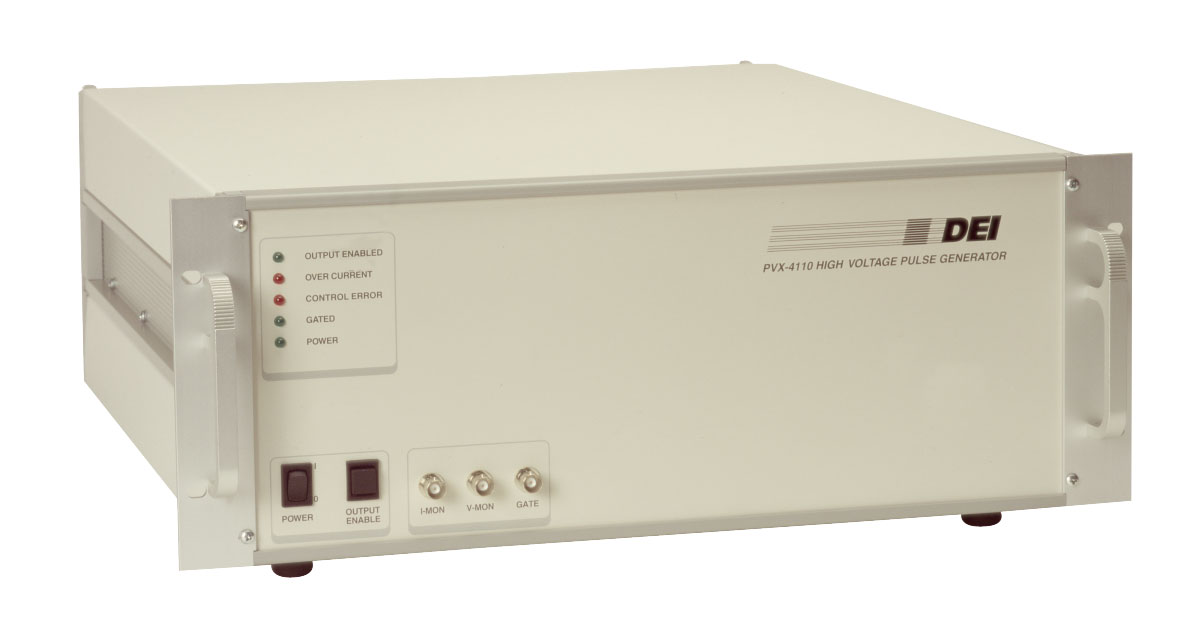
The BNC PVX-4110 pulser is a high-voltage solid-state pulser designed to drive capacitive loads such as acceleration grids and deflection plates.
The PVX-4110 generates an output voltage swing of 10,000 volts, with an output current of 30 amperes peak and 0.1 amperes continuous. It produces very flat voltage pulses to DC into a capacitive load.
The PVX-4110 can generate single-ended output pulses from ground to +10,000 V or from ground to −10,000 V, and it can also generate pulses originating from a voltage offset from ground. This offset can be from −10,000 V to +10,000 V, with a maximum power-supply voltage differential (Vhigh − Vlow) of 10,000 V or less.
2. Specifications
All specifications are measured into a 50 pF load connected with 4 feet of RG-11 cable.
Input Pulse Voltage +V IN (Vhigh)
| Source | External |
|---|---|
| Absolute maximum value | +10,000 volts |
| Absolute minimum value | −10,000 volts |
| Relative maximum value | +10,000 volts over Vlow voltage |
| Relative minimum value | Vlow voltage |
| Input connector | LEMO ERA-3S-415-CTL, rear panel (+V IN) |
| Maximum input power | 100 watts (VHIGH + VLOW supplies) |
Input Pulse Voltage −V IN (Vlow)
| Source | External |
|---|---|
| Absolute maximum value | +10,000 volts |
| Absolute minimum value | −10,000 volts |
| Input connector | LEMO ERA-3S-415-CTL, rear panel (−V IN) |
Output Pulse Voltage
| Maximum value | ±10,000 volts (VHIGH − VLOW) |
|---|---|
| Minimum value | 0 volts |
| Means of adjustment | Controlled by power-supply input voltages |
| Output connector | LEMO ERA-3S-415-CTL, rear panel (OUTPUT) |
| Pulse rise and fall time | ≤60 ns (10%–90%) |
| Pulse width | <150 ns to DC, controlled by input gate |
| Pulse recurrence frequency | Single shot to 10 kHz, controlled by input gate (1) |
| Maximum duty cycle | Continuous |
| Droop | <1% into a capacitive load |
Gate
| Gate source | External |
|---|---|
| Gate input | +5 V ±1 V into 50 Ω |
| Gate rise time | <20 ns |
| Gate input connector | Type BNC, front panel |
Current Monitor Output
| Current monitor | 10 A/V into 50 Ω, typically within 3% of the actual current, 25 MHz bandwidth limit |
|---|---|
| Connector | Type BNC, front panel |
Voltage Monitor Output
| Voltage monitor | 2000 V/V into 1 MΩ, typically within 3% of the actual voltage, 25 MHz bandwidth limit |
|---|---|
| Connector | Type BNC, front panel |
General
| Support power | 90–240 VAC, 50/60 Hz, <1 A |
|---|---|
| Size | 7″ H × 19″ W × 20″ D rack-mount enclosure |
These specifications are measured driving a 50 pF load connected with 4 feet of RG-11 cable, at 10,000 V output. However, the PVX-4110 can drive loads of a few picofarads to several hundred picofarads of capacitance, limited by its maximum power-dissipation capability (1). At lower load capacitances and/or voltages less than 10,000 V, the PVX-4110 can operate at continuous pulse recurrence frequencies greater than 10 kHz. The PVX-4110 can also drive resistive or inductive loads, within limitations. Contact BNC for additional information and applications assistance.
(1) The power dissipated in the PVX-4110 when driving a capacitive load is defined by the formula CV2F, where C is the total load capacitance (including the load, the interconnect cable, and the internal capacitance of the PVX-4110), V is the pulse voltage, and F is the pulse repetition frequency (or the total pulses per second). For these calculations, the internal capacitance of the PVX-4110 is 50 pF and RG-11 cable is 21.5 pF/foot. Given the maximum dissipation of 100 W, the maximum load capacitance, frequency, and/or voltage at which the PVX-4110 can operate can be approximated using this formula. This formula also approximates the high-voltage power-supply requirements needed to drive a given load at a specific voltage and frequency. It is not applicable when driving resistive or inductive loads.
3. Safety
The high voltage of this device dictates the use of caution when operating or servicing this equipment. The following is a summary of general safety precautions that must be observed during all phases of operation and repair of the PVX-4110.
3.1 Operating Safety Summary
The safety information contained in this summary is for both operating and servicing personnel. Specific warnings may be found throughout this manual but may not appear in this summary.
3.1.1 Power Source
The PVX-4110 is designed to operate from a power source that will not apply more than 240 volts AC between the supply conductors or between either supply conductor and ground. A protective grounding connection by way of the grounding conductor in the AC power cord is essential.
3.1.2 Grounding
The PVX-4110 is grounded through the grounding conductor of the AC power cord. To avoid electrical shock, plug the PVX-4110 into a properly wired receptacle before making connection to any input or output connectors. Use only a power cord that is in good condition.
3.1.3 Cover Removal
3.1.4 General Operating Precautions
Do not remove the input or output cables while the pulser is in operation. Never short-circuit the output of the unit. Failure to observe these precautions can result in potential electric shock to personnel, arcing, and damage to the connectors and system.
The top cover of the PVX-4110 is not safety interlocked. Extreme caution should be exercised when removing the cover. Any pulsed-power system is capable of random triggering via transients. Therefore, when the PVX-4110 is turned on, or dangerous voltage is present in the chassis, assume it is possible to get a pulse on the output connector.
3.2 Servicing Safety Summary
The PVX-4110 contains dangerous voltages and stored energy. BNC strongly recommends that all repairs and adjustments be performed by factory-qualified personnel. BNC will not be responsible for personal injury or damage to the driver that occurs during repair by any party other than the factory.
3.2.1 Servicing Procedure
Do not perform internal repair or adjustments unless another person capable of rendering first aid and resuscitation is present.
3.2.2 Internal Energy Storage
4. Operating Considerations
4.1 Output Cabling
The PVX-4110 is designed to drive capacitive loads with fast rise times. Since the current out of the PVX-4110 is limited, the lower the capacitance, the faster the rise time. Given fixed load characteristics, only the interconnecting cable type and length will vary the output capacitance.
The unit is supplied with RG-11 coaxial cable, which has a capacitance of 21 pF per foot. The unit is series terminated in the characteristic impedance of this cable, which is 75 Ω. BNC recommends that the shortest length of cable possible be used to ensure the fastest possible rise times and best pulse fidelity.
The PVX-4110 uses LEMO high-voltage connectors for the DC inputs and pulse output. The bulkhead connector is a LEMO part number ERA.3S.415.CTL. The mating cable connector is a LEMO part number FFB.3S.415.CTAC11.
4.2 Load Simulation
This unit was tested with a 50 pF capacitive load connected to the output with 4 feet of RG-11 coaxial cable.
4.3 Trigger Input
An input trigger of +5 V ±1 V into 50 Ω with a rise time of <20 ns is required to gate on the PVX-4110. Departure from these values can result in a loss of performance. These trigger requirements are met by any high-quality low-voltage pulse generator. The trigger should be set to +5 V ±1 V into 50 Ω before the trigger cable is attached to the PVX-4110 trigger input. The input trigger amplitude should be set using a 50 Ω load (for example, a 50 Ω scope input) before connecting it to the PVX-4110. If the trigger input is greater than +5 V into 50 Ω, pulse stretching can occur.
4.4 Pulse Voltages +V IN and −V IN
The PVX-4110 pulser is rated at a maximum pulse output voltage of ±10,000 V. Proper precautions should be taken by the user to ensure that the maximum voltage is not exceeded.
4.5 Output Pulse Considerations
The PVX-4110 pulser can generate single-ended output pulses from ground to +10,000 V or from ground to −10,000 V, and it can also generate pulses originating from a voltage offset from ground. This offset can be from −10,000 V to +10,000 V, but the maximum power-supply voltage differential (Vhigh − Vlow) should never exceed 10,000 V. The Vhigh supply should always be equal to or greater than the Vlow supply, but never greater than 10,000 V above the Vlow supply. Therefore the Vlow supply may be set to any voltage between −10,000 V and +10,000 V, and the Vhigh supply may be set to any voltage between −10,000 V and +10,000 V, but the voltage difference between Vlow and Vhigh should never exceed +10,000 V. If the unit is operated with a single power supply (single-ended), the unused power-supply input should be grounded.
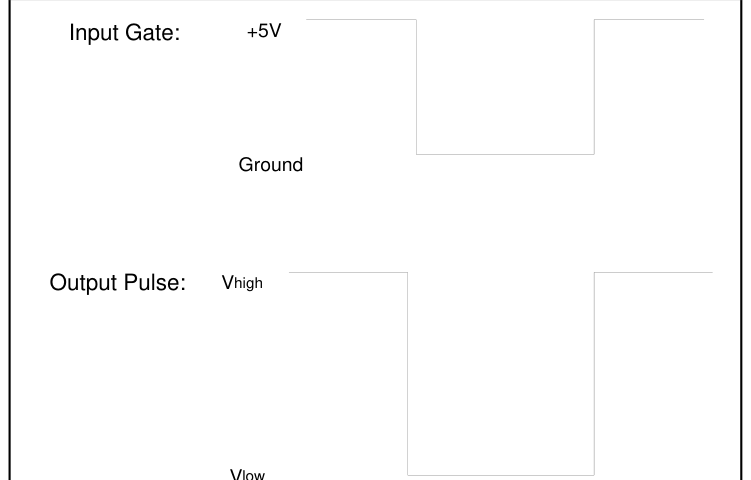
When the input gate is high, the Vhigh supply is connected to the output. When the input gate is low, the Vlow supply is connected to the output. Therefore the PVX-4110 can be used to generate a negative-going pulse by logically inverting the input gate, so that the input gate is high until the unit is pulsed. When the input gate goes low, the Vlow supply is connected to the output, thereby generating a negative-going pulse (see the example in the figure below).
4.6 Controls and Indicators
4.6.1 Power Switch and LED
The switch labeled POWER controls all AC power in the chassis. The LED above the switch illuminates when AC power is turned on.
4.6.2 Output Switch and LED
The output switch enables and disables the pulse output. When the switch is on, the output is enabled and the OUTPUT ENABLED LED above the switch is illuminated.
4.6.3 Gate Connector
The BNC connector labeled GATE is the input to gate the pulser. The input should be +5 V into 50 Ω, with a rise time less than 20 ns. The output pulse width and frequency are controlled by the input gate's width and frequency.
4.6.4 Gated LED
The LED labeled GATED illuminates when a gate signal of the appropriate amplitude and width to gate the pulser is received. If the GATED LED is not illuminated, the PVX-4110 will not generate an output pulse.
4.6.5 Over Current LED
The LED labeled OVER CURRENT illuminates if the output pulse current exceeds 15 A. If this LED illuminates, the pulse output will be inhibited for 6–7 milliseconds. If the LED illuminates continuously, the cause of the over-current fault should be corrected before attempting to operate the pulser.
4.6.6 PRF Limit LED
The LED labeled PRF LIMIT illuminates if the input gate frequency exceeds 10 kHz. If this LED illuminates, the pulse output will be inhibited. Reduce the frequency of the input gate before attempting to operate the pulser.
4.6.7 Current Monitor
The BNC connector labeled CURRENT MONITOR provides a 10 A/V monitor of the output current, with a 25 MHz bandwidth limit. This monitor should be terminated into 50 Ω, such as the 50 Ω input of an oscilloscope.
4.6.8 Voltage Monitor
The BNC connector labeled VOLTAGE MONITOR provides a 2000 V/V monitor of the output voltage, with a 25 MHz bandwidth limit. This monitor should be terminated into 1 MΩ, such as the 1 MΩ input of an oscilloscope.
5. Preparation for Use
5.1 General
After unpacking, initial inspection and preliminary electrical-check procedures should be performed to assure that the unit is in good working order. If it is determined that the unit is damaged, the carrier should be notified immediately. Repair problems should be directed to the service department, Berkeley Nucleonics Corporation (BNC), San Rafael, CA. Telephone: (800) 234-7858.
5.2 Initial Inspection
- Inspect the unit for exterior mechanical damage.
- Inspect the power input cord and input power module for obvious signs of damage.
5.3 Electrical Installation
Standard units are shipped ready for use with a nominal 110 to 240 VAC input.
5.3.1 Input Power Cord
The input power cord terminates externally in a three-prong polarized plug. The unit chassis is wired to the plug through the line cord; therefore, insertion of the plug into a compatible receptacle hooked up to a grounded input will automatically ground the unit. The unit should not be operated without a grounded AC input.
5.4 Electrical Check
Before proceeding, review the precautions in Section 3.
5.4.1 Power-Up
The unit should be powered up using the following procedures:
- Before connecting the pulse generator to the PVX-4110, set up the pulse-generator output to deliver a +5 V pulse (±1 V) into 50 Ω, with a rep rate of approximately 500 Hz and a pulse width of 1 µs.
- Connect the positive output power supply to the rear-panel connector labeled +V IN. Connect the negative output power supply to the rear-panel connector labeled −V IN. For +10,000 V single-ended output, −V IN must be connected to ground. The power-supply input should be grounded if no power supply is connected. Ensure that both power supplies are turned off.
- Plug the power cord into the AC power input and turn on the front-panel POWER switch. The POWER indicator LED should turn on, indicating that the PVX-4110 is operational. If this does not occur, unplug the unit from AC power and refer to Section 7, Troubleshooting.
- Connect the pulse generator to the front-panel BNC connector of the PVX-4110 labeled GATE.
- Connect an appropriate load to the rear-panel output connector.
- Monitor the voltage at the output by connecting an appropriate high-voltage probe to the output load, utilizing an appropriate attenuator if necessary.
- Slowly turn up the high-voltage power supplies. The PVX-4110 should produce an output pulse, with a pulse width and pulse recurrence frequency following that of the incoming trigger.
- If there is no output from the PVX-4110, or the output is severely distorted, turn off the high-voltage power supplies. Leave the PVX-4110 connected to the AC input without pulse voltage and with all connectors in place for approximately five minutes to bleed off the stored energy, then disconnect the AC power and refer to Section 7, Troubleshooting.
6. Operating Instructions
This section provides basic operating instructions for the PVX-4110. Additional application information may be found in Section 7.
- To avoid personal injury, do not remove the covers and do not operate the PVX-4110 while the covers are removed. The covers do not contain safety interlocks.
- Do not remove the input or output cables while the driver is in operation. The PVX-4110 offers limited protection against shorts and arcs to ground; however, never intentionally short-circuit the pulse-voltage output of the pulser. If allowed to operate into a short for an extended period of time, damage to the unit, load, and/or associated cabling may result. Failure to observe these precautions can result in potential electric shock to personnel, arcing, and damage to the connectors and system.
- Pulsed-power systems are capable of random triggering via transients. When the PVX-4110 is turned on, or voltage is present in the chassis, assume it is possible to get a pulse on the output connector.
6.1 Power-Up Procedures
The unit should be powered up using the procedures detailed in Section 5.3.1. When this is accomplished, the driver can be adjusted for the particular application through the following procedure:
- Monitoring the output of the PVX-4110 on an oscilloscope using a high-voltage probe connected to the output load, set the output amplitude of the PVX-4110 to the desired level by adjusting the output voltage of the high-voltage power supplies.
- Set the output pulse width and pulse recurrence frequency by varying the controls of the input pulse generator. The output pulse width should be set by monitoring the output of the PVX-4110. The output pulse voltage will follow the input trigger, but will not replicate in time the exact duration of the input trigger due to asymmetric system propagation delays.
6.2 Power-Down Procedures
- Set the high-voltage power supplies to zero.
- Turn off the high-voltage power supplies.
- Leave the PVX-4110 connected to the AC input without pulse voltage and with all connectors in place for approximately five minutes to bleed off the stored energy.
- Turn off the PVX-4110 power switch.
- Disconnect the AC power to the unit.
- Before disconnecting or handling the load or output cable, disconnect the output cable from the rear panel of the PVX-4110.
7. Troubleshooting
7.1 Troubleshooting Procedures
Before attempting to service or troubleshoot the PVX-4110, review the servicing safety summary in Section 3. The power MOSFETs utilized in the PVX-4110 are mounted on the printed circuit board. In the unlikely event that the MOSFETs need to be replaced, it is highly recommended that the unit be returned to the factory for servicing. The table below summarizes potential problems and their solutions. If these recommendations do not resolve the problem, BNC customer service can be contacted for further assistance.
| Symptom | Solutions |
|---|---|
| POWER LED does not illuminate | AC power not plugged in. Fuse(s) are blown (see fuse-replacement instructions in Section 7.1.1). |
| No output pulse | No input trigger. Input trigger voltage too low. Input trigger pulse width too short (increase width). Input trigger frequency too high (reduce frequency). No high voltage (check power supplies). Output not connected correctly (check all cables and connections). Pulser is damaged (contact BNC customer service). |
7.1.1 Fuses
| Fuse location | Fuse value |
|---|---|
| Power entry module, rear panel | 3 A, fast blow |
7.2 Factory Service
If the procedures above fail to resolve an operational problem, please contact the factory for further assistance:
Berkeley Nucleonics Corporation
2955 Kerner Blvd. Suite D
San Rafael, CA 94901
Call: (800) 234-7858
Fax: (415) 453-9956
Email: info@berkeleynucleonics.com
8. System Failure Modes
The PVX-4110 is capable of generating large-amplitude current pulses with very fast rise and fall times. There is limited over-current or over-voltage protection circuitry, and it is the user's responsibility to assure that the interconnect cables and load do not create transients, over-current, or over-voltage conditions that could damage the PVX-4110. Failure to do so voids the warranty.
8.1 Over-Current Failure
When the output is shorted, the PVX-4110 can deliver in excess of 30 A of current (depending on cabling, pulse power-supply setting, and so on). A current pulse of this magnitude is in excess of the driver's specifications. The PVX-4110 offers limited protection against shorts and arcs to ground; however, if allowed to operate into a short for an extended period of time, damage to the unit, load, and/or associated cabling may result.
9. Warranty
There are no warranties, express or implied, including any implied warranty of fitness for a particular purpose nor any implied warranty of merchantability made by Berkeley Nucleonics (BNC) except as follows:
BNC warrants equipment manufactured by it to be free from defects in materials and/or workmanship under conditions of normal use for a period of one year from the date of shipment to the purchaser. BNC will repair or replace, at BNC's option, any product manufactured by it which is shown to be defective or fails to perform within specifications within one year from the date of shipment to the purchaser. OEM, modified, and custom items of equipment are similarly warranted for a period of ninety (90) days from the date of shipment to the purchaser.
Equipment claimed to be defective must be returned, transportation prepaid, to BNC's factory within the warranty period. Returns must be preauthorized by contact with BNC's customer service department. Written documentation of such preauthorization shall be included with the returned item.
At BNC's discretion, BNC may elect to repair or replace the equipment claimed to be defective, or refund the original purchase price plus taxes and transportation charges incurred by the purchaser.
This warranty shall not apply to any product that has been (1) repaired, worked on, or altered by persons unauthorized by BNC; (2) subjected to misuse, neglect, or damage by others; or (3) connected, installed, adjusted, or used in a manner not authorized in the instructions or specifications furnished by BNC.
This warranty is the purchaser's sole remedy for claimed defects in the equipment sold or manufactured by BNC. BNC's liability to the purchaser is limited to the repair or replacement of the claimed defective equipment or, at BNC's option, refund of the purchase price, taxes, and transportation charges incurred by the purchaser. BNC will not be responsible for or liable to the purchaser for consequential losses or damages asserted to be attributable to a claimed defect in the equipment provided.
Changes made by BNC in the design or manufacture of similar equipment that are effected subsequent to the date of shipment of the warranted equipment to the purchaser are reflective of BNC's program of constant product development and improvement and shall not be construed as an acknowledgment of deficiency in the product shipped to the purchaser. BNC is under no obligation to make any changes to product previously shipped.