1Overview
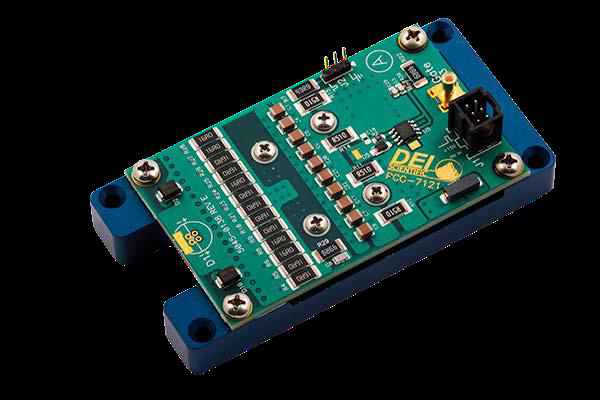
The PCO-7121 is a compact and economical OEM pulsed-current laser diode driver module. It is designed to provide extremely fast high-current pulses for driving laser diodes in range finder, LiDAR, atmospheric communications, and other applications that call for high-current nanosecond pulses. The module delivers variable output current from 5 A to 50 A, with pulse widths from 22 ns to 1 µs at repetition rates from single shot up to 1 MHz.
Berkeley Nucleonics acquired Directed Energy, Inc., now a division of Berkeley Nucleonics. The PCO-7121 ships from the same San Rafael, California build and carries a single support path. The driver is supplied mounted on a half-inch thick aluminum heat spreader, which provides the cooling the module needs and simplifies mounting or installation in a host system.
2How It Works
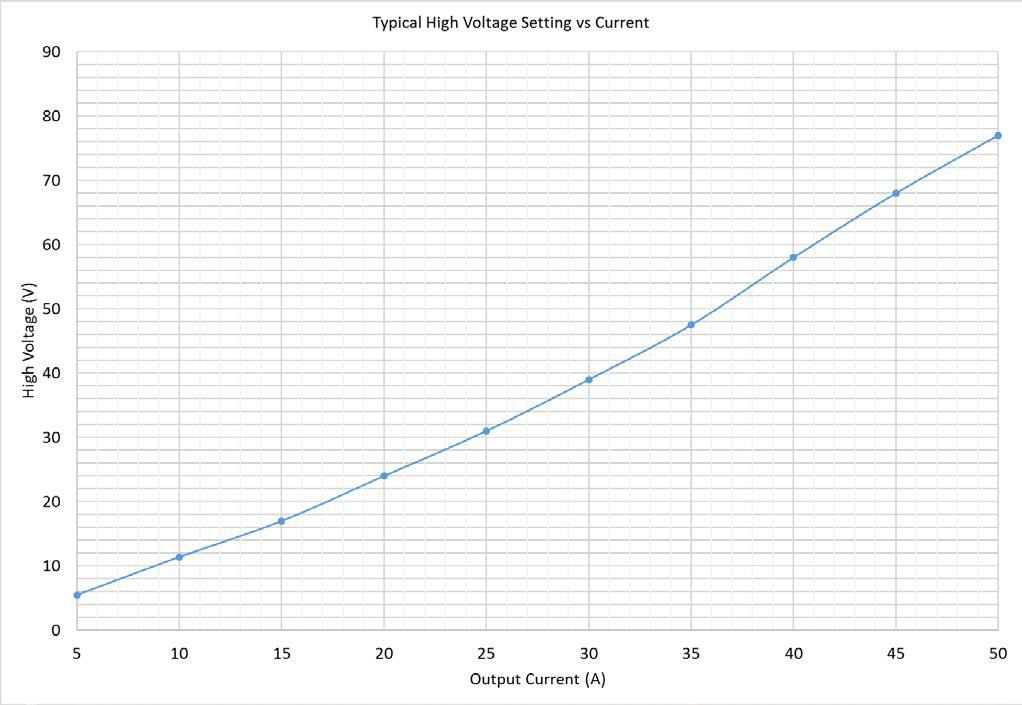
The DC high voltage and the +15 VDC housekeeping supply are connected through J1, a six-pin male header, using the supplied control cable. Pulse current depends on the HV supply voltage across a range of 0 V to +95 V maximum. Higher supply voltage drives higher peak current, within the safe operating area of the module.
Externally generated pulses are fed to the gate input through either J1 or the SMB connector. The width and repetition rate of the gate pulses directly set the timing of the output pulses, so the host system retains full control of pulse shape and cadence. Throughput delay is typically 28 ns from gate input to output.
Laser diode connection
Mounting pads are provided to mount the laser diode directly to the driver. The four-hole mounting pattern accepts TO-18, TO-5, TO-52, 5.6 mm, and 9 mm packages. To accommodate a range of packages and mounting preferences, two solder pads at the end of the board accept various laser diode packages mounted on-axis to the driver. Alternately, low-inductance strip line cable can connect the board to a remotely located diode.
Current monitor
A current monitor output lets the user observe diode current in real time on an oscilloscope. Scaling is 20 A/V typical into a 50 ohm termination, which gives a direct, low-latency view of the pulse for setup and verification.
3Specifications
All specifications are measured after the module is thermally stabilized for 30 minutes, driving a shorted load and using the current monitor connection.
Pulse amplitude
| Parameter | Specification |
|---|---|
| Output current range | 5 A to 50 A |
| Pulse width | 22 ns to 1000 ns |
| Rise time | ≤ 12 ns (for output currents above 20 A) |
| Fall time | ≤ 10 ns |
| Frequency | Single shot to 1 MHz |
| Throughput delay | 28 ns typical |
| Housekeeping power required | 15 V ± 250 mV, 80 mA |
| High voltage input voltage | 0 V to 95 VDC |
| High voltage input power | ≤ 12 W typical (driving a shorted load at maximum SOA level) |
Gate
| Parameter | Specification |
|---|---|
| Gate input | +5 V |
| Gate pulse width | 10 ns to 1000 ns |
| Termination impedance | 50 Ω |
| Gate connector | SMB or J1 pin 2 |
Current monitor
| Parameter | Specification |
|---|---|
| Current monitor scaling | 20 A/V typical |
| Current monitor termination | 50 Ω |
| Current monitor + | J2 pin 1 |
| Current monitor − | J2 pin 3 |
General
| Parameter | Specification |
|---|---|
| Size (L x W x H) | 101.6 mm x 50.8 mm x 27 mm |
| Weight (approximate) | 100 g |
| Mounting hole spacing | 92.1 mm x 43.2 mm |
| Hole diameter | 3.8 mm |
| Operating temperature | 0 °C to 35 °C |
| Cooling | Air cooled |
| Output connector D3 | Four-hole mounting pattern accepts TO-18, TO-5, TO-52, 5.6 mm, and 9 mm packages |
4Output Protection & Safety
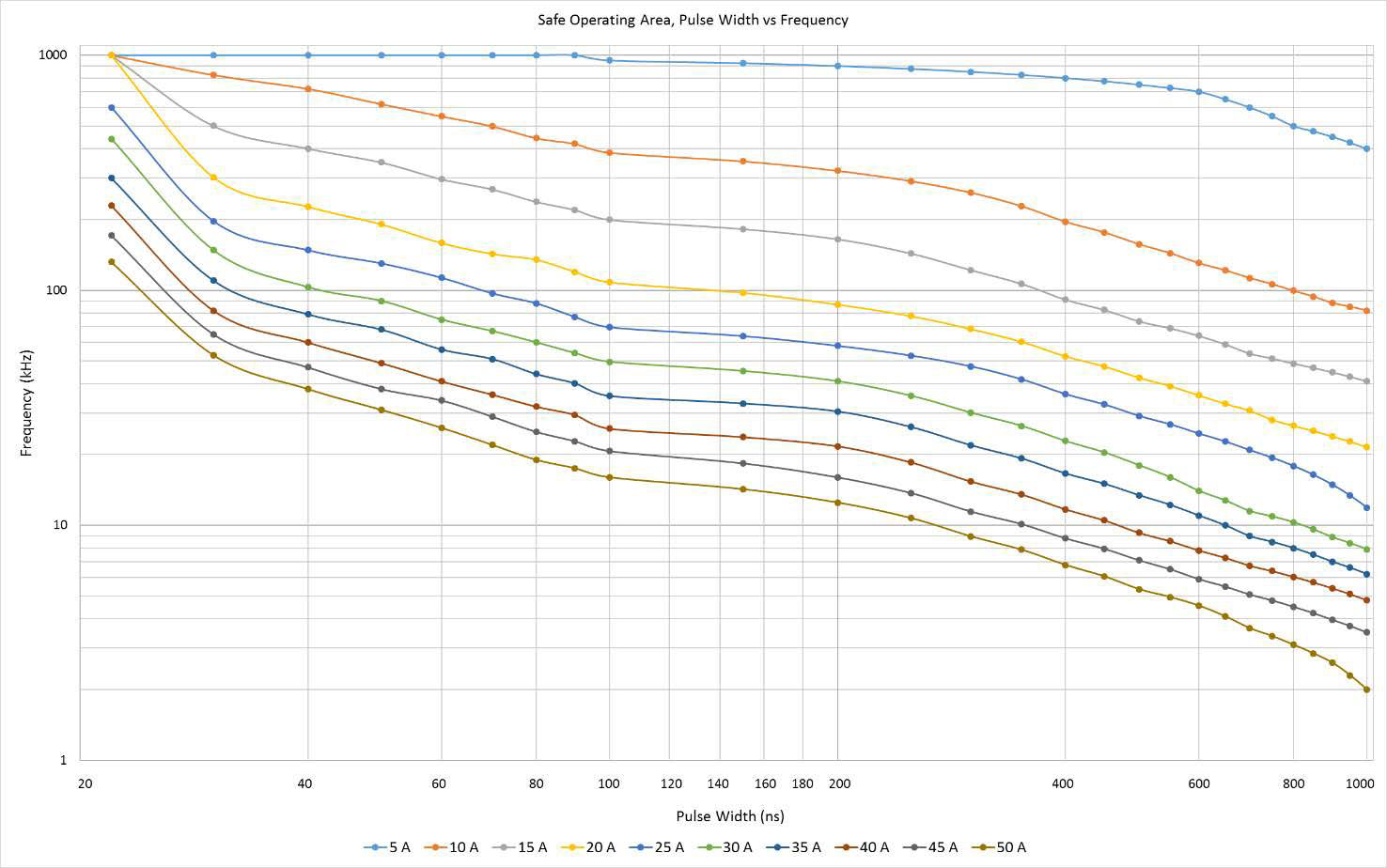
The PCO-7121 must be operated within its safe operating area at all times. The safe operating area defines the allowed combination of peak current, pulse width, and repetition rate that keeps the module and the connected diode within thermal limits.
Because the high voltage input range extends to 95 VDC and peak currents reach 50 A, use low-inductance connections between the driver and the diode, and keep the housekeeping and high voltage supplies within their stated tolerances. The aluminum heat spreader is part of the thermal design and should remain mounted to an adequate heat path during operation.
5Control & Interfaces
All power and signal connections route through the J1 six-pin header, with the gate available on either J1 or the SMB connector. The host system supplies the gate timing, the high voltage, and the housekeeping power.
| Connection | Pin / Connector |
|---|---|
| Gate input | J1 pin 2 (or SMB) |
| +15 VDC input | J1 pin 4 |
| High voltage input | J1 pin 6 |
| Return | J1 pins 1, 3, 5 |
| Current monitor + / − | J2 pin 1 / J2 pin 3 |
6Applications
The PCO-7121 suits OEM systems that need fast, high-current pulses to a laser diode in a small footprint. Typical uses include:
- Laser rangefinding. Short, high-current pulses for time-of-flight distance measurement.
- LiDAR. Fast diode pulsing for mapping, ranging, and detection systems.
- Atmospheric communications. High-rate optical pulsing for free-space links.
- General nanosecond pulsing. Any application that needs variable high-current pulses from 5 A to 50 A at rates up to 1 MHz.
7Ordering Information
| Part number | Description |
|---|---|
| PCO-7121 | Laser diode driver module |
| 6100-0137 | Control cable (included) |
| PCA-9145 | Current monitor cable (optional) |
Contact
For a quote, configuration help, or application support, reach the Berkeley Nucleonics team.
Email: info@berkeleynucleonics.com
Phone: 800-234-7858