Advancements in phased-array antenna systems have brought about major developments in radar, mobile communications and satellite broadcasting. The Berkeley Nucleonics Model 855B is used as an internal LO source in many of the new state of the art phased array antennas.
Communication with conventional satellites requires one to focus a narrow electromagnetic frequency beam at the satellite (parabolic surface). Due to the antenna's size and weight, it can be quite difficult and costly to track a satellites' movement. Phased arrays, however, are composed of several smaller, fixed antennas. By changing the relative phase for the signal that each unit transmits, the combination of all these small signals produces a larger focused beam, and because this process is fully electronic, adjustments to the beam's direction are nearly instantaneous. A phased-array antenna system can, therefore, track a satellite regardless of its movements, without the need for any mechanical moving parts.
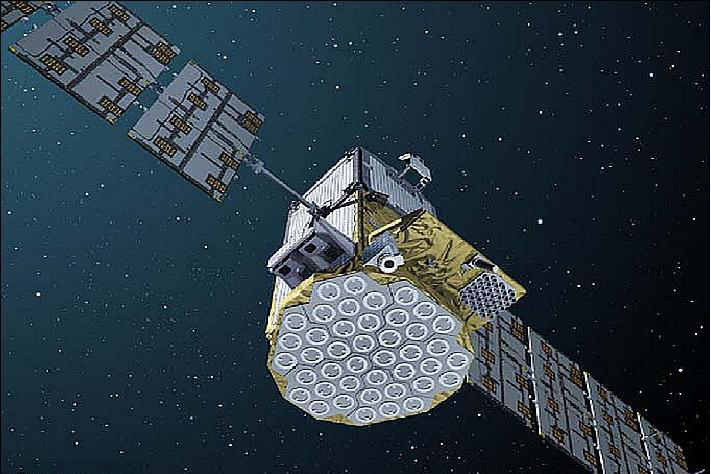
"Phased-array satellite antennas have been around for years," says John Lauder, Chief Technical Officer at Berkeley Nucleonics. "The challenge has been to decrease the technology size while reducing the manufacturing cost to an economical price point. Previous industry standards were a fraction of a percent radial programming accuracy, but this level or radial resolution offers an order of magnitude improvement."
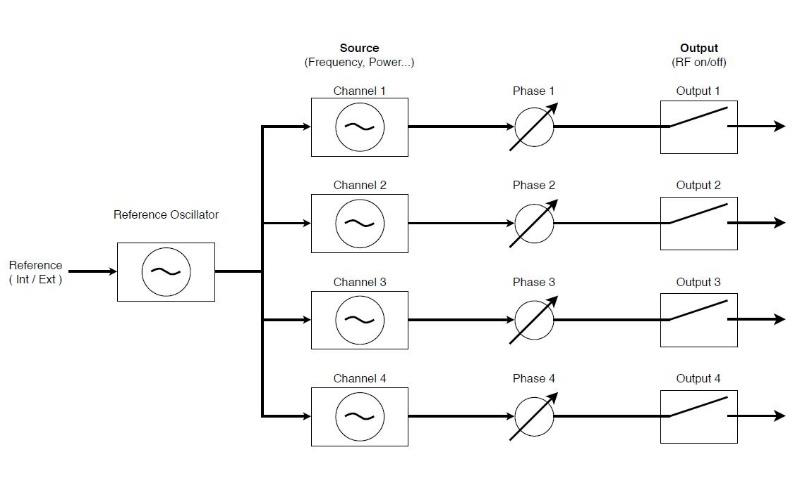
Multi-channel signal generators play a critical role in the development and advancement of phased-array antenna systems, similar to how they are used as internal LO sources in the frequency-converting components of larger antennas. The Model 855 offers an extremely high resolution with a programmable RF output phase of 16 bits, which assists in beam formation. Both the frequency and the phase can also be swept with the same high resolution to provide nearly flawless, synchronous multi-channel sweeps. Another key feature of the Model 855 is its high phase stability between outputs and devices when using a common reference, which can be scaled depending on the application. And the inclusion of the Option PHS (phase-coherent switching) allows users to replicate initial phase between channels, resulting in reproducible beams over power cycles without the need for phase calibration after cycling the power.
About the Company
Founded in 1963, BNC is a leading manufacturer of precision electronic instrumentation for RF/Microwave research. BNC has its corporate headquarters in San Rafael, California with several additional manufacturing facilities and sales offices located throughout the United States. Phased Array Antennas are evolving rapidly, and BNC is at the forefront of this technology shift, capitalizing on these new requirements with its patented, high performance, software-defined radio technology, and a PC-controlled, networked architecture that provides unparalleled performance for the price. In addition to the RF / Microwave signal source line of equipment, BNC offers Phase Noise Test Systems (Signal Source Analyzers) & Real-Time Spectrum Analyzers.